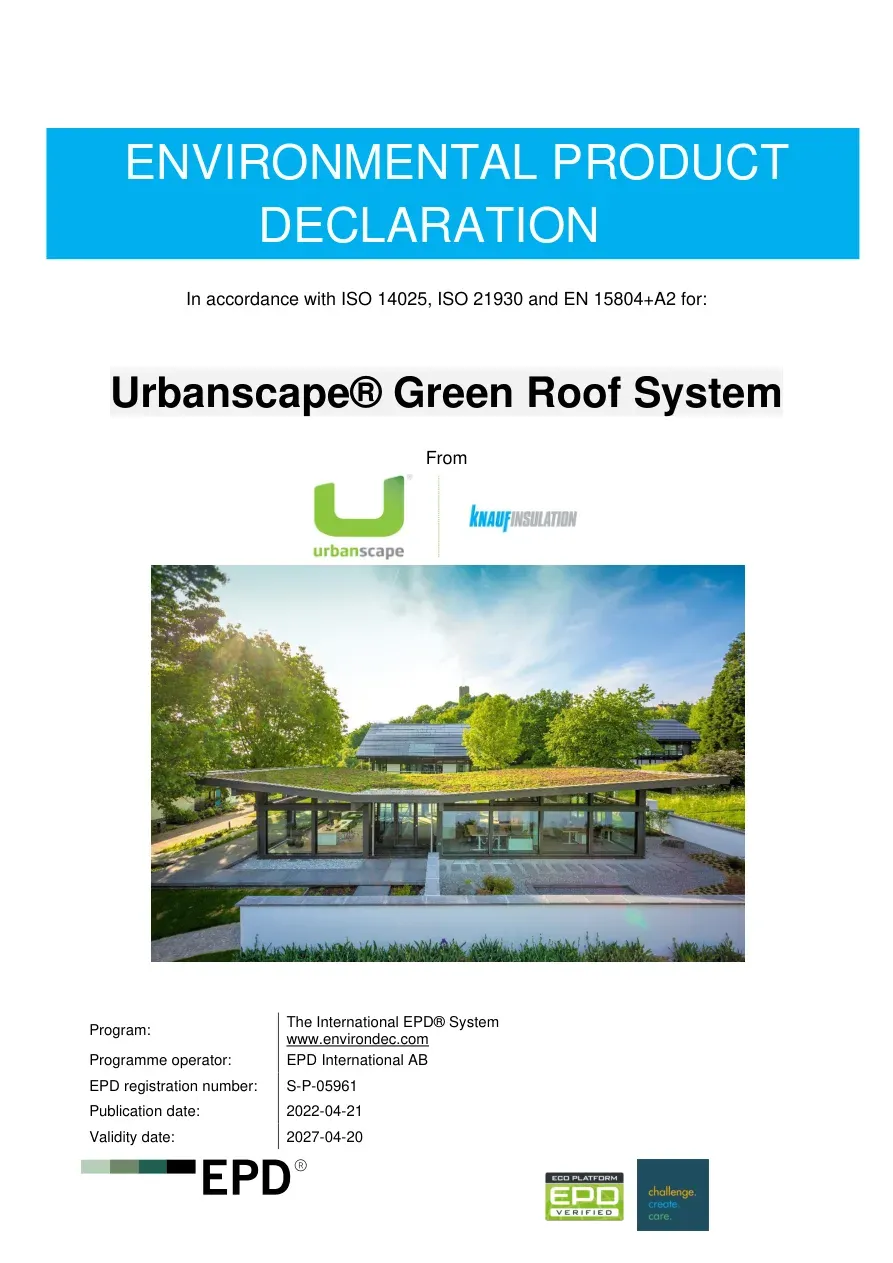
In accordance with ISO 14025, ISO 21930 and EN 15804+A2 for: Urbanscape® Green Roof System From Program: The International EPD® System www.environdec.com Programme operator: EPD International AB EPD registration number: S-P-05961 Publication date: 2022-04-21 Validity date: 2027-04-20 ENVIRONMENTAL PRODUCT DECLARATION
2 EPD Urbanscape® Green Roof System Programme-related information and verification The EPD owner has the sole ownership, liability, and responsibility for the EPD. EPDs within the same product category but from different programmes may not be comparable. EPDs of construction products may not be comparable if they do not comply with EN 15804+A2:2019. For further information about comparability, see EN 15804+A2:2019 and ISO 14025. Programme: The International EPD® System EPD International AB Box 210 60 SE-100 31 Stockholm Sweden www.environdec.com info@environdec.com EPD registration number: S-P-05961 Published: 2022-04-21 Valid until: 2027-04-20 EPD owner Knauf Insulation Sprl Rue de Maestricht 95 4600 Visé Belgium Product Category Rules: PCR 2019:14. Construction products (EN 15804:A2) Version 1.11 Product group classification: UN CPC 37 Reference year for plant data: 2020 Geographical application scope: Europe CEN standard EN 15804+A2 serves as the Core Product Category Rules (PCR) Product category rules (PCR): PCR 2019:14. Construction products (EN 15804+A2:2019) Version 1.11PCR review was conducted by: The Technical Committee of the International EPD@ System Review chair: Claudia A. Peña, University of Concepción, Chile. The review panel may be contacted via the Secretariat www.environdec.com/contact. Independent third-party verification of the declaration and data, according to ISO 14025:2006. ☐ EPD process certification ☒ EPD verification Third party verifier: Chris Foster – EuGeos SRL In case of individual verifiers: Approved by: The International EPD® System Technical Committee, supported by the Secretariat Procedure for follow-up of data during EPD validity involves third party verifier: ☒ Yes ☐ No An EPD should provide current information and may be updated if conditions change. The stated validity is therefore subject to the continued registration and publication at www.environdec.com.
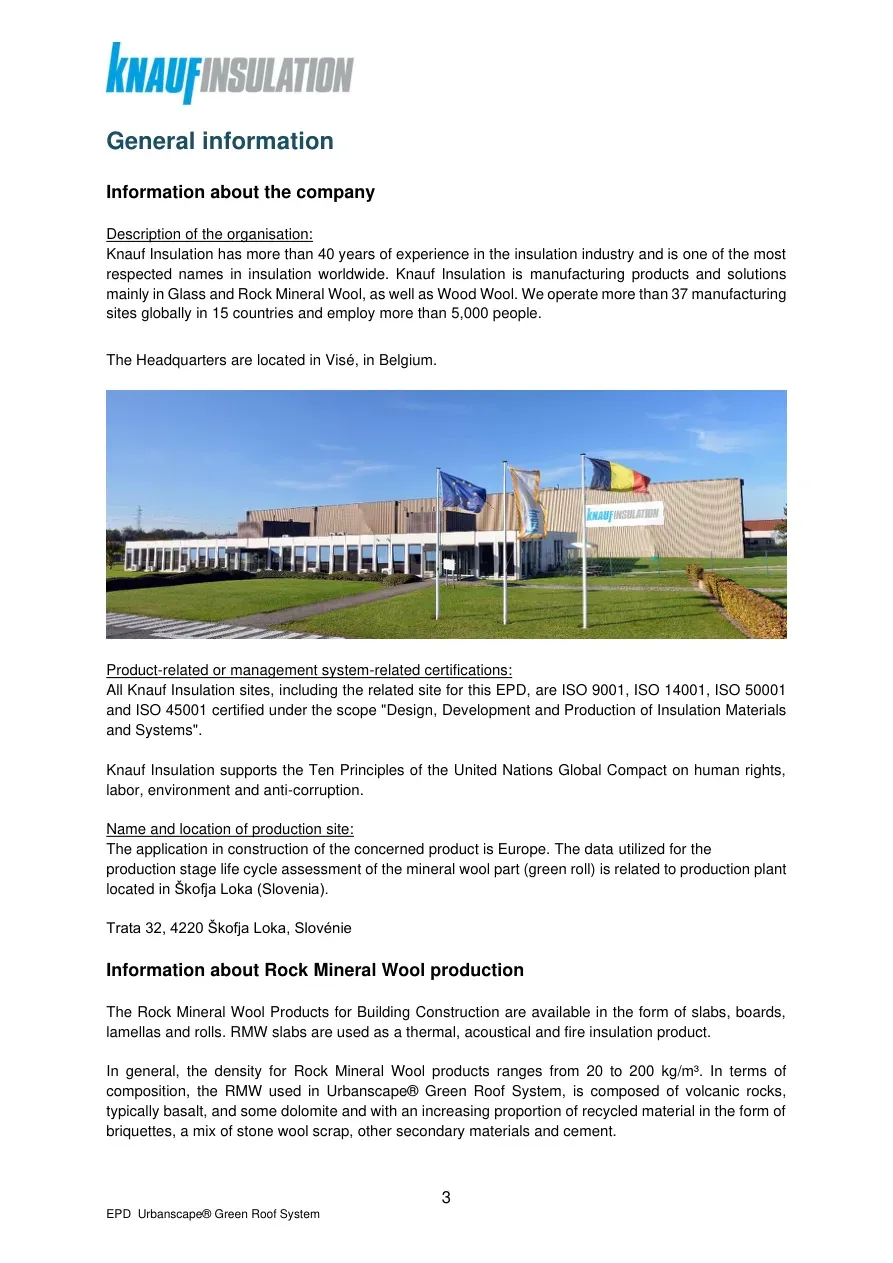
3 EPD Urbanscape® Green Roof System General information Information about the company Description of the organisation: Knauf Insulation has more than 40 years of experience in the insulation industry and is one of the most respected names in insulation worldwide. Knauf Insulation is manufacturing products and solutions mainly in Glass and Rock Mineral Wool, as well as Wood Wool. We operate more than 37 manufacturing sites globally in 15 countries and employ more than 5,000 people. The Headquarters are located in Visé, in Belgium. Product-related or management system-related certifications: All Knauf Insulation sites, including the related site for this EPD, are ISO 9001, ISO 14001, ISO 50001 and ISO 45001 certified under the scope "Design, Development and Production of Insulation Materials and Systems". Knauf Insulation supports the Ten Principles of the United Nations Global Compact on human rights, labor, environment and anti-corruption. Name and location of production site: The application in construction of the concerned product is Europe. The data utilized for the production stage life cycle assessment of the mineral wool part (green roll) is related to production plant located in Škofja Loka (Slovenia). Trata 32, 4220 Škofja Loka, Slovénie Information about Rock Mineral Wool production The Rock Mineral Wool Products for Building Construction are available in the form of slabs, boards, lamellas and rolls. RMW slabs are used as a thermal, acoustical and fire insulation product. In general, the density for Rock Mineral Wool products ranges from 20 to 200 kg/m³. In terms of composition, the RMW used in Urbanscape® Green Roof System, is composed of volcanic rocks, typically basalt, and some dolomite and with an increasing proportion of recycled material in the form of briquettes, a mix of stone wool scrap, other secondary materials and cement.
4 EPD Urbanscape® Green Roof System Product information Product name: Urbanscape® Green Roof System Product description: The Urbanscape® Green Roof System is an innovative, lightweight, low-thickness, extensive greening system with a high-water retention capacity. It consists of a mix of three layers. Starting at the top, a layer of Urbanscape® Sedum vegetation in the form of pre-cultivated rolls comprising up to 12 different sedum species. The sebaceous sedum plants are adept at storing water in their leaves and are therefore extremely suitable for varying weather conditions. The mix of different species provides a diverse leaves and flowers dense cover throughout the year. Next, an Urbanscape® Green Roll growing media of needle-punched, binder-free rock mineral wool that provides both good rooting of the sedum mat and excellent water retention. The Green Roll can be of different thicknesses but the most common is the 40 mm thickness which has been selected for this life cycle assessment calculation. Finally, a drainage layer Urbanscape® Drainmat which guarantees high water discharge capacity. The drainage layer is a three-dimensional, light and flexible composite matting made up of a drainage core of looped polypropylene filaments, which gives it a high drainage capacity, provided on both sides with a nonwoven filter fabric. Urbanscape® Drainmat is a high-performance CE-marked drainage system made of 100 % recyclable polypropylene. If needed, depending on the roof quality, an additional root barrier membrane can be added underneath the system (but this is not part of this study). This kind of green roof is defined as instant green roof as vegetation is covering at least 95% of substrate media directly at installation. Application: The Urbanscape® Green Roof System is an innovative, lightweight, low-thickness, extensive vegetation system with a high-water retention capacity. It can be installed on terraces and inaccessible roofs with a slope of 20% or less on residential, non-residential, and industrial buildings in urban areas. It is suitable for all types of load-bearing elements -
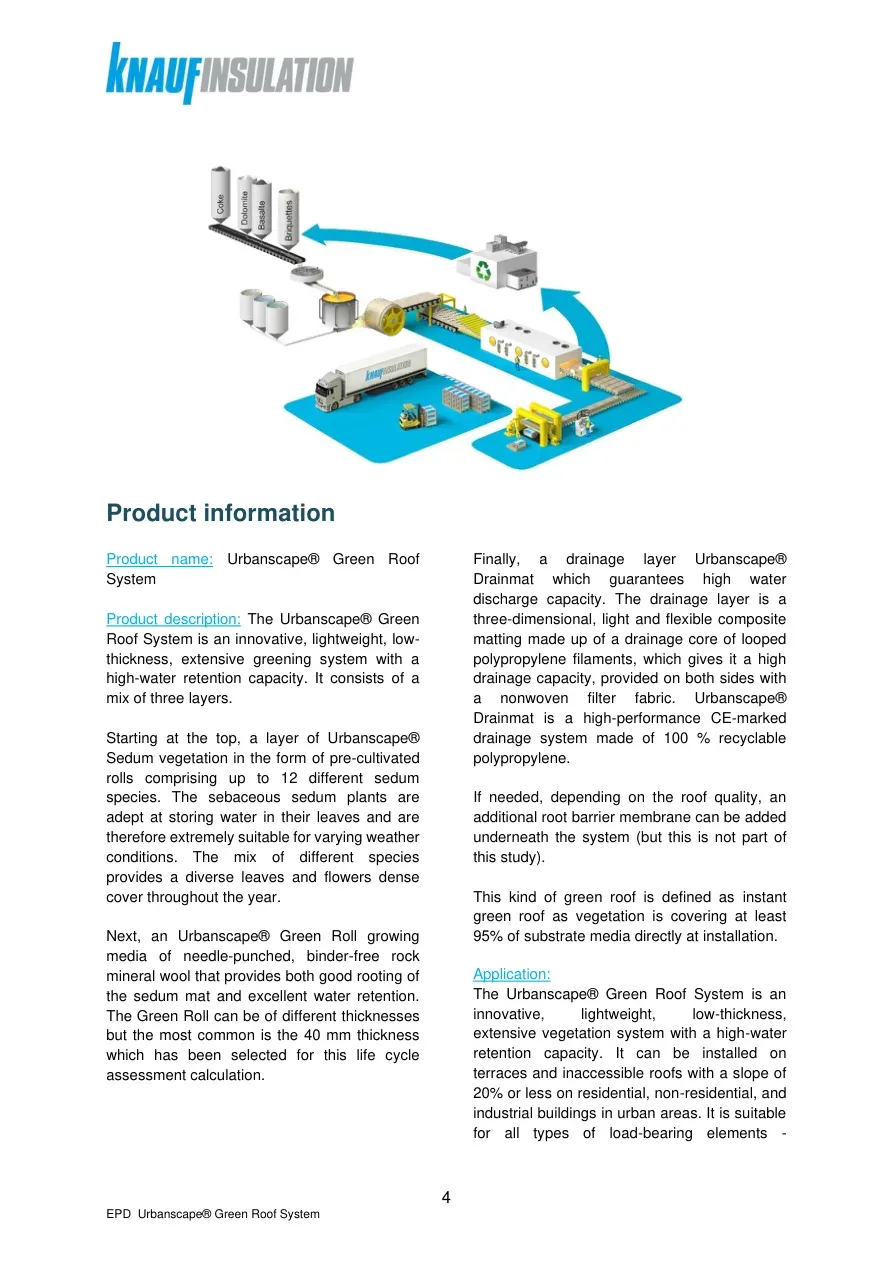
5 EPD Urbanscape® Green Roof System concrete, steel, wood - in new construction as well as in renovation. Production process: The Urbanscape® Green Roof System is made of three different layers. The sedum-blanket is composed up to 12 different species of sedums and it boasts at least 95 % coverage upon delivery. The Sedum-mix blanket is cultivated in the Netherlands in open fields to allow further extensive use on the roofs. The growing media is made of binder-free rock mineral wool manufactured by Knauf Insulation in Škofja Loka (Slovenia). Main raw materials used in the production of mineral wool are diabase (a rock that is similar to volcanic rock basalt), dolomite and briquettes (briquettes made mainly of recycled mineral wool reintroduced in the melting process). For these first two layers, specific manufacturing data was used. The drainage system, made of 100% recyclable polypropylene, is manufactured in Italy. The production of the layer was approximated as an injection moulding process. Technical data: The Urbanscape® Green Roof System meets several technical requirements. The most important ones are summarized in the table here below. Name Value Unit Water storage capacity 37 Vol. -% System sound absorption (/EN ISO 10140-1 // EN ISO 10140-2) 57 dB System height 100 mm System weight saturated 57.55 kg/m² System weight unsaturated (dry) 20.55 kg/m² Retenton (System maximum water retention capacity) 37 l/m² pH value of the growing media (CaCl2) 7.5 Fire resistance class for growing media (EN 13501-1) A1 Salt content of the growing media (KCl) 0.03 g/l LCA information Functional unit / declared unit The declared unit is 1 m² of Urbanscape® Green Roof System including the 3 components sedum-blanket, Green roll and drainage layer. Potential root barrier, protection layer or waterproof membrane are not considered into this specific EPD as those additional layers depends on the existing roof quality. However, the quality of the roof should be most of the time sufficient to avoir adding any additional layers to the 3 proposed components of the Urbanscape® system. Geographical scope: The RMW layer of the product is manufactured in Škofja Loka (Slovenia) with the related country energy mix for electricity. The Sedum layer is supplied from the Netherlands and the drainage layer in Italy. Regarding the market area, the product is mainly marketed in Europe, therefore the use phase and end of life scenario are modelled as European. Energy: Regional electricity mix and gas inputs were used in modelling raw material production, taking datasets from Slovenia and Italy, both with reference year 2017 (the latest available in GaBi database). 0.365 kg of CO2 eq. is released for 1 kWh of Electricity consumption from Slovenia and 0.452 kg of CO2 eq. for Italy. Reference service life: The Reference Service Life (RSL) or durability of Urbanscape® Green Roof can be with proper maintenance as long as the lifetime of the roof on which it is installed. The scenario selected in this EPD is 50 years. Time representativeness & Information on Specific Data: All primary and secondary data is modelled to be specific to the technologies or combinations of technologies under consideration. When technology-specific data is not available, proxy data is used. The technological representativeness is good. All primary data is collected for the year 2020. All secondary data comes from the GaBi 2021
6 EPD Urbanscape® Green Roof System databases and is representative of the years 2015-2020. As the study aimed to compare the product systems for the reference year 2020/2021, the temporal representativeness is good. Database(s) and LCA software used: The LCA model, the data aggregation and environmental impacts are calculated with the software GaBi 10. Background databases are GaBi datasets with last update 2021. The impact models used are those indicated in EN 15804:2012+A2:2019. System diagram: The diagram illustrates the life cycle stages of construction products in general. The system boundaries starts with the raw materials for the production of the three layers of the Urbanscape® System. These are manufactured separately before being assembled. It must be noted that for A1-A3 stage, the Urbanscape® Sedum vegetation (production of the seeds is outside of the system boundaries) and the Urbanscape® Green Roll growing media (binder-free rock mineral wool) are modelled with specific data. The drainage layer Urbanscape® Drainmat production was approximated as an injection moulding process. Description of system boundaries: The system boundary of the EPD follows the modularity approach defined by the EN 15804:2012+A2:2019. The type of EPD is cradle-to-grave. List and explanation of the modules declared in the EPD. The product stage (A1-A3) includes: - A1 - raw material extraction and processing, processing of secondary material input (e.g. recycling processes), - A2 - transport to the manufacturer and - A3 - manufacturing. This includes provision of all materials, products and energy, packaging processing and its transport, as well as waste processing up to the end-of-waste state or disposal of final residues during the product stage. The LCA results are given in an aggregated form for the product stage, meaning that the modules A1, A2 and A3 are considered as a unique module A1-A3. The construction process stage includes: - A4 - transport to the construction site and - A5 - installation into the building. The transport to the building site (A4) and installation (A5) included in this LCA use the following parameters: Parameter Value Average transport distance 900 km Type of fuel and vehicle consumption or type of vehicle used for transport. Truck Euro 6 (34 – 40 t / 27 t payload). 140 L for 100 km. Truck capacity utilization (including 30% of empty returns) 61 % of the weight capacity Loss of materials in construction site 2% Packaging Wooden pallet 40% recycled, 60% incinerated Packaging Plastic sheet 40% recycled, 60% incinerated The treatment of the packaging waste after the installation of the product (A5) has been considered. The Use stage (B1-B7) includes: - B1: Use - B2: Maintenance - B3: Repair - B4: Replacement - B5: Refurbishment - B6: Operational Energy Use - B7: Operational Water Use For the B1 use stage, carbon sequestration is included in this study. The CO2 sequestered by the sedums during their 50 years life will be released by composting the materials at the end of their life.
7 EPD Urbanscape® Green Roof System For the maintenance stage (B2), fertilisation in the first year is recommended and included in this study. Thereafter, the green roof can be fertilised in subsequent years if required. In this study, fertilisation every 5 years is considered, reflecting actual practice. Stages B3 (repair), B4 (replacement) and B5 (renovation) the Urbanscape® product has no impact as the system is considered to be self-maintaining. The green roof system lives very well on its own, but to maintain an installation, one annual visit to remove weeds is recommended: there is always some colonisation of native plants by air. This is not a bad thing as it provides additional biodiversity; however, some plants can be too invasive and must be removed to ensure the resilience of the installation. This maintenance is done manually. If maintenance is carried out correctly, there is no reason to replace the plant cover. Sedum has a strong ability to recolonise empty spaces if they exist. If necessary, plants can be taken from landscaped areas and redistributed where they are lacking; they take root very easily. A sedum fragment will naturally re-root to become an independent plant. The stage of use (B6-B7) relating to the operation of the building has no impact on the Urbanscape® product. For B7, operational use of water, for very specific weather conditions, it may be useful to provide water punctually. These specific case studies are not analysed in this study. The end-of-life stage includes: - C1 - de-construction, demolition, - C2 - transport to waste processing, - C3 - waste processing for reuse, recovery and/or recycling and - C4 - disposal. This includes provision of all transports, materials, products and related energy and water use. The common manual dismantling impact of green roof is considered as very small and can be neglected in C1. At the end-of-life, it is assumed that the sedum-blanket and the Green roll are composted (100%), the drainage layer in polypropylene is recycled (20 %) and incinerated (80 %). Module D includes reuse, recovery and/or recycling potentials. According to EN 15804:2012+A2:2019 any declared benefits and loads from net flows leaving the product system not allocated as co-products and having passed the end-of waste state shall be included in module D. Benefits considered in module D originate from the incineration and recycling of packaging materials as well as the recycling and incineration of the drainage layer. Additional information: All raw materials for the manufacturing of the layer of rock mineral wool of the declared product, the required energy, water consumption and the resulting emissions are considered into the LCA. Consecutively, the recipe components with a share even less than 1% are included. All neglected processes contribute less than 5% to the total mass or less than 5% to the total energy consumption. For information, the impact of the Rock Mineral Wool plant construction or machines, are not taken into account in the life cycle assessment. Materials for fixation and installation are not included into this LCA scope. Regarding installation this EPD only includes the environmental impact related to the product itself like material losses and packaging end of life. This may lead to the need of additional construction products or materials for which the impact is not included in this EPD and which shall be taken into account at building level. Knauf Insulation adopts a “worst case” approach into its EPDs. More information: www.knaufinsulation.com Name and contact information of LCA practitioner: Justin Fraselle - Knauf Insulation Sprl Rue de Maestricht 95 4600 Visé, Belgium Contact : sustainability@knaufinsulation.com
8 EPD Urbanscape® Green Roof System Content Declaration The product does not contain substances on the "Candidate List of Substances of Very High Concern for Authorisation" under the REACH regulation (if above 0.1% of the mass). Declared Modules Life cycle stages as defined in the European standard EN 15978 :2011 and the description of the system boundaries for the reference product LCA (X = included in the LCA, MND = module is not declared)
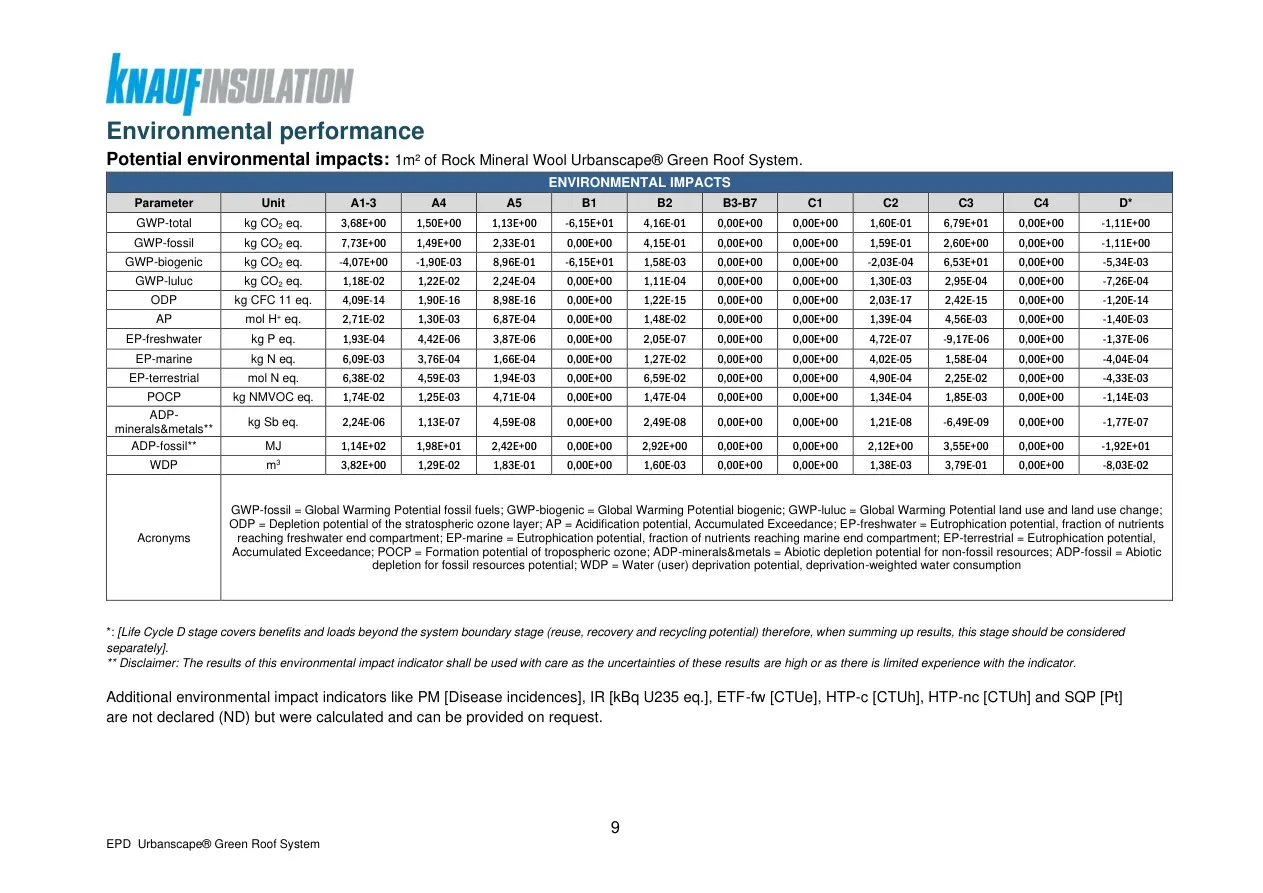
9 EPD Urbanscape® Green Roof System Environmental performance Potential environmental impacts: 1m² of Rock Mineral Wool Urbanscape® Green Roof System. ENVIRONMENTAL IMPACTS Parameter Unit A1-3 A4 A5 B1 B2 B3-B7 C1 C2 C3 C4 D* GWP-total kg CO2 eq. 3,68E+00 1,50E+00 1,13E+00 -6,15E+01 4,16E-01 0,00E+00 0,00E+00 1,60E-01 6,79E+01 0,00E+00 -1,11E+00 GWP-fossil kg CO2 eq. 7,73E+00 1,49E+00 2,33E-01 0,00E+00 4,15E-01 0,00E+00 0,00E+00 1,59E-01 2,60E+00 0,00E+00 -1,11E+00 GWP-biogenic kg CO2 eq. -4,07E+00 -1,90E-03 8,96E-01 -6,15E+01 1,58E-03 0,00E+00 0,00E+00 -2,03E-04 6,53E+01 0,00E+00 -5,34E-03 GWP-luluc kg CO2 eq. 1,18E-02 1,22E-02 2,24E-04 0,00E+00 1,11E-04 0,00E+00 0,00E+00 1,30E-03 2,95E-04 0,00E+00 -7,26E-04 ODP kg CFC 11 eq. 4,09E-14 1,90E-16 8,98E-16 0,00E+00 1,22E-15 0,00E+00 0,00E+00 2,03E-17 2,42E-15 0,00E+00 -1,20E-14 AP mol H+ eq. 2,71E-02 1,30E-03 6,87E-04 0,00E+00 1,48E-02 0,00E+00 0,00E+00 1,39E-04 4,56E-03 0,00E+00 -1,40E-03 EP-freshwater kg P eq. 1,93E-04 4,42E-06 3,87E-06 0,00E+00 2,05E-07 0,00E+00 0,00E+00 4,72E-07 -9,17E-06 0,00E+00 -1,37E-06 EP-marine kg N eq. 6,09E-03 3,76E-04 1,66E-04 0,00E+00 1,27E-02 0,00E+00 0,00E+00 4,02E-05 1,58E-04 0,00E+00 -4,04E-04 EP-terrestrial mol N eq. 6,38E-02 4,59E-03 1,94E-03 0,00E+00 6,59E-02 0,00E+00 0,00E+00 4,90E-04 2,25E-02 0,00E+00 -4,33E-03 POCP kg NMVOC eq. 1,74E-02 1,25E-03 4,71E-04 0,00E+00 1,47E-04 0,00E+00 0,00E+00 1,34E-04 1,85E-03 0,00E+00 -1,14E-03 ADP-minerals&metals** kg Sb eq. 2,24E-06 1,13E-07 4,59E-08 0,00E+00 2,49E-08 0,00E+00 0,00E+00 1,21E-08 -6,49E-09 0,00E+00 -1,77E-07 ADP-fossil** MJ 1,14E+02 1,98E+01 2,42E+00 0,00E+00 2,92E+00 0,00E+00 0,00E+00 2,12E+00 3,55E+00 0,00E+00 -1,92E+01 WDP m3 3,82E+00 1,29E-02 1,83E-01 0,00E+00 1,60E-03 0,00E+00 0,00E+00 1,38E-03 3,79E-01 0,00E+00 -8,03E-02 Acronyms GWP-fossil = Global Warming Potential fossil fuels; GWP-biogenic = Global Warming Potential biogenic; GWP-luluc = Global Warming Potential land use and land use change; ODP = Depletion potential of the stratospheric ozone layer; AP = Acidification potential, Accumulated Exceedance; EP-freshwater = Eutrophication potential, fraction of nutrients reaching freshwater end compartment; EP-marine = Eutrophication potential, fraction of nutrients reaching marine end compartment; EP-terrestrial = Eutrophication potential, Accumulated Exceedance; POCP = Formation potential of tropospheric ozone; ADP-minerals&metals = Abiotic depletion potential for non-fossil resources; ADP-fossil = Abiotic depletion for fossil resources potential; WDP = Water (user) deprivation potential, deprivation-weighted water consumption *: [Life Cycle D stage covers benefits and loads beyond the system boundary stage (reuse, recovery and recycling potential) therefore, when summing up results, this stage should be considered separately]. ** Disclaimer: The results of this environmental impact indicator shall be used with care as the uncertainties of these results are high or as there is limited experience with the indicator. Additional environmental impact indicators like PM [Disease incidences], IR [kBq U235 eq.], ETF-fw [CTUe], HTP-c [CTUh], HTP-nc [CTUh] and SQP [Pt] are not declared (ND) but were calculated and can be provided on request.
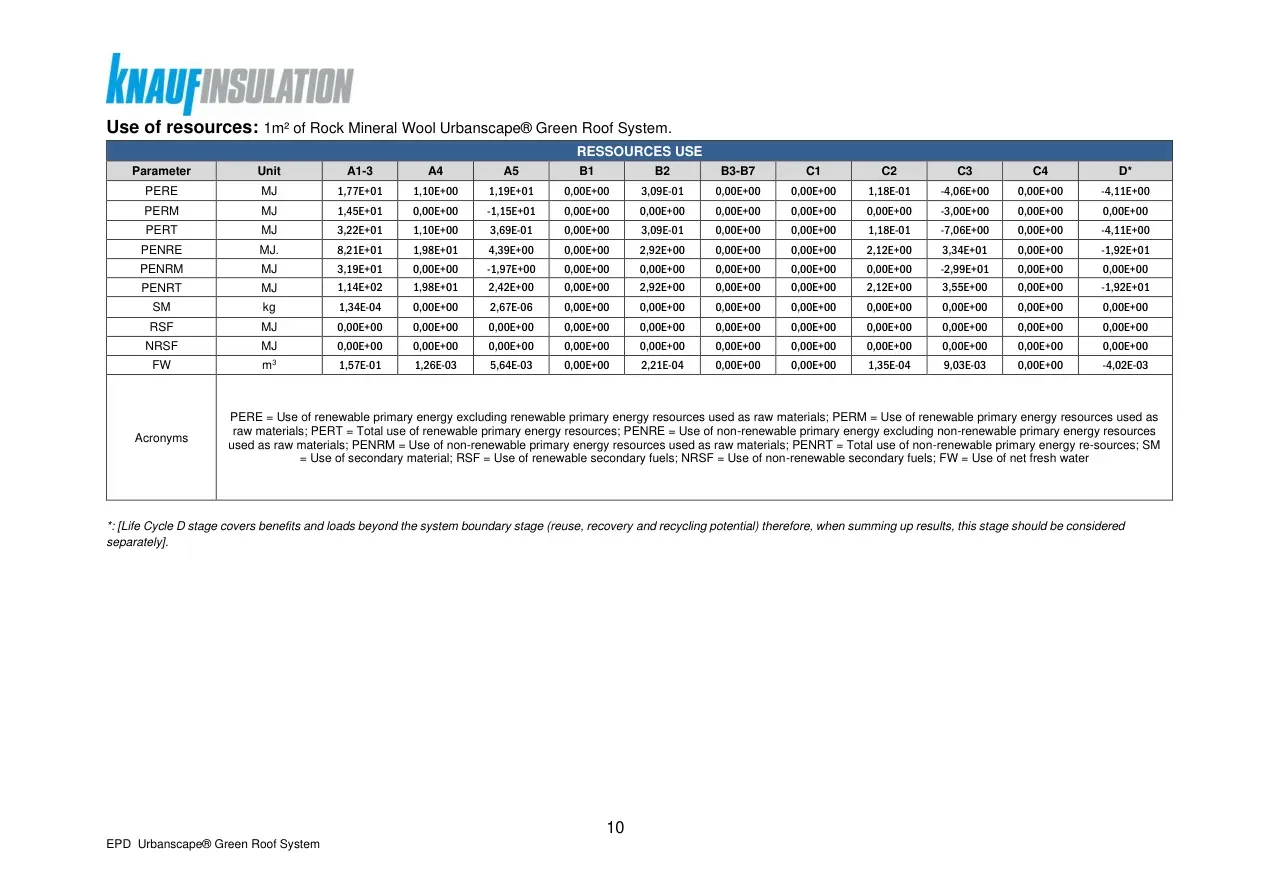
10 EPD Urbanscape® Green Roof System Use of resources: 1m² of Rock Mineral Wool Urbanscape® Green Roof System. RESSOURCES USE Parameter Unit A1-3 A4 A5 B1 B2 B3-B7 C1 C2 C3 C4 D* PERE MJ 1,77E+01 1,10E+00 1,19E+01 0,00E+00 3,09E-01 0,00E+00 0,00E+00 1,18E-01 -4,06E+00 0,00E+00 -4,11E+00 PERM MJ 1,45E+01 0,00E+00 -1,15E+01 0,00E+00 0,00E+00 0,00E+00 0,00E+00 0,00E+00 -3,00E+00 0,00E+00 0,00E+00 PERT MJ 3,22E+01 1,10E+00 3,69E-01 0,00E+00 3,09E-01 0,00E+00 0,00E+00 1,18E-01 -7,06E+00 0,00E+00 -4,11E+00 PENRE MJ. 8,21E+01 1,98E+01 4,39E+00 0,00E+00 2,92E+00 0,00E+00 0,00E+00 2,12E+00 3,34E+01 0,00E+00 -1,92E+01 PENRM MJ 3,19E+01 0,00E+00 -1,97E+00 0,00E+00 0,00E+00 0,00E+00 0,00E+00 0,00E+00 -2,99E+01 0,00E+00 0,00E+00 PENRT MJ 1,14E+02 1,98E+01 2,42E+00 0,00E+00 2,92E+00 0,00E+00 0,00E+00 2,12E+00 3,55E+00 0,00E+00 -1,92E+01 SM kg 1,34E-04 0,00E+00 2,67E-06 0,00E+00 0,00E+00 0,00E+00 0,00E+00 0,00E+00 0,00E+00 0,00E+00 0,00E+00 RSF MJ 0,00E+00 0,00E+00 0,00E+00 0,00E+00 0,00E+00 0,00E+00 0,00E+00 0,00E+00 0,00E+00 0,00E+00 0,00E+00 NRSF MJ 0,00E+00 0,00E+00 0,00E+00 0,00E+00 0,00E+00 0,00E+00 0,00E+00 0,00E+00 0,00E+00 0,00E+00 0,00E+00 FW m3 1,57E-01 1,26E-03 5,64E-03 0,00E+00 2,21E-04 0,00E+00 0,00E+00 1,35E-04 9,03E-03 0,00E+00 -4,02E-03 Acronyms PERE = Use of renewable primary energy excluding renewable primary energy resources used as raw materials; PERM = Use of renewable primary energy resources used as raw materials; PERT = Total use of renewable primary energy resources; PENRE = Use of non-renewable primary energy excluding non-renewable primary energy resources used as raw materials; PENRM = Use of non-renewable primary energy resources used as raw materials; PENRT = Total use of non-renewable primary energy re-sources; SM = Use of secondary material; RSF = Use of renewable secondary fuels; NRSF = Use of non-renewable secondary fuels; FW = Use of net fresh water *: [Life Cycle D stage covers benefits and loads beyond the system boundary stage (reuse, recovery and recycling potential) therefore, when summing up results, this stage should be considered separately].
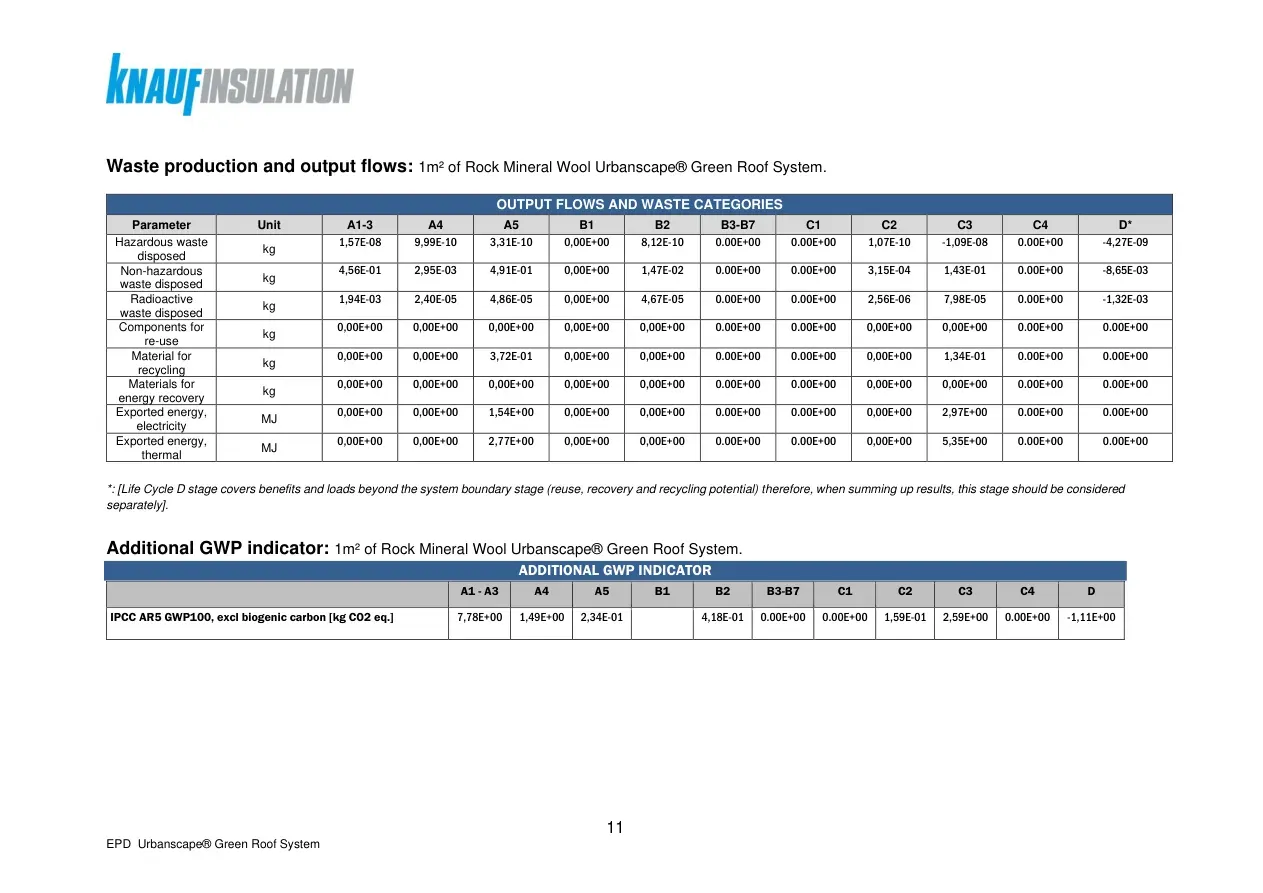
11 EPD Urbanscape® Green Roof System Waste production and output flows: 1m² of Rock Mineral Wool Urbanscape® Green Roof System. OUTPUT FLOWS AND WASTE CATEGORIES Parameter Unit A1-3 A4 A5 B1 B2 B3-B7 C1 C2 C3 C4 D* Hazardous waste disposed kg 1,57E-08 9,99E-10 3,31E-10 0,00E+00 8,12E-10 0.00E+00 0.00E+00 1,07E-10 -1,09E-08 0.00E+00 -4,27E-09 Non-hazardous waste disposed kg 4,56E-01 2,95E-03 4,91E-01 0,00E+00 1,47E-02 0.00E+00 0.00E+00 3,15E-04 1,43E-01 0.00E+00 -8,65E-03 Radioactive waste disposed kg 1,94E-03 2,40E-05 4,86E-05 0,00E+00 4,67E-05 0.00E+00 0.00E+00 2,56E-06 7,98E-05 0.00E+00 -1,32E-03 Components for re-use kg 0,00E+00 0,00E+00 0,00E+00 0,00E+00 0,00E+00 0.00E+00 0.00E+00 0,00E+00 0,00E+00 0.00E+00 0.00E+00 Material for recycling kg 0,00E+00 0,00E+00 3,72E-01 0,00E+00 0,00E+00 0.00E+00 0.00E+00 0,00E+00 1,34E-01 0.00E+00 0.00E+00 Materials for energy recovery kg 0,00E+00 0,00E+00 0,00E+00 0,00E+00 0,00E+00 0.00E+00 0.00E+00 0,00E+00 0,00E+00 0.00E+00 0.00E+00 Exported energy, electricity MJ 0,00E+00 0,00E+00 1,54E+00 0,00E+00 0,00E+00 0.00E+00 0.00E+00 0,00E+00 2,97E+00 0.00E+00 0.00E+00 Exported energy, thermal MJ 0,00E+00 0,00E+00 2,77E+00 0,00E+00 0,00E+00 0.00E+00 0.00E+00 0,00E+00 5,35E+00 0.00E+00 0.00E+00 *: [Life Cycle D stage covers benefits and loads beyond the system boundary stage (reuse, recovery and recycling potential) therefore, when summing up results, this stage should be considered separately]. Additional GWP indicator: 1m² of Rock Mineral Wool Urbanscape® Green Roof System. ADDITIONAL GWP INDICATOR A1 - A3 A4 A5 B1 B2 B3-B7 C1 C2 C3 C4 D IPCC AR5 GWP100, excl biogenic carbon [kg CO2 eq.] 7,78E+00 1,49E+00 2,34E-01 4,18E-01 0.00E+00 0.00E+00 1,59E-01 2,59E+00 0.00E+00 -1,11E+00
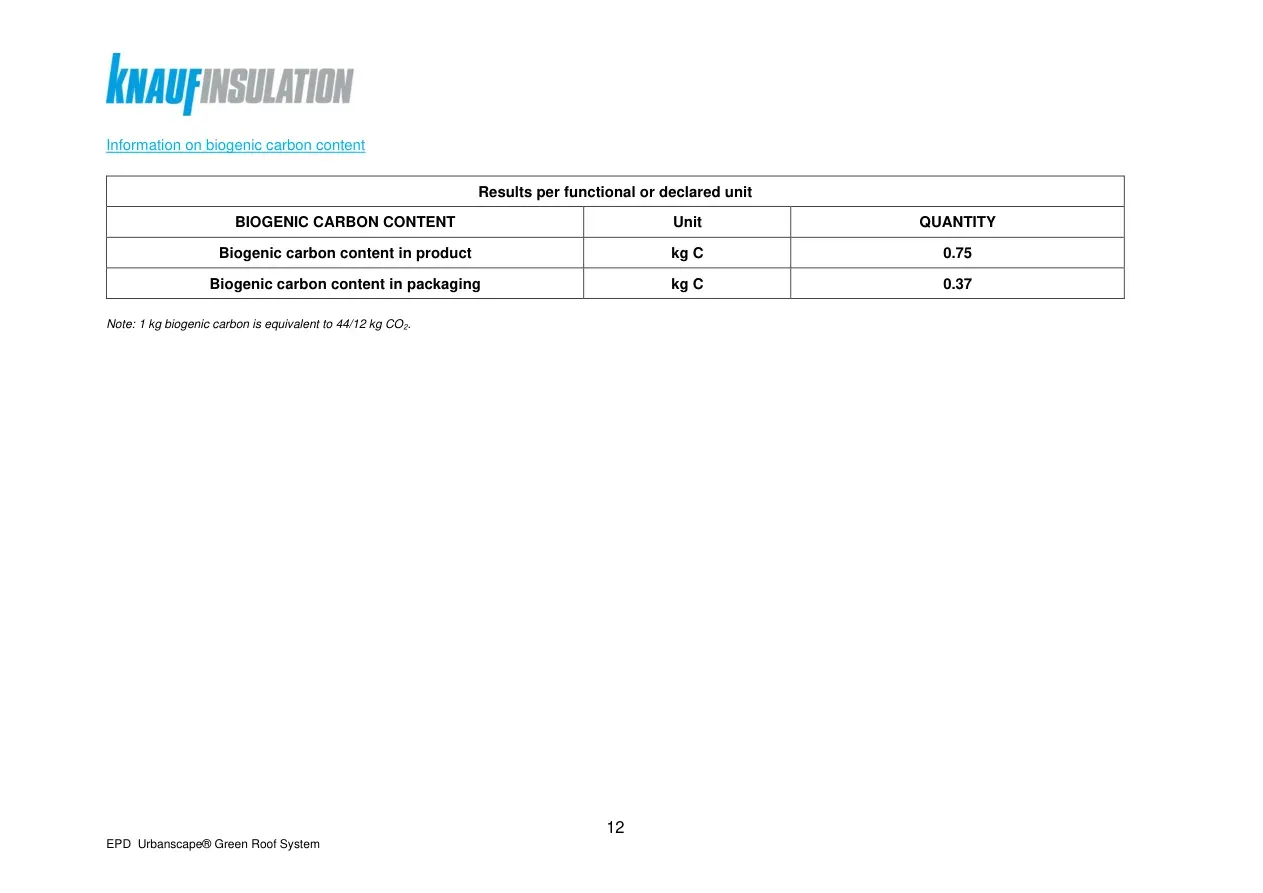
12 EPD Urbanscape® Green Roof System Information on biogenic carbon content Results per functional or declared unit BIOGENIC CARBON CONTENT Unit QUANTITY Biogenic carbon content in product kg C 0.75 Biogenic carbon content in packaging kg C 0.37 Note: 1 kg biogenic carbon is equivalent to 44/12 kg CO2.
13 EPD Urbanscape® Green Roof System LCA interpretation ENVIRONMENTAL IMPACTS The production of the mineral wool is the main contributor to the environmental impacts, mainly due to the energy consumption during production (e.g., electricity…). The sedum-blanket made of renewable materials and the drainage layer have smaller impacts. The Global Warming Potential (GWP) impact main contributor is the production of mineral wool using coke which has a high CO2 emission factor. The sedum layer is a major contributor the GWP impacts, during the production of the sedum and the use phase (50 years), the plants will sequester up to 61.5kg of CO2. This CO2 will then be released at the end of life through the composting of the layer. The incineration of the packaging (wooden pallet and plastic foils) at installation and the end of life of the polypropylene drainage layer has an impact in modules A5 and C2. The benefits from the energy generated via the incineration of a proportion of the packaging and the drainage layer is accounted in the module D. The Ozone layer Depletion Potential (ODP) results are mostly impacted by the plastic sheets (packaging) incineration. The Acidification Potential (AP) is also dominated by the manufacturing of rock mineral wool due to the emissions related to the processes and the energy consumption. The Eutrophication Potential (EP) is significantly influenced by the manufacturing of rock mineral wool due to emissions from cupola furnace, curing oven and other unit processes. The Photochemical Ozone Creation Potential (POCP) is particularly dominated by the manufacturing of rock mineral wool (emissions in the cupola furnace and other unit processes). The Abiotic Depletion Potential Minerals&metals (ADPmm) main impacts are coming from the production of the mineral wool (>50% of total impacts are due to the use of cement in briquettes for recycled materials) The Abiotic Depletion Potential Fossil (ADPf) is dominated by the use of the energy mix (electricity and other sources). There are also originating from the production of the drainmat which is made of polypropylene. USE OF ENERGY RESOURCES The primary energy demand from non-renewable resources is dominated by the production of the green roll made of mineral wool (especially due to the energy consumption). The renewable energy demand is also dominated by the production, mostly due to electricity consumption, and packaging.
References International EPD® System General Programme Instructions of the International EPD® System. Version 3.01. Product category rules (PCR): PCR 2019:14. Construction products (EN 15804+A2:2019) Version 1.1. ISO 14025 DIN EN ISO 14025:2011-10: Environmental labels and declarations — Type III environmental declarations — Principles and procedures EN 15804 EN 15804:2012+A2:2019: Sustainability of construction works — Environmental Product Declarations — Core rules for the product category of construction products GaBi 10 GaBi 10: Software and database for life cycle engineering. LBP, University of Stuttgart and PE INTERNATIONAL AG, 2019. EN 13501-1 EN 13501-1: 2009 Fire classification of construction products and building elements - Part 1: Classification using test data from reaction to fire tests. EN 15978: 2011 EN 15978: 2011 Sustainability of construction works - Assessment of environmental performance of buildings - Calculation method. ISO 21930:2017 Sustainability in buildings and civil engineering works — Core rules for environmental product declarations of construction products and services EN ISO 10140-1 Laboratory measurement of sound insulation of building elements – Part 1: Application rules for specific products EN ISO 10140-2 Laboratory measurement of sound insulation of building elements – Part 2: Measurement of airborne sound insulation IBU PART B PCR – Part B: Requirements of the EPD for green roofs, version 1.2, Institut Bauen und Umwelt e.V., www.bau-umwelt.com, 2019 Background report EPD and FDES for Urbanscape Green Roof System, version 1. 2022.
Contact information: EPD owner: Knauf Insulation Rue de Maestricht 95 4600 Visé Belgium www.knaufinsulation.com Contact: sustainability@knaufinsulation.com LCA support: Université de Liège – Laboratory of Chemical Engineering PEPs - Products, Environment and Processes Allée du 6 août 15, Bat B6 4000 Liège Belgium Sphera Hauptstraße 111-113 70771 Leinfelden-Echterdingen Germany Programme operator: EPD International AB info@environdec.com
