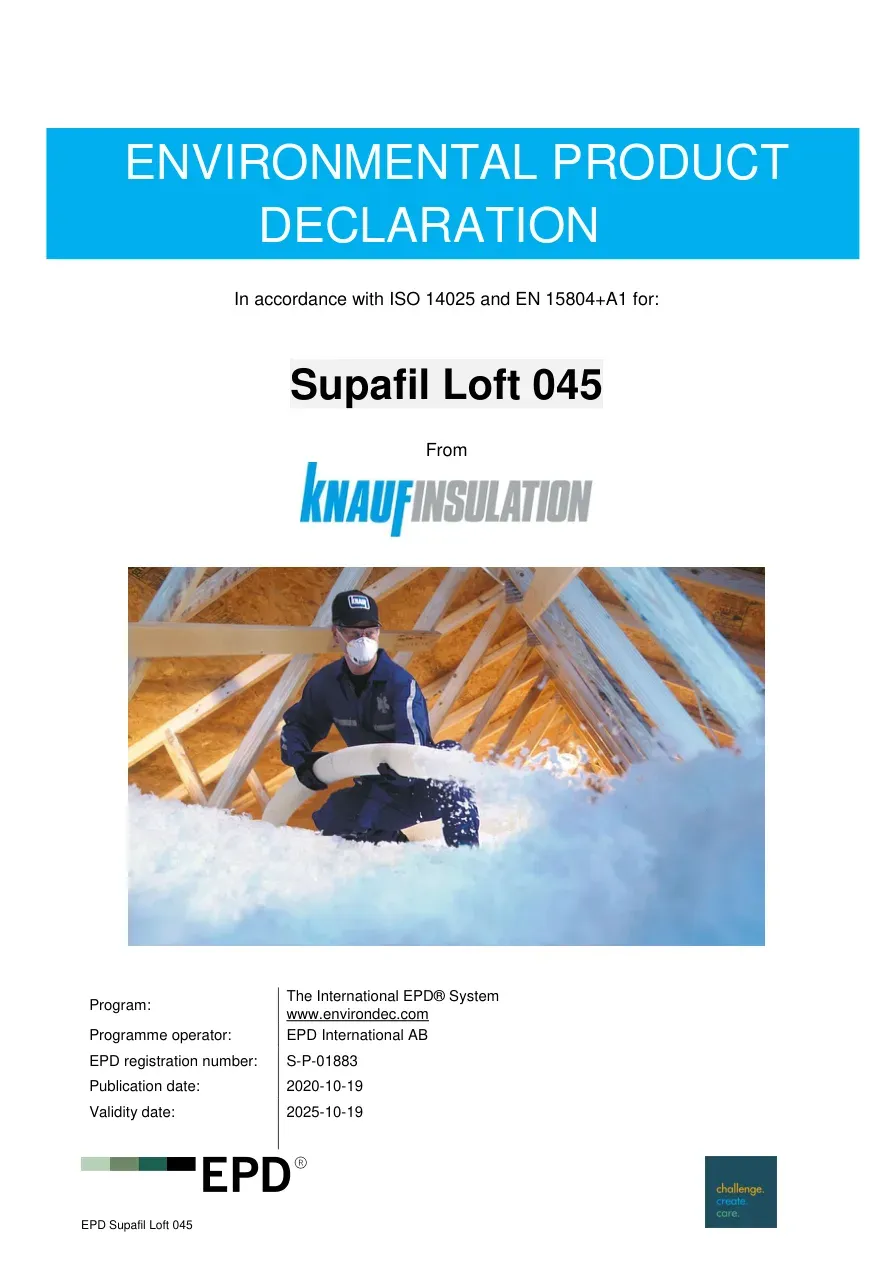
EPD Supafil Loft 045 In accordance with ISO 14025 and EN 15804+A1 for: Supafil Loft 045 From Program: The International EPD® System www.environdec.com Programme operator: EPD International AB EPD registration number: S-P-01883 Publication date: 2020-10-19 Validity date: 2025-10-19 ENVIRONMENTAL PRODUCT DECLARATION
2 EPD Supafil Loft 045 Programme-related information and verification The EPD owner has the sole ownership, liability, and responsibility for the EPD. EPDs of construction products may not be comparable if they do not comply with EN 15804+A1 and if the building context, respectively the product-specific characteristics of performance are not taken into account. Programme: The International EPD® System EPD International AB Box 210 60 SE-100 31 Stockholm Sweden www.environdec.com info@environdec.com EPD registration number: S-P-01883 Published: 2020-10-19 Valid until: 2025-10-19 EPD owner Knauf Insulation Sprl Rue de Maestricht 95 4600 Visé Belgium Product Category Rules: PCR 2012:01. Construction products and construction services. Version 2.3 Sub-PCR-I Thermal insulation products (EN 16783: 2017) Product group classification: UN CPC 37 Reference year for plant data: 2019 Geographical application scope: Europe CEN standard EN 15804+A1 serves as the Core Product Category Rules (PCR) Product category rules (PCR): Construction products and Construction services, 2012:01, version 2.3.Sub-PCR-I Thermal insulation products (EN 16783: 2017) PCR review was conducted by: The technical Committee of the International EPD@ System Independent third-party verification of the declaration and data, according to ISO 14025:2006: ☒ EPD process certification ☐ EPD verification Certified by: Bureau Veritas certification Sverige AB SE006629-1 Procedure for follow-up of data during EPD validity involves third party verifier: ☒ Yes ☐ No
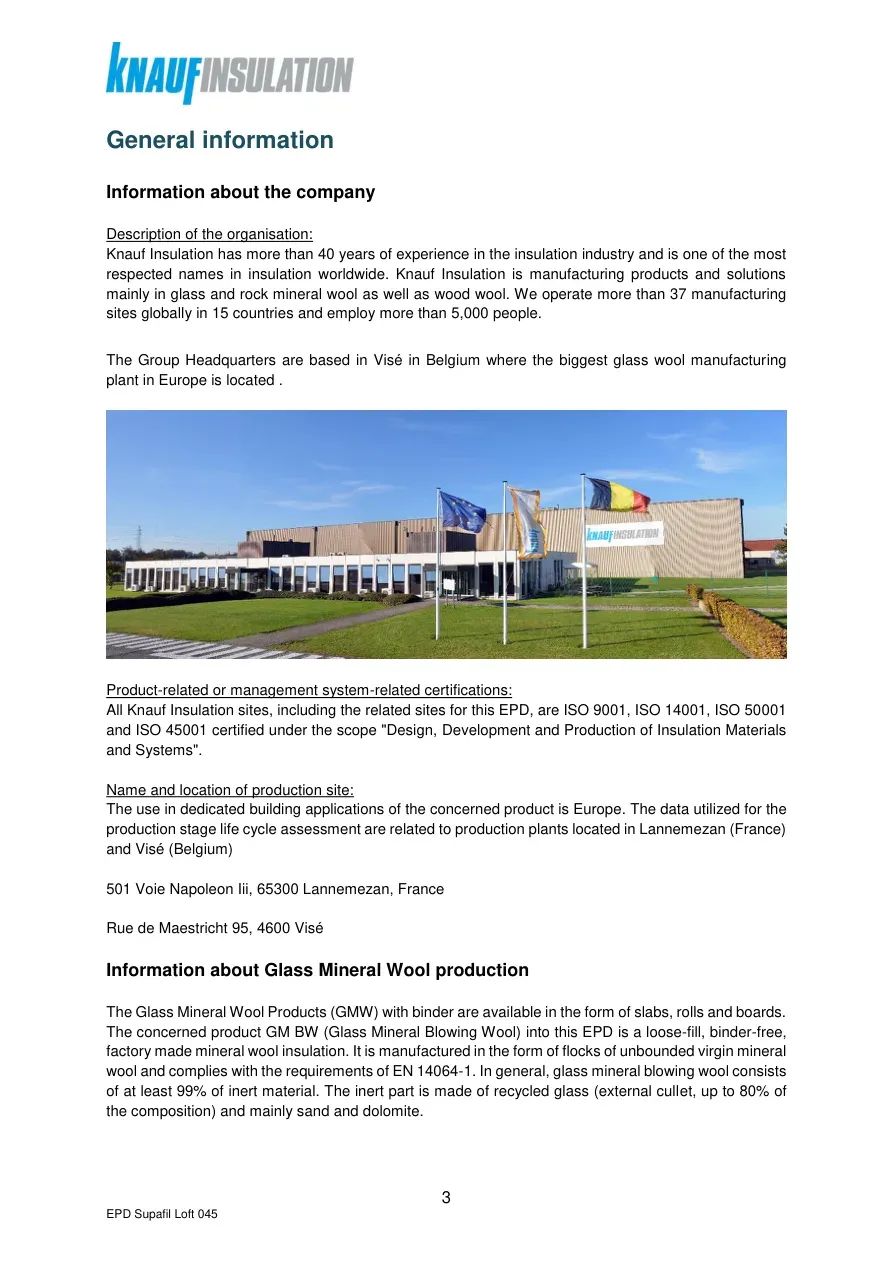
3 EPD Supafil Loft 045 General information Information about the company Description of the organisation: Knauf Insulation has more than 40 years of experience in the insulation industry and is one of the most respected names in insulation worldwide. Knauf Insulation is manufacturing products and solutions mainly in glass and rock mineral wool as well as wood wool. We operate more than 37 manufacturing sites globally in 15 countries and employ more than 5,000 people. The Group Headquarters are based in Visé in Belgium where the biggest glass wool manufacturing plant in Europe is located . Product-related or management system-related certifications: All Knauf Insulation sites, including the related sites for this EPD, are ISO 9001, ISO 14001, ISO 50001 and ISO 45001 certified under the scope "Design, Development and Production of Insulation Materials and Systems". Name and location of production site: The use in dedicated building applications of the concerned product is Europe. The data utilized for the production stage life cycle assessment are related to production plants located in Lannemezan (France) and Visé (Belgium) 501 Voie Napoleon Iii, 65300 Lannemezan, France Rue de Maestricht 95, 4600 Visé Information about Glass Mineral Wool production The Glass Mineral Wool Products (GMW) with binder are available in the form of slabs, rolls and boards. The concerned product GM BW (Glass Mineral Blowing Wool) into this EPD is a loose-fill, binder-free, factory made mineral wool insulation. It is manufactured in the form of flocks of unbounded virgin mineral wool and complies with the requirements of EN 14064-1. In general, glass mineral blowing wool consists of at least 99% of inert material. The inert part is made of recycled glass (external cullet, up to 80% of the composition) and mainly sand and dolomite.
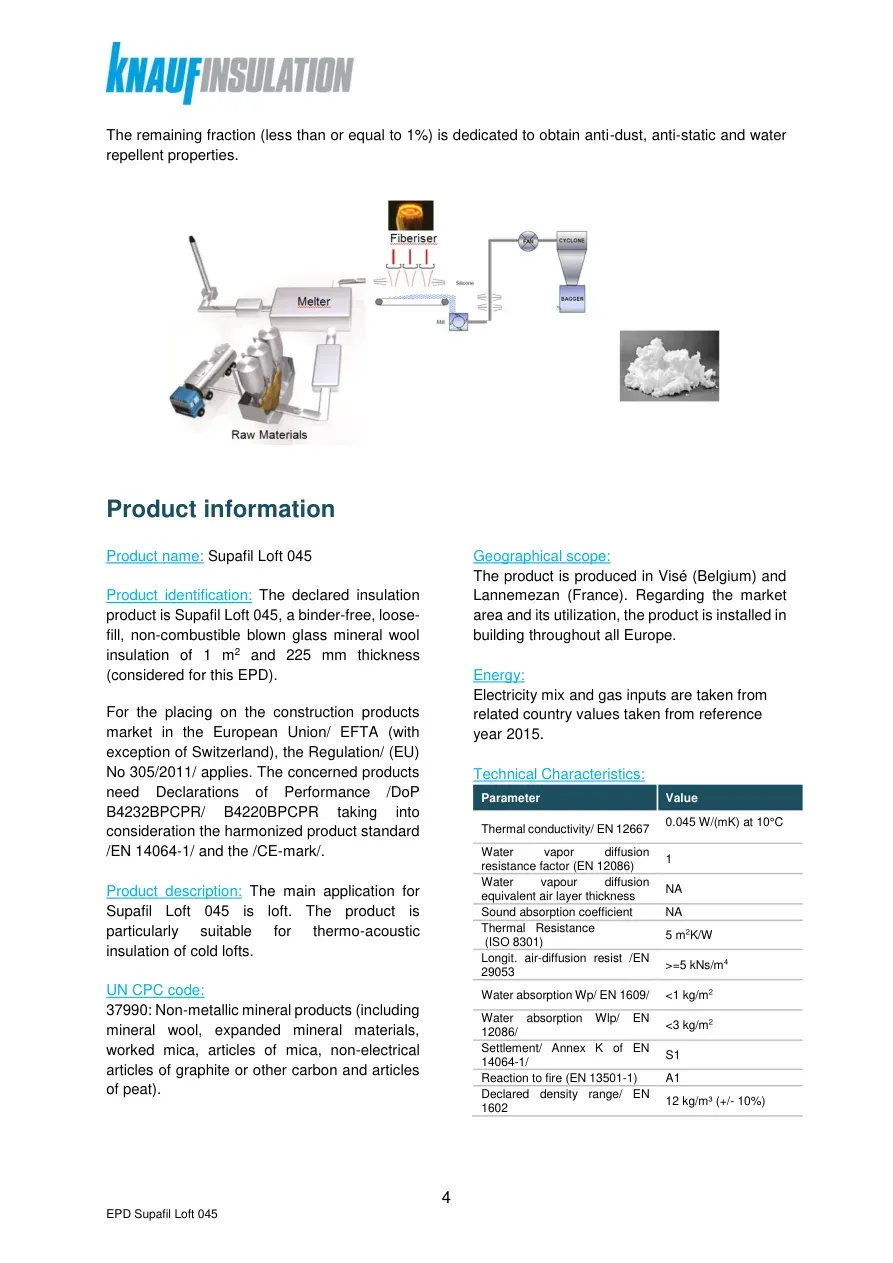
4 EPD Supafil Loft 045 The remaining fraction (less than or equal to 1%) is dedicated to obtain anti-dust, anti-static and water repellent properties. Product information Product name: Supafil Loft 045 Product identification: The declared insulation product is Supafil Loft 045, a binder-free, loose-fill, non-combustible blown glass mineral wool insulation of 1 m2 and 225 mm thickness (considered for this EPD). For the placing on the construction products market in the European Union/ EFTA (with exception of Switzerland), the Regulation/ (EU) No 305/2011/ applies. The concerned products need Declarations of Performance /DoP B4232BPCPR/ B4220BPCPR taking into consideration the harmonized product standard /EN 14064-1/ and the /CE-mark/. Product description: The main application for Supafil Loft 045 is loft. The product is particularly suitable for thermo-acoustic insulation of cold lofts. UN CPC code: 37990: Non-metallic mineral products (including mineral wool, expanded mineral materials, worked mica, articles of mica, non-electrical articles of graphite or other carbon and articles of peat). Geographical scope: The product is produced in Visé (Belgium) and Lannemezan (France). Regarding the market area and its utilization, the product is installed in building throughout all Europe. Energy: Electricity mix and gas inputs are taken from related country values taken from reference year 2015. Technical Characteristics: Parameter Value Thermal conductivity/ EN 12667 0.045 W/(mK) at 10°C Water vapor diffusion resistance factor (EN 12086) 1 Water vapour diffusion equivalent air layer thickness NA Sound absorption coefficient NA Thermal Resistance (ISO 8301) 5 m2K/W Longit. air-diffusion resist /EN 29053 >=5 kNs/m4 Water absorption Wp/ EN 1609/ <1 kg/m2 Water absorption Wlp/ EN 12086/ <3 kg/m2 Settlement/ Annex K of EN 14064-1/ S1 Reaction to fire (EN 13501-1) A1 Declared density range/ EN 1602 12 kg/m³ (+/- 10%)
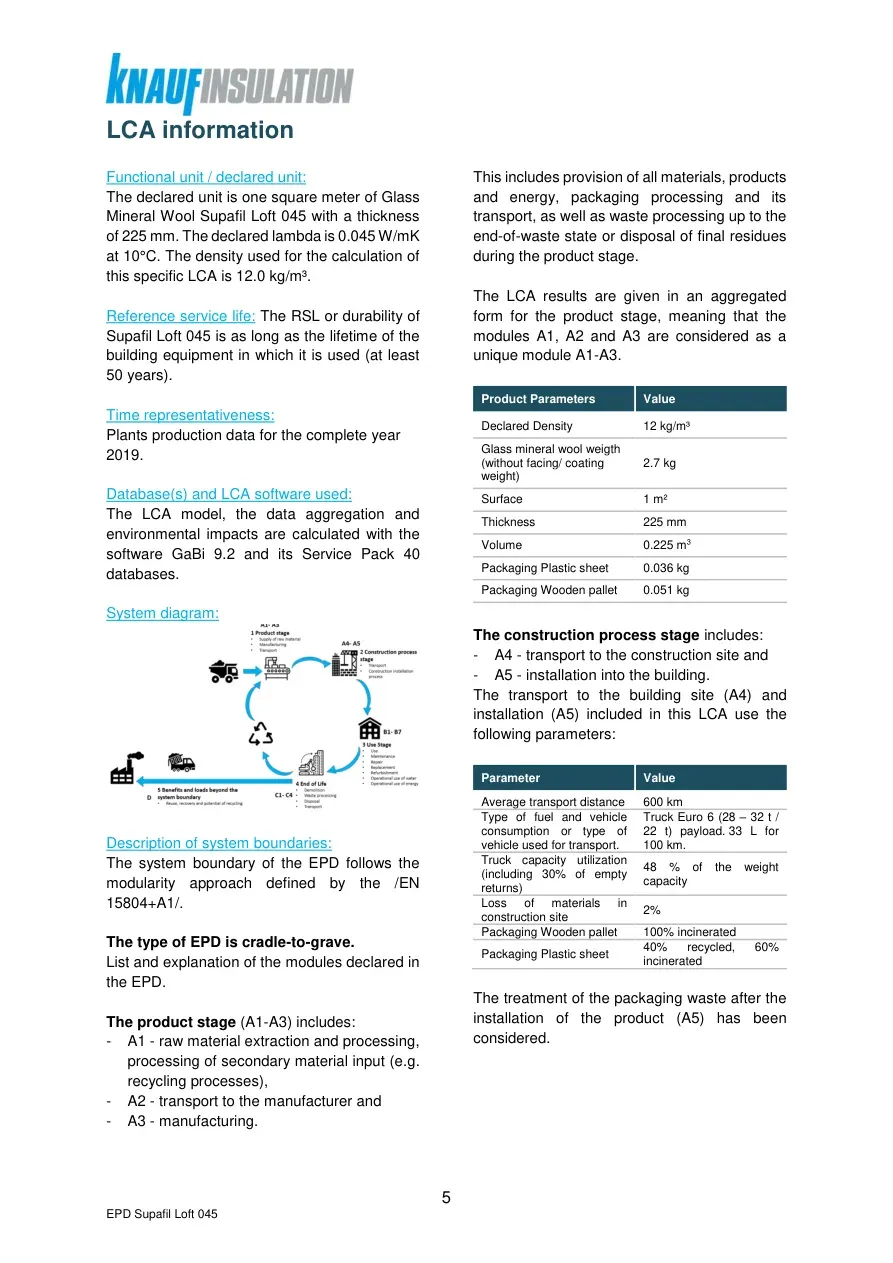
5 EPD Supafil Loft 045 LCA information Functional unit / declared unit: The declared unit is one square meter of Glass Mineral Wool Supafil Loft 045 with a thickness of 225 mm. The declared lambda is 0.045 W/mK at 10°C. The density used for the calculation of this specific LCA is 12.0 kg/m³. Reference service life: The RSL or durability of Supafil Loft 045 is as long as the lifetime of the building equipment in which it is used (at least 50 years). Time representativeness: Plants production data for the complete year 2019. Database(s) and LCA software used: The LCA model, the data aggregation and environmental impacts are calculated with the software GaBi 9.2 and its Service Pack 40 databases. System diagram: Description of system boundaries: The system boundary of the EPD follows the modularity approach defined by the /EN 15804+A1/. The type of EPD is cradle-to-grave. List and explanation of the modules declared in the EPD. The product stage (A1-A3) includes: - A1 - raw material extraction and processing, processing of secondary material input (e.g. recycling processes), - A2 - transport to the manufacturer and - A3 - manufacturing. This includes provision of all materials, products and energy, packaging processing and its transport, as well as waste processing up to the end-of-waste state or disposal of final residues during the product stage. The LCA results are given in an aggregated form for the product stage, meaning that the modules A1, A2 and A3 are considered as a unique module A1-A3. Product Parameters Value Declared Density 12 kg/m³ Glass mineral wool weigth (without facing/ coating weight) 2.7 kg Surface 1 m² Thickness 225 mm Volume 0.225 m3 Packaging Plastic sheet 0.036 kg Packaging Wooden pallet 0.051 kg The construction process stage includes: - A4 - transport to the construction site and - A5 - installation into the building. The transport to the building site (A4) and installation (A5) included in this LCA use the following parameters: Parameter Value Average transport distance 600 km Type of fuel and vehicle consumption or type of vehicle used for transport. Truck Euro 6 (28 – 32 t / 22 t) payload. 33 L for 100 km. Truck capacity utilization (including 30% of empty returns) 48 % of the weight capacity Loss of materials in construction site 2% Packaging Wooden pallet 100% incinerated Packaging Plastic sheet 40% recycled, 60% incinerated The treatment of the packaging waste after the installation of the product (A5) has been considered.
6 EPD Supafil Loft 045 The Use stage (B1-B7) includes: - B1: Use - B2: Maintenance - B3: Repair - B4: Replacement - B5: Refurbishment - B6: Operational Energy Use - B7: Operational Water Use Once installation is complete, no actions or technical operations are required during the use stages until the end of life. Therefore, the mineral wool has no impacts (excluding potential energy savings) on this stage. The end-of-life stage includes: - C1 - de-construction, demolition, - C2 - transport to waste processing, - C3 - waste processing for reuse, recovery and/or recycling and - C4 - disposal. This includes provision of all transports, materials, products and related energy and water use. The common manual dismantling impact of insulation is considered as very small and can be neglected in C1. Although Glass Mineral Wool products from Knauf Insulation are partly recycled at their end-of-life, an established collection system does not yet exist. Therefore, the assumption chosen in this study, 100% landfill (C4) after the use phase, is the most conservative approach. Parameter Value Disposal type (mineral wool) 100% landfill Average transport distance waste (C2) 50 km Type of fuel and vehicle consumption or type of vehicle used for transport. Truck-trailer, Euro 3, 34 - 40t gross weight / 27t payload capacity/ 40 L for 100 km. (if 100 % utilization). Truck capacity utilization 70 % of the weight capacity Module D includes reuse, recovery and/or recycling potentials. According to /EN 15804+A1/, any declared benefits and loads from net flows leaving the product system not allocated as co-products and having passed the end-of waste state shall be included in module D. Benefits considered in module D originate from packaging recycling or incineration. Content Declaration The product does not contain substances on the "Candidate List of Substances of Very High Concern for Authorisation" under the REACH regulation (if above 0.1% of the mass). Supafil® is labialized “LBC Declare Red List free” and supports LEED, WELL and Living Building Challenge certification. Knauf Insulation Supafil® products complies with Indoor Air Comfort Gold (eurofins) requirements. Recycled material External cullet utilized in the batch mix for the specified production sites is accounted for in the assessment. Recycled content for this product was calculated at 80 % in 2019 according to the cullet market availability. Additional information: All raw materials for the manufacturing of the declared product, the required energy, water consumption and the resulting emissions are considered into the LCA. Consecutively, the recipe components with a share even less than 1% are included. All neglected processes contribute less than 5% to the total mass or less than 5% to the total energy consumption. For information, the impacts of the Glass Mineral Wool plant construction or machines, called capital goods, are not taken into account in the life cycle assessment. Knauf Insulation adopts a “worst case” approach into its EPDs. More information: www.knaufinsulation.com Name and contact information of LCA practitioner: Yaprak Nayir Knauf Insulation Sprl Rue de Maestricht 95 4600 Visé Belgium Contact: yaprak.nayir@knaufinsulation.com
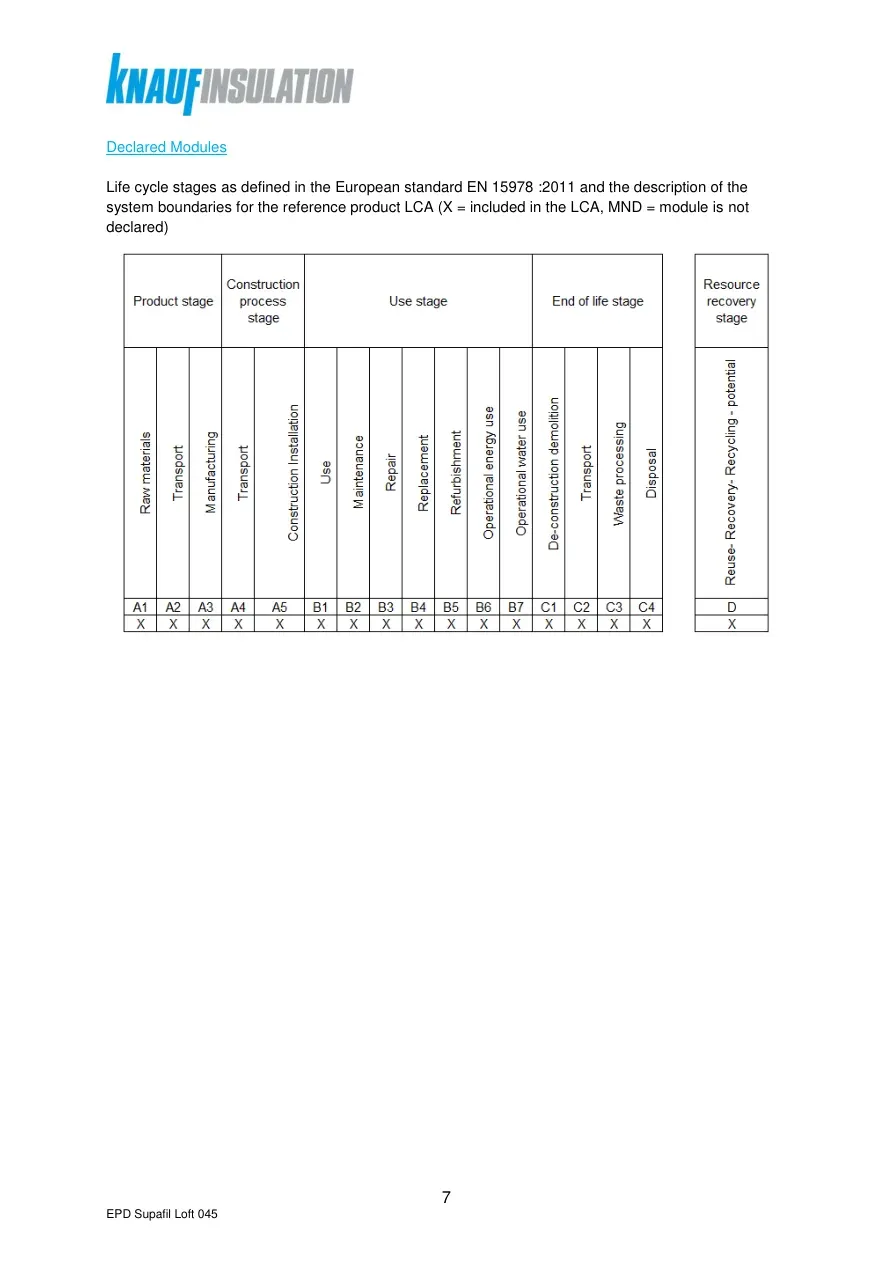
7 EPD Supafil Loft 045 Declared Modules Life cycle stages as defined in the European standard EN 15978 :2011 and the description of the system boundaries for the reference product LCA (X = included in the LCA, MND = module is not declared)
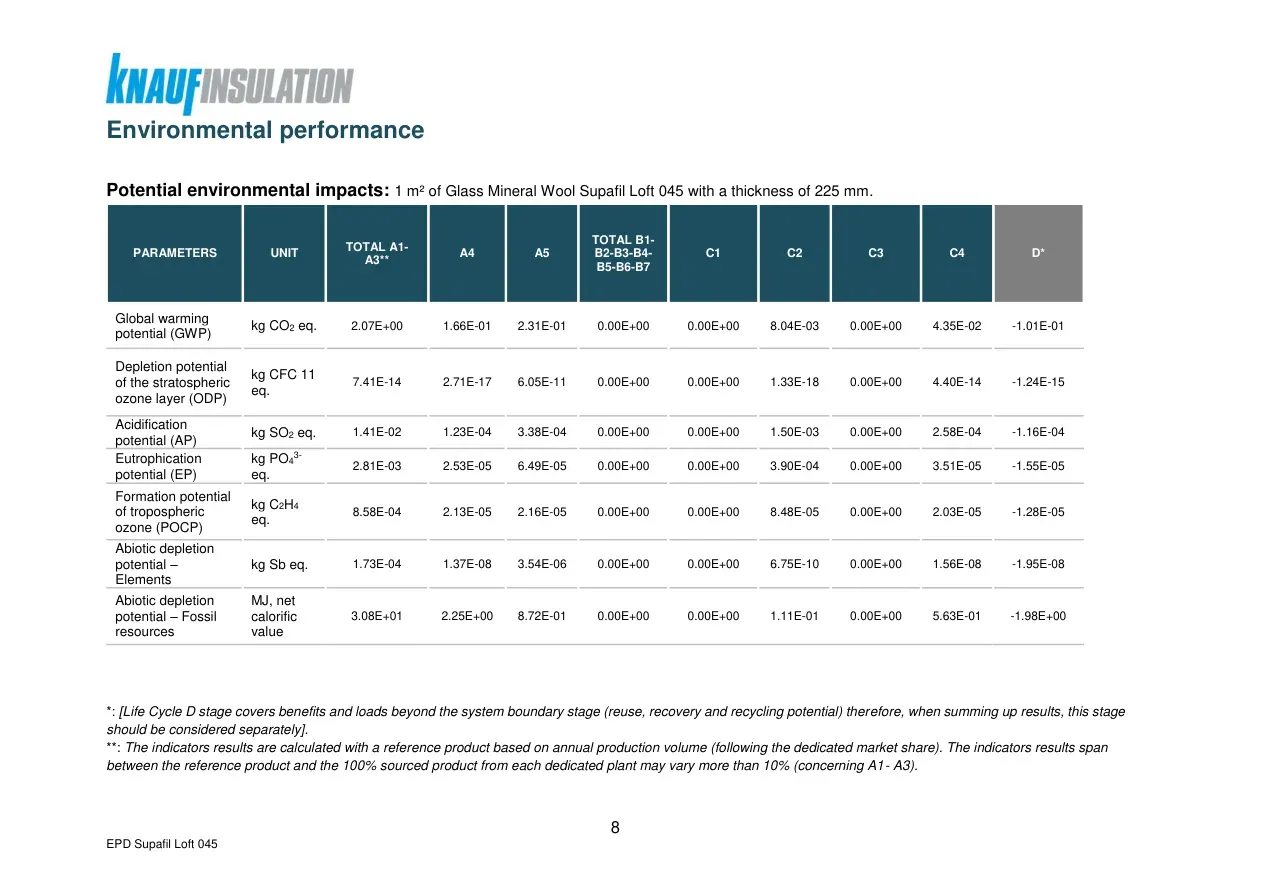
8 EPD Supafil Loft 045 Environmental performance Potential environmental impacts: 1 m² of Glass Mineral Wool Supafil Loft 045 with a thickness of 225 mm. PARAMETERS UNIT TOTAL A1-A3** A4 A5 TOTAL B1-B2-B3-B4-B5-B6-B7 C1 C2 C3 C4 D* Global warming potential (GWP) kg CO2 eq. 2.07E+00 1.66E-01 2.31E-01 0.00E+00 0.00E+00 8.04E-03 0.00E+00 4.35E-02 -1.01E-01 Depletion potential of the stratospheric ozone layer (ODP) kg CFC 11 eq. 7.41E-14 2.71E-17 6.05E-11 0.00E+00 0.00E+00 1.33E-18 0.00E+00 4.40E-14 -1.24E-15 Acidification potential (AP) kg SO2 eq. 1.41E-02 1.23E-04 3.38E-04 0.00E+00 0.00E+00 1.50E-03 0.00E+00 2.58E-04 -1.16E-04 Eutrophication potential (EP) kg PO43- eq. 2.81E-03 2.53E-05 6.49E-05 0.00E+00 0.00E+00 3.90E-04 0.00E+00 3.51E-05 -1.55E-05 Formation potential of tropospheric ozone (POCP) kg C2H4 eq. 8.58E-04 2.13E-05 2.16E-05 0.00E+00 0.00E+00 8.48E-05 0.00E+00 2.03E-05 -1.28E-05 Abiotic depletion potential – Elements kg Sb eq. 1.73E-04 1.37E-08 3.54E-06 0.00E+00 0.00E+00 6.75E-10 0.00E+00 1.56E-08 -1.95E-08 Abiotic depletion potential – Fossil resources MJ, net calorific value 3.08E+01 2.25E+00 8.72E-01 0.00E+00 0.00E+00 1.11E-01 0.00E+00 5.63E-01 -1.98E+00 *: [Life Cycle D stage covers benefits and loads beyond the system boundary stage (reuse, recovery and recycling potential) therefore, when summing up results, this stage should be considered separately]. **: The indicators results are calculated with a reference product based on annual production volume (following the dedicated market share). The indicators results span between the reference product and the 100% sourced product from each dedicated plant may vary more than 10% (concerning A1- A3).
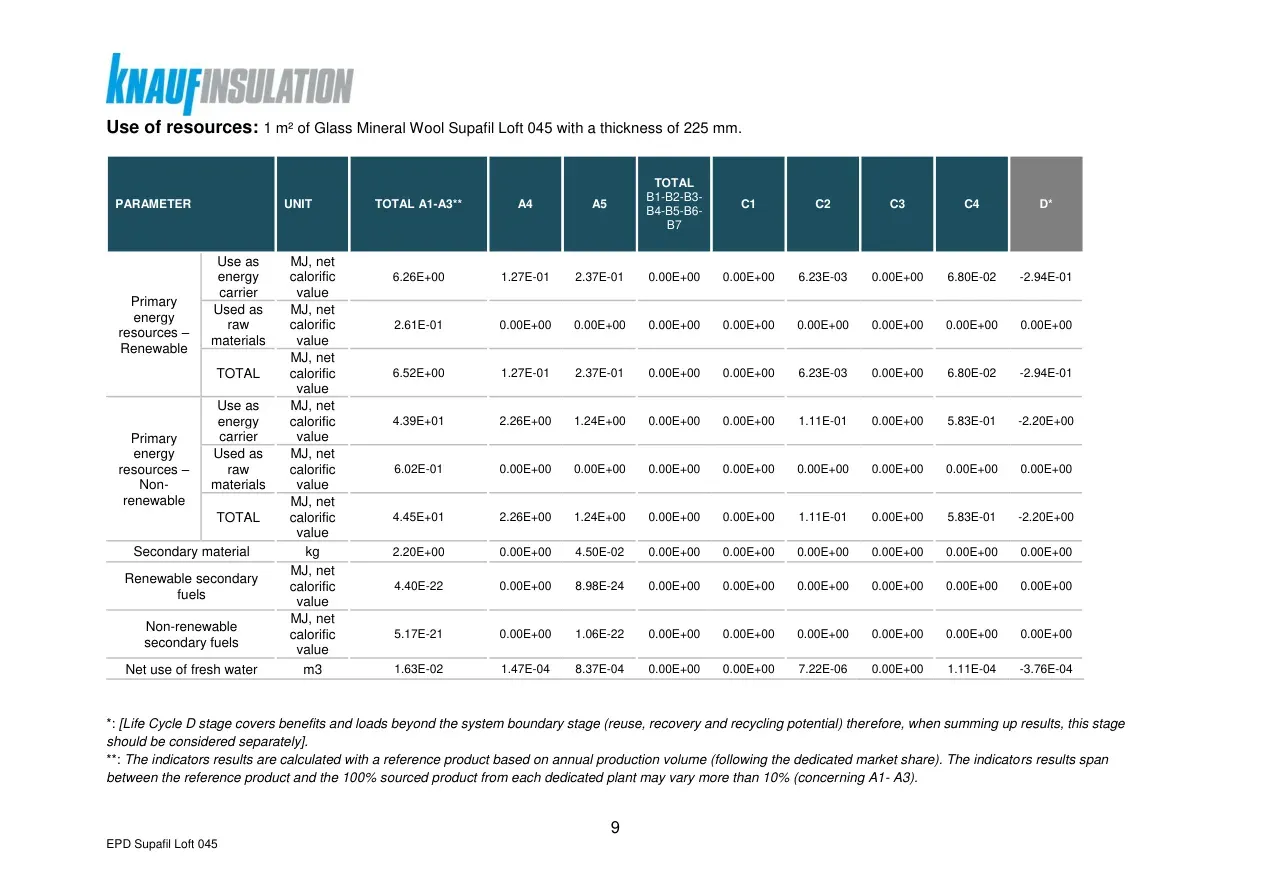
9 EPD Supafil Loft 045 Use of resources: 1 m² of Glass Mineral Wool Supafil Loft 045 with a thickness of 225 mm. PARAMETER UNIT TOTAL A1-A3** A4 A5 TOTAL B1-B2-B3-B4-B5-B6-B7 C1 C2 C3 C4 D* Primary energy resources – Renewable Use as energy carrier MJ, net calorific value 6.26E+00 1.27E-01 2.37E-01 0.00E+00 0.00E+00 6.23E-03 0.00E+00 6.80E-02 -2.94E-01 Used as raw materials MJ, net calorific value 2.61E-01 0.00E+00 0.00E+00 0.00E+00 0.00E+00 0.00E+00 0.00E+00 0.00E+00 0.00E+00 TOTAL MJ, net calorific value 6.52E+00 1.27E-01 2.37E-01 0.00E+00 0.00E+00 6.23E-03 0.00E+00 6.80E-02 -2.94E-01 Primary energy resources – Non-renewable Use as energy carrier MJ, net calorific value 4.39E+01 2.26E+00 1.24E+00 0.00E+00 0.00E+00 1.11E-01 0.00E+00 5.83E-01 -2.20E+00 Used as raw materials MJ, net calorific value 6.02E-01 0.00E+00 0.00E+00 0.00E+00 0.00E+00 0.00E+00 0.00E+00 0.00E+00 0.00E+00 TOTAL MJ, net calorific value 4.45E+01 2.26E+00 1.24E+00 0.00E+00 0.00E+00 1.11E-01 0.00E+00 5.83E-01 -2.20E+00 Secondary material kg 2.20E+00 0.00E+00 4.50E-02 0.00E+00 0.00E+00 0.00E+00 0.00E+00 0.00E+00 0.00E+00 Renewable secondary fuels MJ, net calorific value 4.40E-22 0.00E+00 8.98E-24 0.00E+00 0.00E+00 0.00E+00 0.00E+00 0.00E+00 0.00E+00 Non-renewable secondary fuels MJ, net calorific value 5.17E-21 0.00E+00 1.06E-22 0.00E+00 0.00E+00 0.00E+00 0.00E+00 0.00E+00 0.00E+00 Net use of fresh water m3 1.63E-02 1.47E-04 8.37E-04 0.00E+00 0.00E+00 7.22E-06 0.00E+00 1.11E-04 -3.76E-04 *: [Life Cycle D stage covers benefits and loads beyond the system boundary stage (reuse, recovery and recycling potential) therefore, when summing up results, this stage should be considered separately]. **: The indicators results are calculated with a reference product based on annual production volume (following the dedicated market share). The indicators results span between the reference product and the 100% sourced product from each dedicated plant may vary more than 10% (concerning A1- A3).
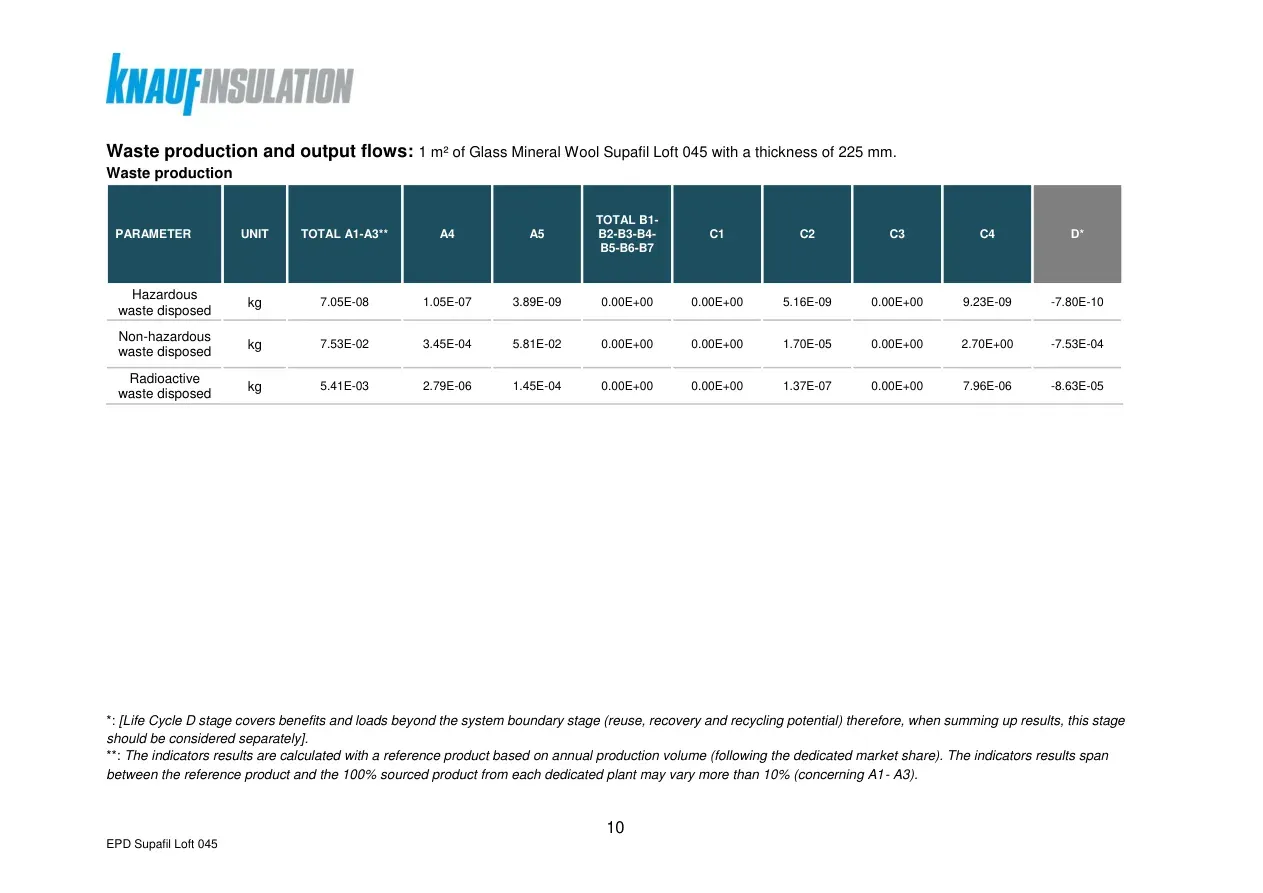
10 EPD Supafil Loft 045 Waste production and output flows: 1 m² of Glass Mineral Wool Supafil Loft 045 with a thickness of 225 mm. Waste production PARAMETER UNIT TOTAL A1-A3** A4 A5 TOTAL B1-B2-B3-B4-B5-B6-B7 C1 C2 C3 C4 D* Hazardous waste disposed kg 7.05E-08 1.05E-07 3.89E-09 0.00E+00 0.00E+00 5.16E-09 0.00E+00 9.23E-09 -7.80E-10 Non-hazardous waste disposed kg 7.53E-02 3.45E-04 5.81E-02 0.00E+00 0.00E+00 1.70E-05 0.00E+00 2.70E+00 -7.53E-04 Radioactive waste disposed kg 5.41E-03 2.79E-06 1.45E-04 0.00E+00 0.00E+00 1.37E-07 0.00E+00 7.96E-06 -8.63E-05 *: [Life Cycle D stage covers benefits and loads beyond the system boundary stage (reuse, recovery and recycling potential) therefore, when summing up results, this stage should be considered separately]. **: The indicators results are calculated with a reference product based on annual production volume (following the dedicated market share). The indicators results span between the reference product and the 100% sourced product from each dedicated plant may vary more than 10% (concerning A1- A3).
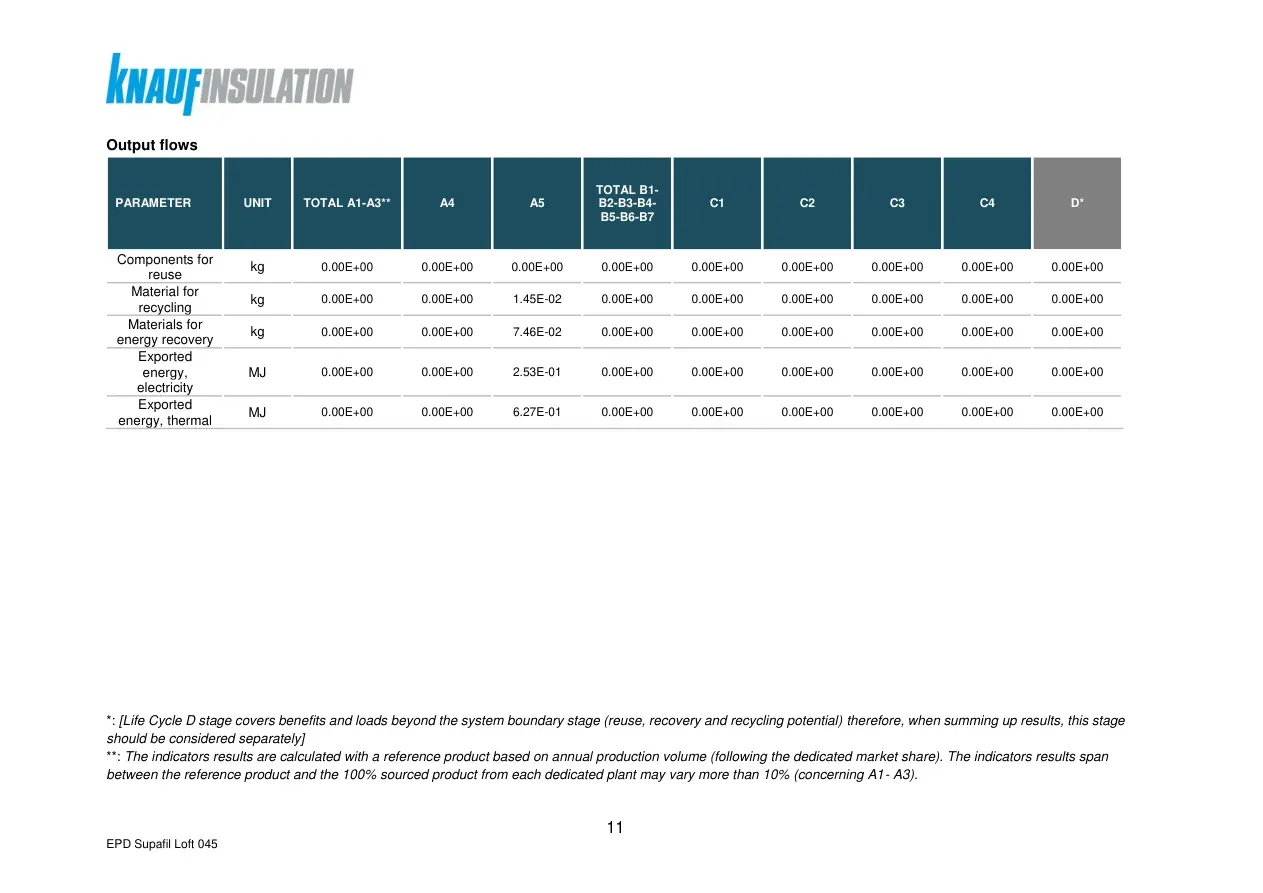
11 EPD Supafil Loft 045 Output flows PARAMETER UNIT TOTAL A1-A3** A4 A5 TOTAL B1-B2-B3-B4-B5-B6-B7 C1 C2 C3 C4 D* Components for reuse kg 0.00E+00 0.00E+00 0.00E+00 0.00E+00 0.00E+00 0.00E+00 0.00E+00 0.00E+00 0.00E+00 Material for recycling kg 0.00E+00 0.00E+00 1.45E-02 0.00E+00 0.00E+00 0.00E+00 0.00E+00 0.00E+00 0.00E+00 Materials for energy recovery kg 0.00E+00 0.00E+00 7.46E-02 0.00E+00 0.00E+00 0.00E+00 0.00E+00 0.00E+00 0.00E+00 Exported energy, electricity MJ 0.00E+00 0.00E+00 2.53E-01 0.00E+00 0.00E+00 0.00E+00 0.00E+00 0.00E+00 0.00E+00 Exported energy, thermal MJ 0.00E+00 0.00E+00 6.27E-01 0.00E+00 0.00E+00 0.00E+00 0.00E+00 0.00E+00 0.00E+00 *: [Life Cycle D stage covers benefits and loads beyond the system boundary stage (reuse, recovery and recycling potential) therefore, when summing up results, this stage should be considered separately] **: The indicators results are calculated with a reference product based on annual production volume (following the dedicated market share). The indicators results span between the reference product and the 100% sourced product from each dedicated plant may vary more than 10% (concerning A1- A3).
12 EPD Supafil Loft 045 LCA interpretation ENVIRONMENTAL IMPACTS All impact categories except the ADPE and the ODP are dominated by the production. This is mainly All impact categories except the ADPE and the ODP are dominated by the production. This is mainly due to the high impact of energy consumption (electricity and natural gas) during the production of glass mineral wool. The Global Warming Potential (GWP) is clearly dominated by the production, mostly due to energy consumption (electricity and natural gas). However, regarding the electricity mix, the French and Belgian mix are quite low in terms of CO2 emissions mainly due to the high nuclear source of electricity. The high cullet content is also helping to reduce the energy use in the melting furnace. The Ozone layer Depletion Potential (ODP) seems highly influenced by the installation step, mostly due to plastics packaging incineration scenario resulting in emissions of halogenated compounds. The Acidification Potential (AP) is also dominated by the production due to the processes emissions and the electricity consumption. Most of impact is by emissions of sulphur dioxide, ammonia and nitrogen oxides. The Eutrophication Potential (EP) is significantly influenced by production due to emissions from curing oven, furnace and other unit processes. The Photochemical Ozone Creation Potential (POCP) is dominated by the production due to emissions in the curing oven and some other unit processes but also by energy consumption. The Abiotic Depletion Potential Element (ADPe) is dominated by the raw materials production. The Abiotic Depletion Potential Fossil (ADPf) is dominated by natural gas use and the electricity consumption for the production. The installation stage has a “positive” contribution due to the energy recovery from incineration of some plastic packaging and the avoidance of new plastic production due to the percentage of recycled plastic packaging. RESOURCES USE Total Use of Non-Renewable Primary Energy Resources (PENRT) is dominated by the production of glass mineral wool products (especially due to the energy consumption) and with the little influence of raw materials and packaging. Total Use of Renewable Primary Energy Resources (PERT) is dominated by the production, (electricity mix) and the packaging (wooden pallets). For the Use of Secondary Material (SM), there is a lot of external cullet used into the batch process (recycled glass from windows and bottles) up to 80% depending on plants.
References International EPD® System General Programme Instructions of the International EPD® System. Version 2.5. Product Category Rules PCR 2012:01. Construction products and construction services. Version 2.3 Sub-PCR-I Thermal insulation products (EN 16783: 2017). ISO 14025 DIN EN ISO 14025:2011-10: Environmental labels and declarations — Type III environmental declarations — Principles and procedures EN 15804 EN 15804:2012-04+A1 2013: Sustainability of construction works — Environmental Product Declarations — Core rules for the product category of construction products GaBi 9.2 GaBi 9.2: Software and database for life cycle engineering. LBP, University of Stuttgart and PE INTERNATIONAL AG, 2019. EN 1602: EN1602: 2013 Thermal insulation products for building applications – Determination of the apparent density EN 12667 EN 12667: 2001 Thermal performance of building materials and products - Determination of thermal resistance by means of guarded hot plate and heat flow meter methods - Products of high and medium thermal resistance EN 14064 – Part 1 EN 14064:2010 Thermal insulation products for buildings – In-situ formed loose fill mineral wool products for buildings- In-situ formed loose fill mineral wool products- Part 1: Specification for the loose fill products before installation EN 14064 – Part 2 EN 14064:2010 Thermal insulation products for buildings – In-situ formed loose fill mineral wool products – Part 2: Specification for the installed products EN 13501-1 EN 13501-1: 2009 Fire classification of construction products and building elements - Part 1: Classification using test data from reaction to fire tests. DIN 4102 / T17 DIN 4102 / T17: 1990 Fire behaviour of building materials and elements; determination of melting point of mineral fibre insulating materials; concepts, requirements and testing. EN 12086 EN 12086: 2013 Thermal insulating products for building applications –determination of water vapour transmission properties.
DoP B4232BPCPR/ B4220BPCPR Declaration of Performance www.dopki.com ISO 8301:1991 Thermal insulation — Determination of steady-state thermal resistance and related properties — Heat flow meter apparatus. EN 29053 EN 29053: 1993 Acoustics; materials for acoustical applications; determination of airflow resistance ISO 10456 ISO 10456: 2007 Building materials and products — Hygrothermal properties — Tabulated design values and procedures for determining declared and design thermal values EN 1609:2013 Thermal insulating products for building applications. Determination of short term water absorption by partial immersion
Contact information: EPD owner: Knauf Insulation Rue de Maestricht 95 4600 Visé Belgium www.knaufinsulation.com Contact: yaprak.nayir@knaufinsulation.com LCA support: Université de Liège – Laboratory of Chemical Engineering PEPs - Products, Environment and Processes Allée du 6 août 15, Bat B6 4000 Liège Belgium Thinkstep Hauptstraße 111-113 70771 Leinfelden-Echterdingen Germany Programme operator: EPD International AB info@environdec.com
