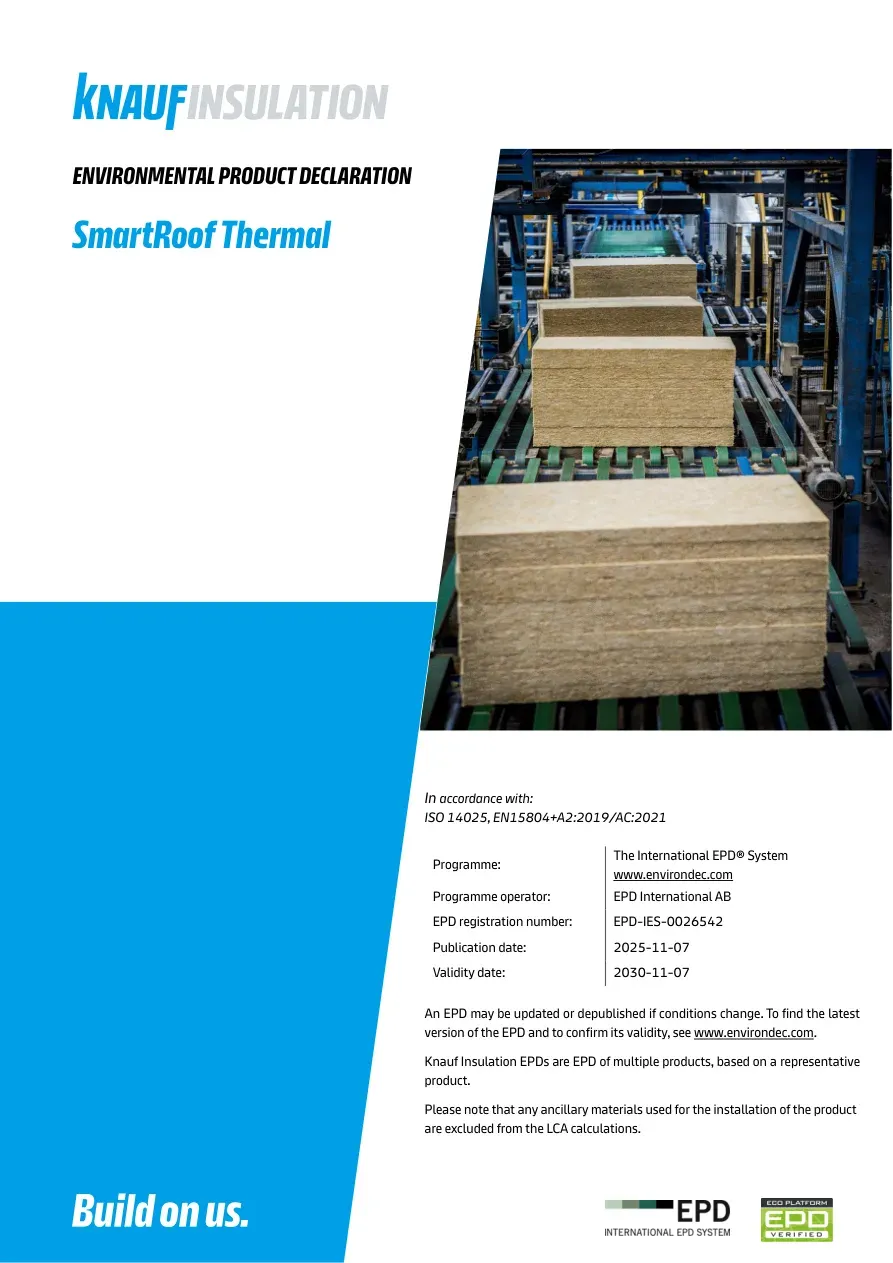
1 EPD SmartRoof Thermal, Holzbau Fassaden-Dämmplatte HFD (STD) ENVIRONMENTAL PRODUCT DECLARATION SmartRoof Thermal, Holzbau Fassaden-Dämmplatte HFD (STD) In accordance with: ISO 14025, EN15804+A2:2019/AC:2021 Programme: The International EPD® System www.environdec.com Programme operator: EPD International AB EPD registration number: EPD-IES-0026542 Publication date: 2025-11-07 Validity date: 2030-11-07 Date of update: 2026-05-27 Version number: 2 An EPD may be updated or depublished if conditions change. To find the latest version of the EPD and to confirm its validity, see www.environdec.com. Knauf Insulation EPDs are EPD of multiple products, based on a representative product. Please note that any ancillary materials used for the installation of the product are excluded from the LCA calculations.
2 EPD SmartRoof Thermal, Holzbau Fassaden-Dämmplatte HFD (STD) Programme-related information and verification The EPD owner has the sole ownership, liability, and responsibility for the EPD. EPDs within the same product category but registered in different EPD programmes, or not compliant with EN 15804, may not be comparable. For two EPDs to be comparable, they must be based on the same PCR (including the same version number) or be based on fully-aligned PCRs or versions of PCRs; cover products with identical functions, technical performances and use (e.g. identical declared/functional units); have equivalent system boundaries and descriptions of data; apply equivalent data quality requirements, methods of data collection, and allocation methods; apply identical cut-off rules and impact assessment methods (including the same version of characterization factors); have equivalent content declarations; and be valid at the time of comparison. For further information about comparability, see EN 15804 and ISO 14025. Programme: The International EPD® System EPD International AB Box 210 60 SE-100 31 Stockholm (Sweden) www.environdec.com support@environdec.com EPD registration number: EPD-IES-0026542 Published: 2025-11-07 Valid until: 2030-11-07 EPD owner Knauf Insulation Sprl Rue de Maestricht 95 4600 Visé (Belgium) Product Category Rules: PCR 2019:14. Construction products (EN 15804+A2) Version 2.0.1 C-PCR-005 Thermal insulation products (EN 16783: 2024) Version: 2025-04-08 Product group classification: UN CPC 37 Reference year for plant data: 2024 (Skofja Loka, Surdulica), 2022 (Nova Bana, Sankt Egidien), 2023 (Illange) Geographical application scope: Europe CEN standard EN 15804 serve as the Core Product Category Rules (PCR) Product category rules (PCR): PCR 2019:14. Construction products (EN 15804+A2) Version 2.0.1, UN CPC 37 C-PCR-005 Thermal insulation products (EN 16783: 2024) Version: 2024-05-03 PCR review was conducted by: The Technical Committee of the International EPD System A full list of members is available on www.environdec.com. The review panel may be contacted via support@environdec.com. External and independent (‘third-party’) verification of the declaration and data, according to ISO 14025:2006, via EPD verification through: ☒ EPD process certification* without a pre-verified LCA/EPD tool Third-party verification, accountable for the certification: Bureau Veritas Certification Sverige ABV, Fabriksgatan 13, Göteborg, 41250 Accredited by: SWEDAC - Sverige AB 1236 *EPD process certification involves an accredited certification body certifying and periodically auditing the EPD process and conducting external and independent verification of EPDs that are regularly published. More information can be found in the General Programme Instructions on www.envrondec.com. Procedure for follow-up of data during EPD validity involves third party verifier: ☒ Yes ☐ No
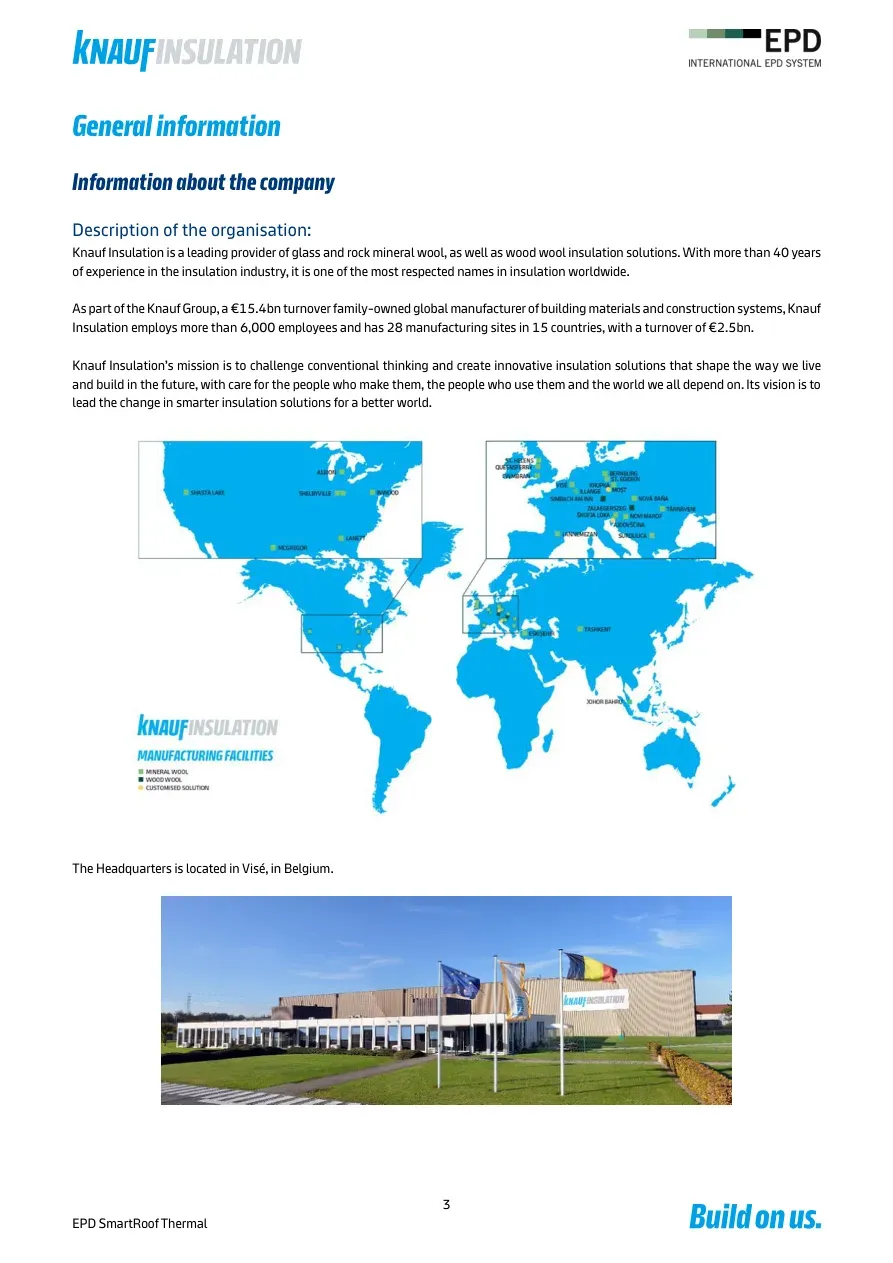
3 EPD SmartRoof Thermal, Holzbau Fassaden-Dämmplatte HFD (STD) General information Information about the company Description of the organisation: Knauf Insulation is a leading provider of glass and rock mineral wool, as well as wood wool insulation solutions. With more than 40 years of experience in the insulation industry, it is one of the most respected names in insulation worldwide. As part of the Knauf Group, a €15.4bn turnover family-owned global manufacturer of building materials and construction systems, Knauf Insulation employs more than 6,000 employees and has 28 manufacturing sites in 15 countries, with a turnover of €2.5bn. Knauf Insulation’s mission is to challenge conventional thinking and create innovative insulation solutions that shape the way we live and build in the future, with care for the people who make them, the people who use them and the world we all depend on. Its vision is to lead the change in smarter insulation solutions for a better world. The Headquarters is located in Visé, in Belgium.
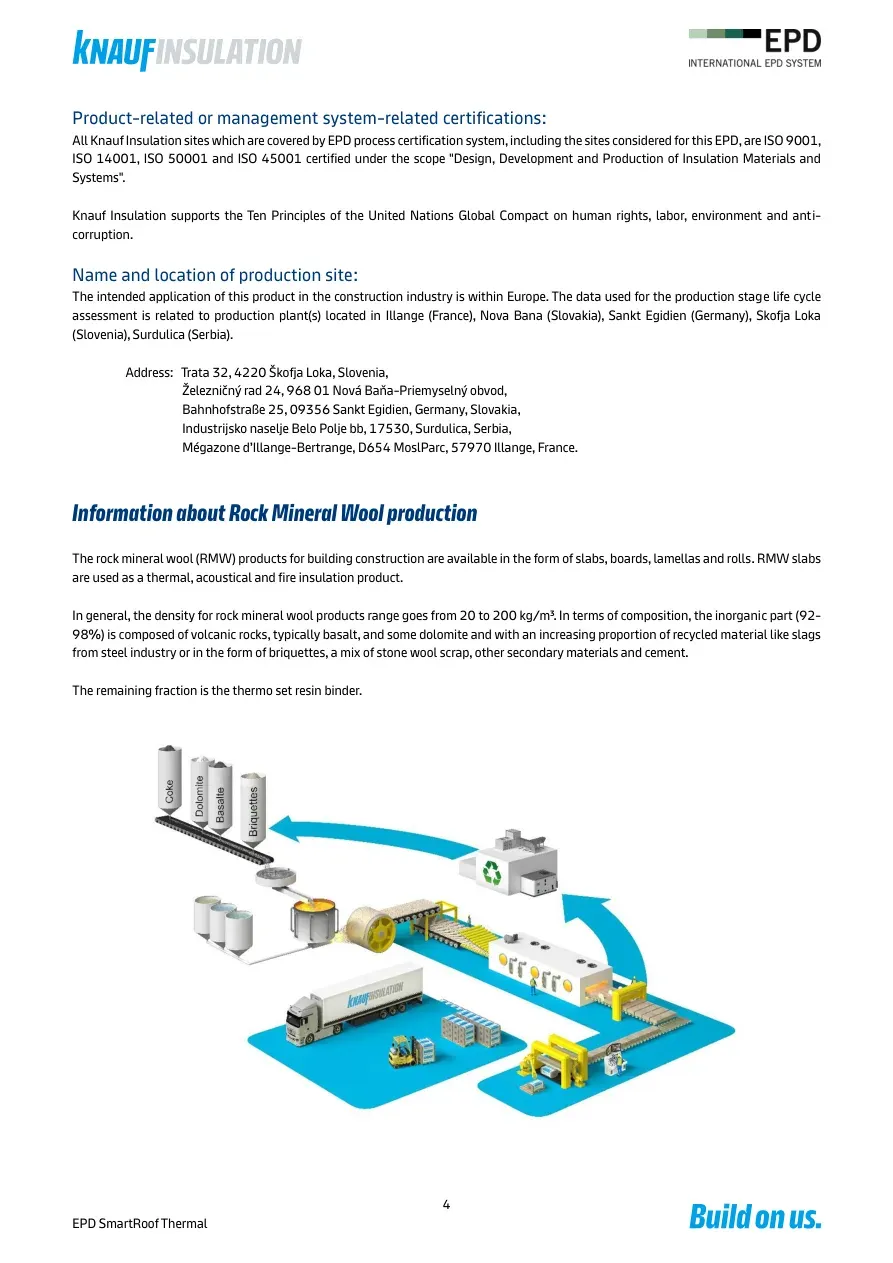
4 EPD SmartRoof Thermal, Holzbau Fassaden-Dämmplatte HFD (STD) Product-related or management system-related certifications: All Knauf Insulation sites which are covered by EPD process certification system, including the sites considered for this EPD, are ISO 9001, ISO 14001, ISO 50001 and ISO 45001 certified under the scope "Design, Development and Production of Insulation Materials and Systems". Knauf Insulation supports the Ten Principles of the United Nations Global Compact on human rights, labor, environment and anti-corruption. Name and location of production site: The intended application of this product in the construction industry is within Europe. The data used for the production stage life cycle assessment is related to production plant(s) located in Illange (France), Nova Bana (Slovakia), Sankt Egidien (Germany), Skofja Loka (Slovenia), Surdulica (Serbia). Address: Trata 32, 4220 Škofja Loka, Slovenia, Železničný rad 24, 968 01 Nová Baňa-Priemyselný obvod, Bahnhofstraße 25, 09356 Sankt Egidien, Germany, Slovakia, Industrijsko naselje Belo Polje bb, 17530, Surdulica, Serbia, Mégazone d’Illange-Bertrange, D654 MoslParc, 57970 Illange, France. Information about Rock Mineral Wool production The rock mineral wool (RMW) products for building construction are available in the form of slabs, boards, lamellas and rolls. RMW slabs are used as a thermal, acoustical and fire insulation product. In general, the density for rock mineral wool products range goes from 20 to 200 kg/m³. In terms of composition, the inorganic part (92-98%) is composed of volcanic rocks, typically basalt, and some dolomite and with an increasing proportion of recycled material like slags from steel industry or in the form of briquettes, a mix of stone wool scrap, other secondary materials and cement. The remaining fraction is the thermo set resin binder.
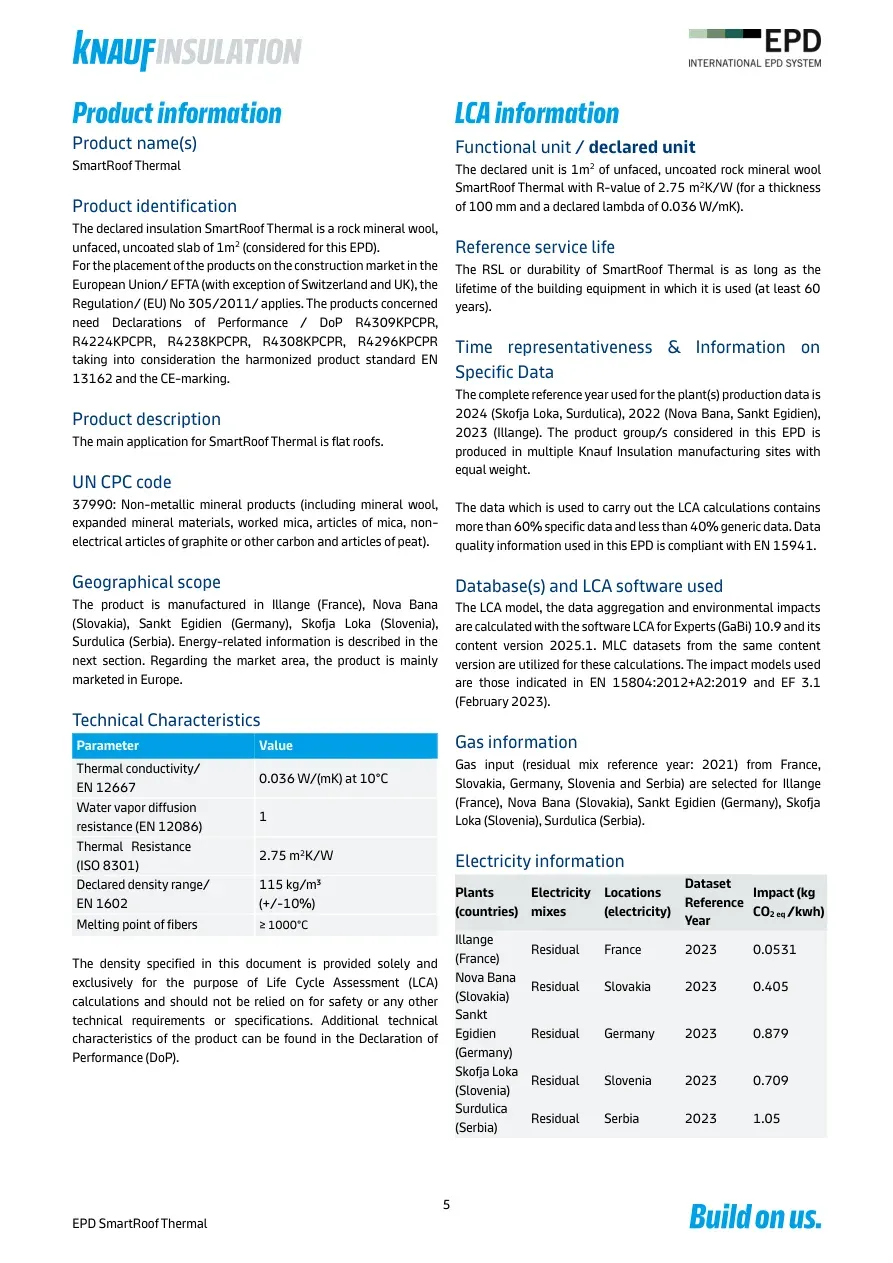
5 EPD SmartRoof Thermal, Holzbau Fassaden-Dämmplatte HFD (STD) Product information Product name(s) SmartRoof Thermal, Holzbau Fassaden-Dämmplatte HFD (STD) Product identification The declared insulation SmartRoof Thermal, Holzbau Fassaden-Dämmplatte HFD (STD) is a rock mineral wool, unfaced, uncoated slab of 1m2 (considered for this EPD). For the placement of the products on the construction market in the European Union/ EFTA (with exception of Switzerland and UK), the Regulation/ (EU) No 305/2011/ applies. The products concerned need Declarations of Performance / DoP R4309KPCPR, R4224KPCPR, R4238KPCPR, R4308KPCPR, R4296KPCPR taking into consideration the harmonized product standard EN 13162 and the CE-marking. Product description The main application for SmartRoof Thermalis flat roofs. For Holzbau Fassaden-Dämmplatte HFD (STD), is Timber Frame Prefab. UN CPC code 37990: Non-metallic mineral products (including mineral wool, expanded mineral materials, worked mica, articles of mica, non-electrical articles of graphite or other carbon and articles of peat). Geographical scope The product is manufactured in Illange (France), Nova Bana (Slovakia), Sankt Egidien (Germany), Skofja Loka (Slovenia), Surdulica (Serbia). Energy-related information is described in the next section. Regarding the market area, the product is mainly marketed in Europe. Technical Characteristics Parameter Value Thermal conductivity/ EN 12667 0.036 W/(mK) at 10°C Water vapor diffusion resistance (EN 12086) 1 Thermal Resistance (ISO 8301) 2.75 m2K/W Declared density range/ EN 1602 115 kg/m³ (+/-10%) Melting point of fibers ≥ 1000°C The density specified in this document is provided solely and exclusively for the purpose of Life Cycle Assessment (LCA) calculations and should not be relied on for safety or any other technical requirements or specifications. Additional technical characteristics of the product can be found in the Declaration of Performance (DoP).LCA information Functional unit / declared unit The declared unit is 1m2 of unfaced, uncoated rock mineral wool SmartRoof Thermal, Holzbau Fassaden-Dämmplatte HFD (STD) with R-value of 2.75 m2K/W (for a thickness of 100 mm and a declared lambda of 0.036 W/mK). Reference service life The RSL or durability of SmartRoof Thermal, Holzbau Fassaden-Dämmplatte HFD (STD) is as long as the lifetime of the building equipment in which it is used (at least 60 years). Time representativeness & Information on Specific Data The complete reference year used for the plant(s) production data is 2024 (Skofja Loka, Surdulica), 2022 (Nova Bana, Sankt Egidien), 2023 (Illange). The product group/s considered in this EPD is produced in multiple Knauf Insulation manufacturing sites with equal weight. The data which is used to carry out the LCA calculations contains more than 60% specific data and less than 40% generic data. Data quality information used in this EPD is compliant with EN 15941. Database(s) and LCA software used The LCA model, the data aggregation and environmental impacts are calculated with the software LCA for Experts (GaBi) 10.9 and its content version 2025.1. MLC datasets from the same content version are utilized for these calculations. The impact models used are those indicated in EN 15804:2012+A2:2019 and EF 3.1 (February 2023). Gas information Gas input (residual mix reference year: 2021) from France, Slovakia, Germany, Slovenia and Serbia) are selected for Illange (France), Nova Bana (Slovakia), Sankt Egidien (Germany), Skofja Loka (Slovenia), Surdulica (Serbia). Electricity information Plants (countries) Electricity mixes Locations (electricity) Dataset Reference Year Impact (kg CO2 eq /kwh) Illange (France) Residual France 2023 0.0531 Nova Bana (Slovakia) Residual Slovakia 2023 0.405 Sankt Egidien (Germany) Residual Germany 2023 0.879 Skofja Loka (Slovenia) Residual Slovenia 2023 0.709 Surdulica (Serbia) Residual Serbia 2023 1.05
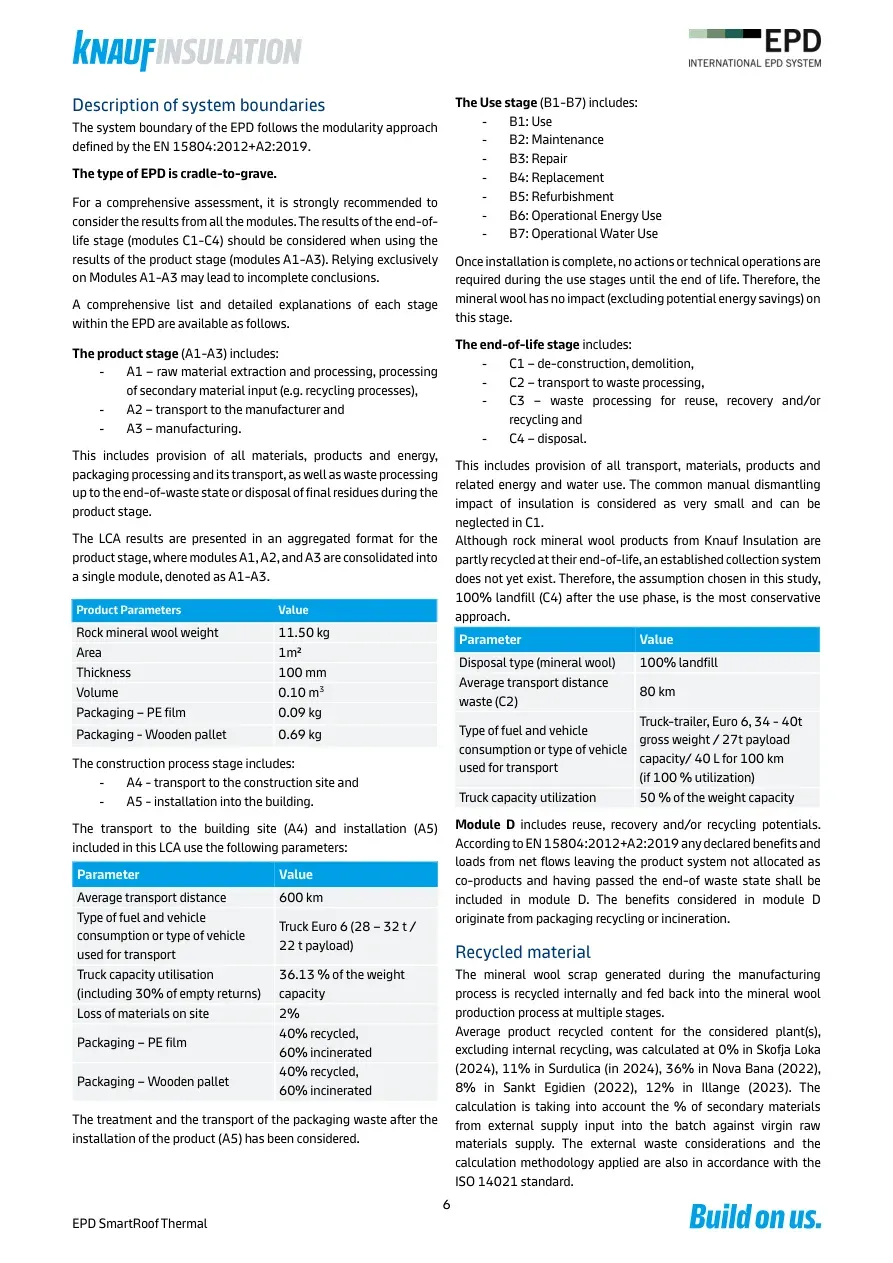
6 EPD SmartRoof Thermal, Holzbau Fassaden-Dämmplatte HFD (STD) Description of system boundaries The system boundary of the EPD follows the modularity approach defined by the EN 15804:2012+A2:2019. The type of EPD is cradle-to-grave. For a comprehensive assessment, it is strongly recommended to consider the results from all the modules. The results of the end-of-life stage (modules C1-C4) should be considered when using the results of the product stage (modules A1-A3). Relying exclusively on Modules A1-A3 may lead to incomplete conclusions. A comprehensive list and detailed explanations of each stage within the EPD are available as follows. The product stage (A1-A3) includes: - A1 – raw material extraction and processing, processing of secondary material input (e.g. recycling processes), - A2 – transport to the manufacturer and - A3 – manufacturing. This includes provision of all materials, products and energy, packaging processing and its transport, as well as waste processing up to the end-of-waste state or disposal of final residues during the product stage. The LCA results are presented in an aggregated format for the product stage, where modules A1, A2, and A3 are consolidated into a single module, denoted as A1-A3. Product Parameters Value Rock mineral wool weight 11.50 kg Area 1m² Thickness 100 mm Volume 0.10 m3 Packaging – PE film 0.09 kg Packaging - Wooden pallet 0.69 kg The construction process stage includes: - A4 - transport to the construction site and - A5 - installation into the building. The transport to the building site (A4) and installation (A5) included in this LCA use the following parameters: The treatment and the transport of the packaging waste after the installation of the product (A5) have been considered. The Use stage (B1-B7) includes: - B1: Use - B2: Maintenance - B3: Repair - B4: Replacement - B5: Refurbishment - B6: Operational Energy Use - B7: Operational Water Use Once installation is complete, no actions or technical operations are required during the use stages until the end of life. Therefore, the mineral wool has no impact (excluding potential energy savings) on this stage. The end-of-life stage includes: - C1 – de-construction, demolition, - C2 – transport to waste processing, - C3 – waste processing for reuse, recovery and/or recycling and - C4 – disposal. This includes provision of all transport, materials, products and related energy and water use. The common manual dismantling impact of insulation is considered as very small and can be neglected in C1. Although rock mineral wool products from Knauf Insulation are partly recycled at their end-of-life, an established collection system does not yet exist. Therefore, the assumption chosen in this study, 100% landfill (C4) after the use phase, is the most conservative approach. Module D includes reuse, recovery and/or recycling potentials. According to EN 15804:2012+A2:2019 any declared benefits and loads from net flows leaving the product system not allocated as co-products and having passed the end-of waste state shall be included in module D. The benefits considered in module D originate from packaging recycling or incineration. Recycled material The mineral wool scrap generated during the manufacturing process is recycled internally and fed back into the mineral wool production process at multiple stages. Average product recycled content for the considered plant(s), excluding internal recycling, was calculated at 0% in Skofja Loka (2024), 11% in Surdulica (in 2024), 36% in Nova Bana (2022), 8% in Sankt Egidien (2022), 12% in Illange (2023). The calculation is taking into account the % of secondary materials from external supply input into the batch against virgin raw materials supply. The external waste considerations and the calculation methodology applied are also in accordance with the ISO 14021 standard. Parameter Value Average transport distance 600 km Type of fuel and vehicle consumption or type of vehicle used for transport Truck Euro 6 (28 – 32 t / 22 t payload) Truck capacity utilisation (including 30% of empty returns) 36.13 % of the weight capacity Loss of materials on site 2% Packaging – PE film 40% recycled, 60% incinerated Packaging – Wooden pallet 40% recycled, 60% incinerated Parameter Value Disposal type (mineral wool) 100% landfill Average transport distance waste (C2) 80 km Type of fuel and vehicle consumption or type of vehicle used for transport Truck-trailer, Euro 6, 34 - 40t gross weight / 27t payload capacity/ 40 L for 100 km (if 100 % utilization) Truck capacity utilization 50 % of the weight capacity
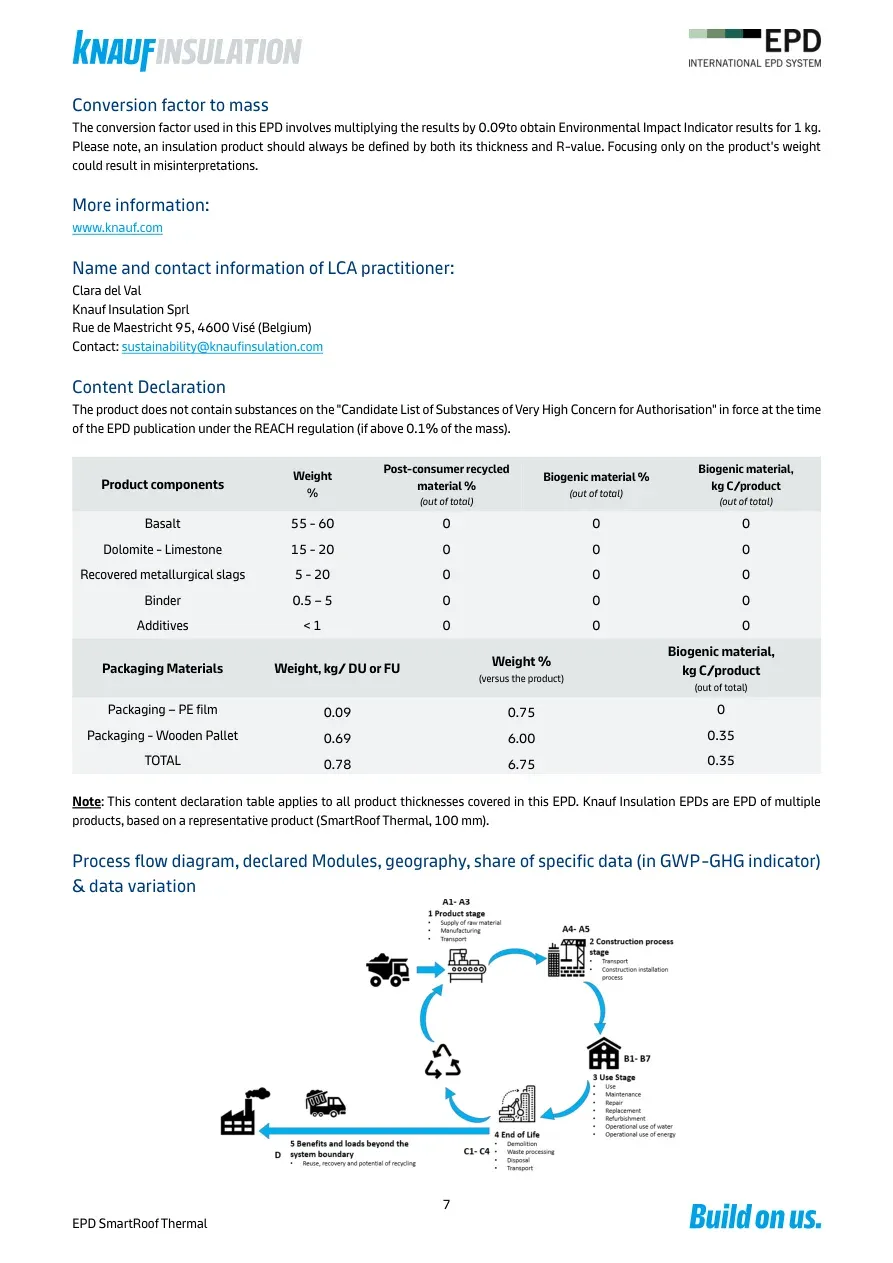
7 EPD SmartRoof Thermal, Holzbau Fassaden-Dämmplatte HFD (STD) Conversion factor to mass The conversion factor used in this EPD involves multiplying the results by 0.09to obtain Environmental Impact Indicator results for 1 kg. Please note, an insulation product should always be defined by both its thickness and R-value. Focusing only on the product's weight could result in misinterpretations. More information: www.knauf.com Name and contact information of LCA practitioner: Clara del Val Knauf Insulation Sprl Rue de Maestricht 95, 4600 Visé (Belgium) Contact: sustainability@knaufinsulation.com Content Declaration The product does not contain substances on the "Candidate List of Substances of Very High Concern for Authorisation" in force at the time of the EPD publication under the REACH regulation (if above 0.1% of the mass). Product components Weight % Post-consumer recycled material % (out of total) Biogenic material % (out of total) Biogenic material, kg C/product (out of total) Basalt 55 - 60 0 0 0 Dolomite - Limestone 15 - 20 0 0 0 Recovered metallurgical slags 5 - 50 0 0 0 Binder 0.5 – 5 0 0 0 Additives < 1 0 0 0 Packaging Materials Weight, kg/ DU or FU Weight % (versus the product) Biogenic material, kg C/product (out of total) Packaging – PE film 0.09 0.75 0 Packaging - Wooden Pallet 0.69 6.00 0.35 TOTAL 0.78 6.75 0.35 Note: This content declaration table applies to all product thicknesses covered in this EPD. Knauf Insulation EPDs are EPD of multiple products, based on a representative product (SmartRoof Thermal, Holzbau Fassaden-Dämmplatte HFD (STD), 100 mm). Process flow diagram, declared Modules, geography, share of specific data (in GWP-GHG indicator) & data variation
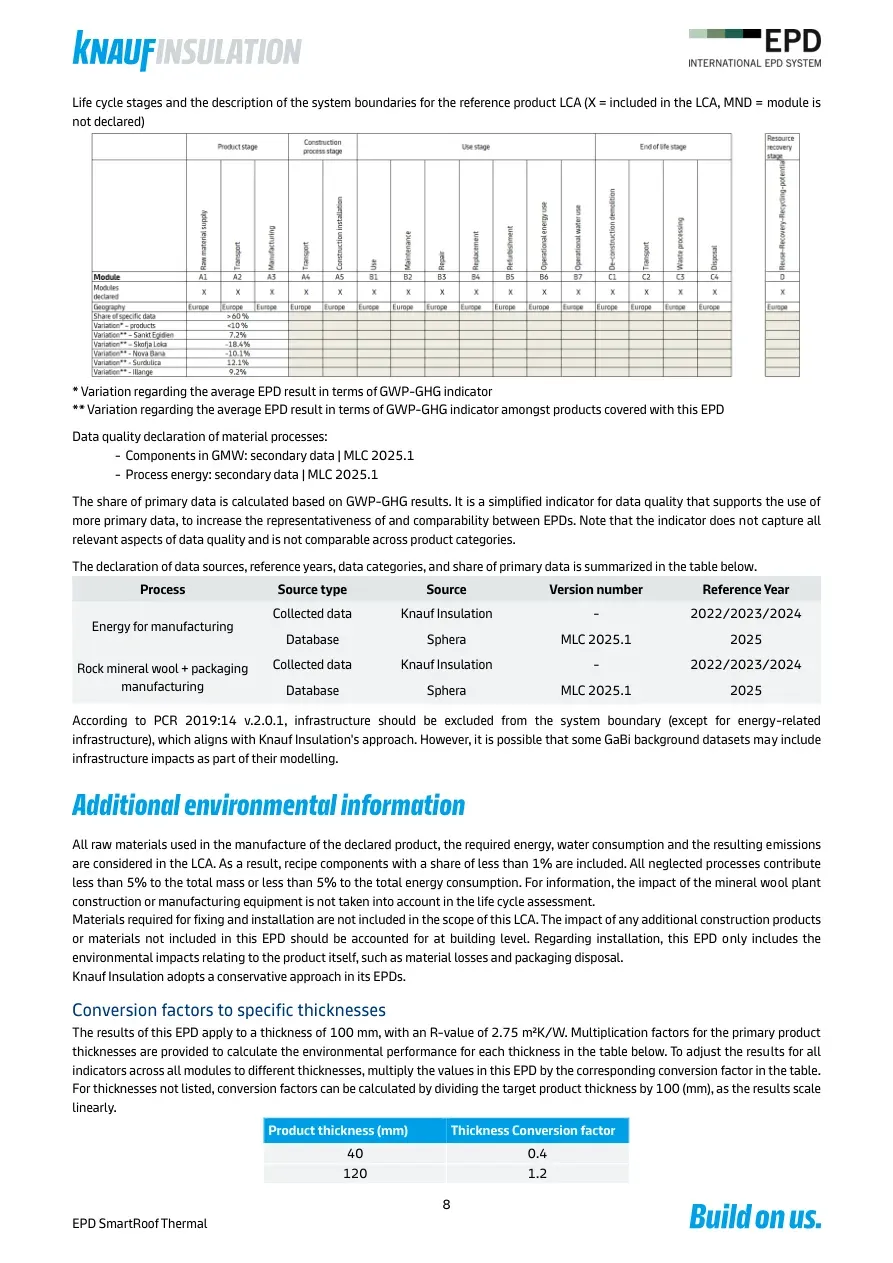
8 EPD SmartRoof Thermal, Holzbau Fassaden-Dämmplatte HFD (STD) Life cycle stages and the description of the system boundaries for the reference product LCA (X = included in the LCA, MND = module is not declared) * Variation regarding the average EPD result in terms of GWP-GHG indicator ** Variation regarding the average EPD result in terms of GWP-GHG indicator amongst products covered with this EPD Data quality declaration of material processes: - Components in GMW: secondary data | MLC 2025.1 - Process energy: secondary data | MLC 2025.1 The share of primary data is calculated based on GWP-GHG results. It is a simplified indicator for data quality that supports the use of more primary data, to increase the representativeness of and comparability between EPDs. Note that the indicator does not capture all relevant aspects of data quality and is not comparable across product categories. The declaration of data sources, reference years, data categories, and share of primary data is summarized in the table below. Process Source type Source Version number Reference Year Energy for manufacturing Collected data Knauf Insulation - 2022/2023/2024 Database Sphera MLC 2025.1 2025 Rock mineral wool + packaging manufacturing Collected data Knauf Insulation - 2022/2023/2024 Database Sphera MLC 2025.1 2025 According to PCR 2019:14 v.2.0.1, infrastructure should be excluded from the system boundary (except for energy-related infrastructure), which aligns with Knauf Insulation's approach. However, it is possible that some GaBi background datasets may include infrastructure impacts as part of their modelling. Additional environmental information All raw materials used in the manufacture of the declared product, the required energy, water consumption and the resulting emissions are considered in the LCA. As a result, recipe components with a share of less than 1% are included. All neglected processes contribute less than 5% to the total mass or less than 5% to the total energy consumption. For information, the impact of the mineral wool plant construction or manufacturing equipment is not taken into account in the life cycle assessment. Materials required for fixing and installation are not included in the scope of this LCA. The impact of any additional construction products or materials not included in this EPD should be accounted for at building level. Regarding installation, this EPD only includes the environmental impacts relating to the product itself, such as material losses and packaging disposal. Knauf Insulation adopts a conservative approach in its EPDs. Conversion factors to specific thickness The results of this EPD apply to a thickness of 100 mm, with an R-value of 2.75 m²K/W. Multiplication factors for the primary product thicknesses are provided to calculate the environmental performance for each thickness in the table below. To adjust the results for all indicators across all modules to different thicknesses, multiply the values in this EPD by the corresponding conversion factor in the table. For thickness not listed, conversion factors can be calculated by dividing the target product thickness by 100 (mm), as the results scale linearly. Product thickness (mm) Thickness Conversion factor 40 0.4 120 1.2
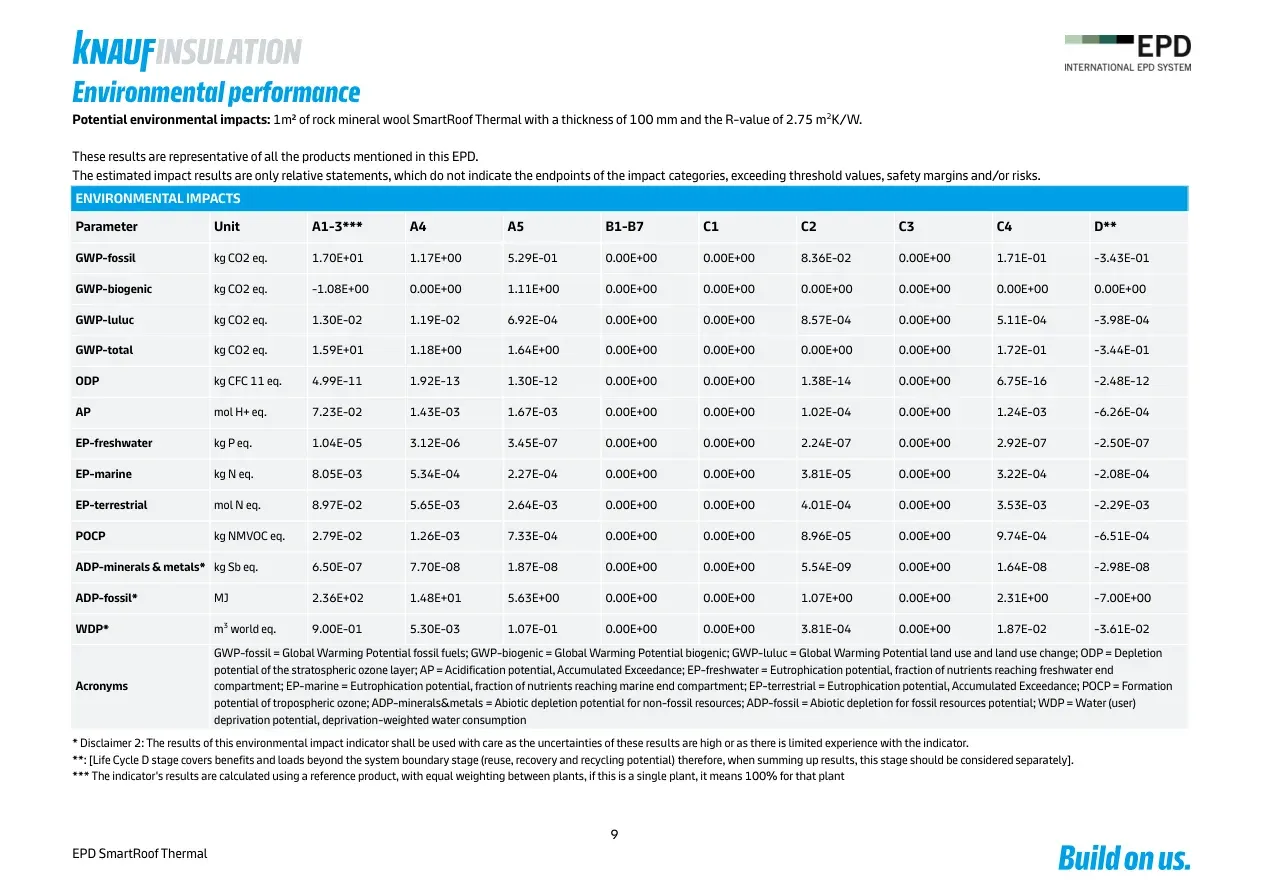
9 EPD SmartRoof Thermal, Holzbau Fassaden-Dämmplatte HFD (STD) Environmental performance Potential environmental impacts: 1m² of rock mineral wool SmartRoof Thermal, Holzbau Fassaden-Dämmplatte HFD (STD) with a thickness of 100 mm and the R-value of 2.75 m2K/W. These results are representative of all the products mentioned in this EPD. The estimated impact results are only relative statements, which do not indicate the endpoints of the impact categories, exceeding threshold values, safety margins and/or risks. ENVIRONMENTAL IMPACTS Parameter Unit A1-3*** A4 A5 B1-B7 C1 C2 C3 C4 D** GWP-fossil kg CO2 eq. 1.70E+01 1.17E+00 5.29E-01 0.00E+00 0.00E+00 8.36E-02 0.00E+00 1.71E-01 -3.43E-01 GWP-biogenic kg CO2 eq. -1.08E+00 0.00E+00 1.11E+00 0.00E+00 0.00E+00 0.00E+00 0.00E+00 0.00E+00 0.00E+00 GWP-luluc kg CO2 eq. 1.30E-02 1.19E-02 6.92E-04 0.00E+00 0.00E+00 8.57E-04 0.00E+00 5.11E-04 -3.98E-04 GWP-total kg CO2 eq. 1.59E+01 1.18E+00 1.64E+00 0.00E+00 0.00E+00 8.45E-02 0.00E+00 1.72E-01 -3.44E-01 ODP kg CFC 11 eq. 4.99E-11 1.92E-13 1.30E-12 0.00E+00 0.00E+00 1.38E-14 0.00E+00 6.75E-16 -2.48E-12 AP mol H+ eq. 7.23E-02 1.43E-03 1.67E-03 0.00E+00 0.00E+00 1.02E-04 0.00E+00 1.24E-03 -6.26E-04 EP-freshwater kg P eq. 1.04E-05 3.12E-06 3.45E-07 0.00E+00 0.00E+00 2.24E-07 0.00E+00 2.92E-07 -2.50E-07 EP-marine kg N eq. 8.05E-03 5.34E-04 2.27E-04 0.00E+00 0.00E+00 3.81E-05 0.00E+00 3.22E-04 -2.08E-04 EP-terrestrial mol N eq. 8.97E-02 5.65E-03 2.64E-03 0.00E+00 0.00E+00 4.01E-04 0.00E+00 3.53E-03 -2.29E-03 POCP kg NMVOC eq. 2.79E-02 1.26E-03 7.33E-04 0.00E+00 0.00E+00 8.96E-05 0.00E+00 9.74E-04 -6.51E-04 ADP-minerals & metals* kg Sb eq. 6.50E-07 7.70E-08 1.87E-08 0.00E+00 0.00E+00 5.54E-09 0.00E+00 1.64E-08 -2.98E-08 ADP-fossil* MJ 2.36E+02 1.48E+01 5.63E+00 0.00E+00 0.00E+00 1.07E+00 0.00E+00 2.31E+00 -7.00E+00 WDP* m3 world eq. 9.00E-01 5.30E-03 1.07E-01 0.00E+00 0.00E+00 3.81E-04 0.00E+00 1.87E-02 -3.61E-02 Acronyms GWP-fossil = Global Warming Potential fossil fuels; GWP-biogenic = Global Warming Potential biogenic; GWP-luluc = Global Warming Potential land use and land use change; ODP = Depletion potential of the stratospheric ozone layer; AP = Acidification potential, Accumulated Exceedance; EP-freshwater = Eutrophication potential, fraction of nutrients reaching freshwater end compartment; EP-marine = Eutrophication potential, fraction of nutrients reaching marine end compartment; EP-terrestrial = Eutrophication potential, Accumulated Exceedance; POCP = Formation potential of tropospheric ozone; ADP-minerals&metals = Abiotic depletion potential for non-fossil resources; ADP-fossil = Abiotic depletion for fossil resources potential; WDP = Water (user) deprivation potential, deprivation-weighted water consumption * Disclaimer 2: The results of this environmental impact indicator shall be used with care as the uncertainties of these results are high or as there is limited experience with the indicator. **: [Life Cycle D stage covers benefits and loads beyond the system boundary stage (reuse, recovery and recycling potential) therefore, when summing up results, this stage should be considered separately]. *** The indicator's results are calculated using a reference product, with equal weighting between plants, if this is a single plant, it means 100% for that plant
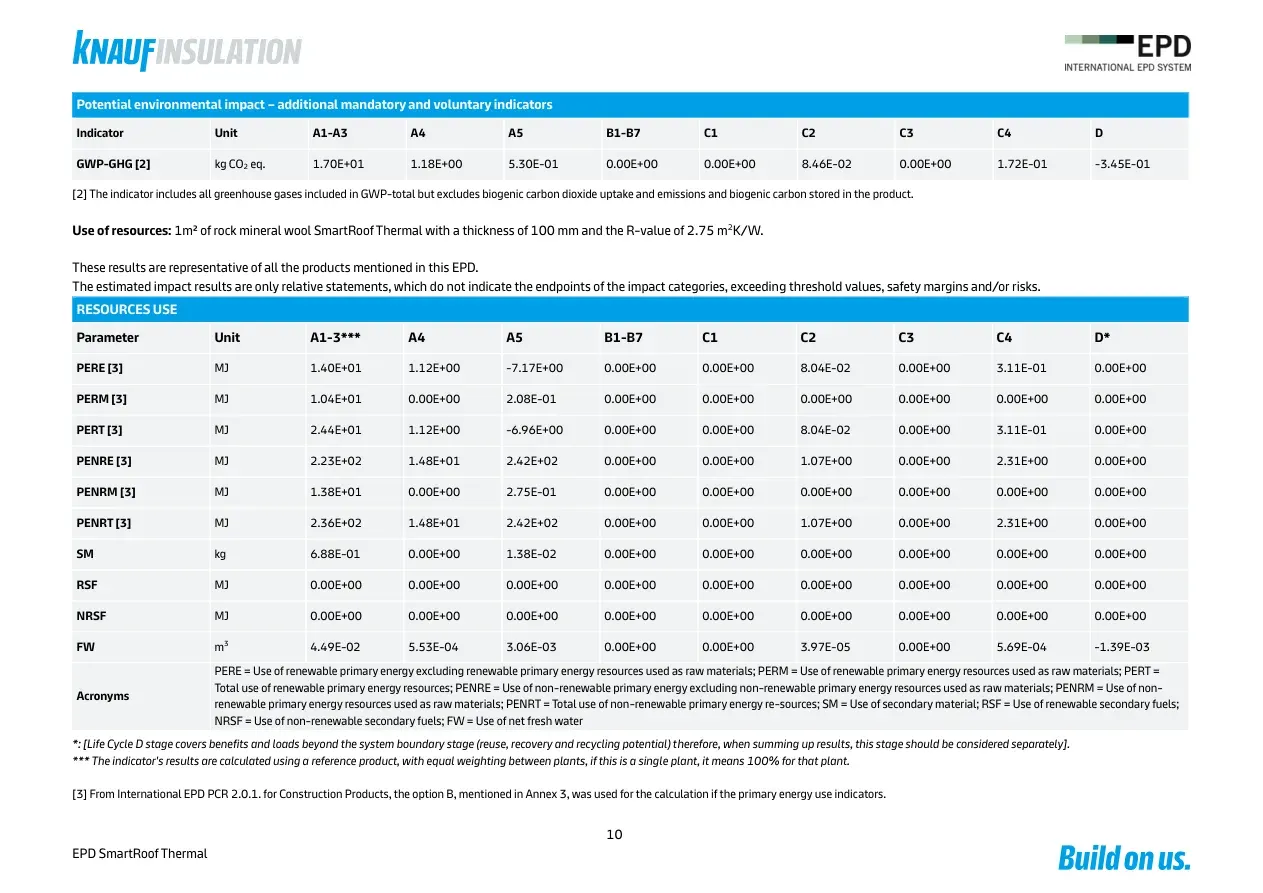
10 EPD SmartRoof Thermal, Holzbau Fassaden-Dämmplatte HFD (STD) [2] The indicator includes all greenhouse gases included in GWP-total but excludes biogenic carbon dioxide uptake and emissions and biogenic carbon stored in the product. Use of resources: 1m² of rock mineral wool SmartRoof Thermal, Holzbau Fassaden-Dämmplatte HFD (STD) with a thickness of 100 mm and the R-value of 2.75 m2K/W. These results are representative of all the products mentioned in this EPD. The estimated impact results are only relative statements, which do not indicate the endpoints of the impact categories, exceeding threshold values, safety margins and/or risks. RESOURCES USE Parameter Unit A1-3*** A4 A5 B1-B7 C1 C2 C3 C4 D* PERE [3] MJ 1.40E+01 1.12E+00 -7.17E+00 0.00E+00 0.00E+00 8.04E-02 0.00E+00 3.11E-01 0.00E+00 PERM [3] MJ 1.04E+01 0.00E+00 2.08E-01 0.00E+00 0.00E+00 0.00E+00 0.00E+00 0.00E+00 0.00E+00 PERT [3] MJ 2.44E+01 1.12E+00 -6.96E+00 0.00E+00 0.00E+00 8.04E-02 0.00E+00 3.11E-01 0.00E+00 PENRE [3] MJ 2.23E+02 1.48E+01 2.42E+02 0.00E+00 0.00E+00 1.07E+00 0.00E+00 2.31E+00 0.00E+00 PENRM [3] MJ 1.38E+01 0.00E+00 2.75E-01 0.00E+00 0.00E+00 0.00E+00 0.00E+00 0.00E+00 0.00E+00 PENRT [3] MJ 2.36E+02 1.48E+01 2.42E+02 0.00E+00 0.00E+00 1.07E+00 0.00E+00 2.31E+00 0.00E+00 SM kg 6.88E-01 0.00E+00 1.38E-02 0.00E+00 0.00E+00 0.00E+00 0.00E+00 0.00E+00 0.00E+00 RSF MJ 0.00E+00 0.00E+00 0.00E+00 0.00E+00 0.00E+00 0.00E+00 0.00E+00 0.00E+00 0.00E+00 NRSF MJ 0.00E+00 0.00E+00 0.00E+00 0.00E+00 0.00E+00 0.00E+00 0.00E+00 0.00E+00 0.00E+00 FW m3 4.49E-02 5.53E-04 3.06E-03 0.00E+00 0.00E+00 3.97E-05 0.00E+00 5.69E-04 -1.39E-03 Acronyms PERE = Use of renewable primary energy excluding renewable primary energy resources used as raw materials; PERM = Use of renewable primary energy resources used as raw materials; PERT = Total use of renewable primary energy resources; PENRE = Use of non-renewable primary energy excluding non-renewable primary energy resources used as raw materials; PENRM = Use of non-renewable primary energy resources used as raw materials; PENRT = Total use of non-renewable primary energy re-sources; SM = Use of secondary material; RSF = Use of renewable secondary fuels; NRSF = Use of non-renewable secondary fuels; FW = Use of net fresh water *: [Life Cycle D stage covers benefits and loads beyond the system boundary stage (reuse, recovery and recycling potential) therefore, when summing up results, this stage should be considered separately]. *** The indicator's results are calculated using a reference product, with equal weighting between plants, if this is a single plant, it means 100% for that plant. [3] From International EPD PCR 2.0.1. for Construction Products, the option B, mentioned in Annex 3, was used for the calculation if the primary energy use indicators. Potential environmental impact – additional mandatory and voluntary indicators Indicator Unit A1-A3 A4 A5 B1-B7 C1 C2 C3 C4 D GWP-GHG [2] kg CO2 eq. 1.70E+01 1.18E+00 5.30E-01 0.00E+00 0.00E+00 8.46E-02 0.00E+00 1.72E-01 -3.45E-01
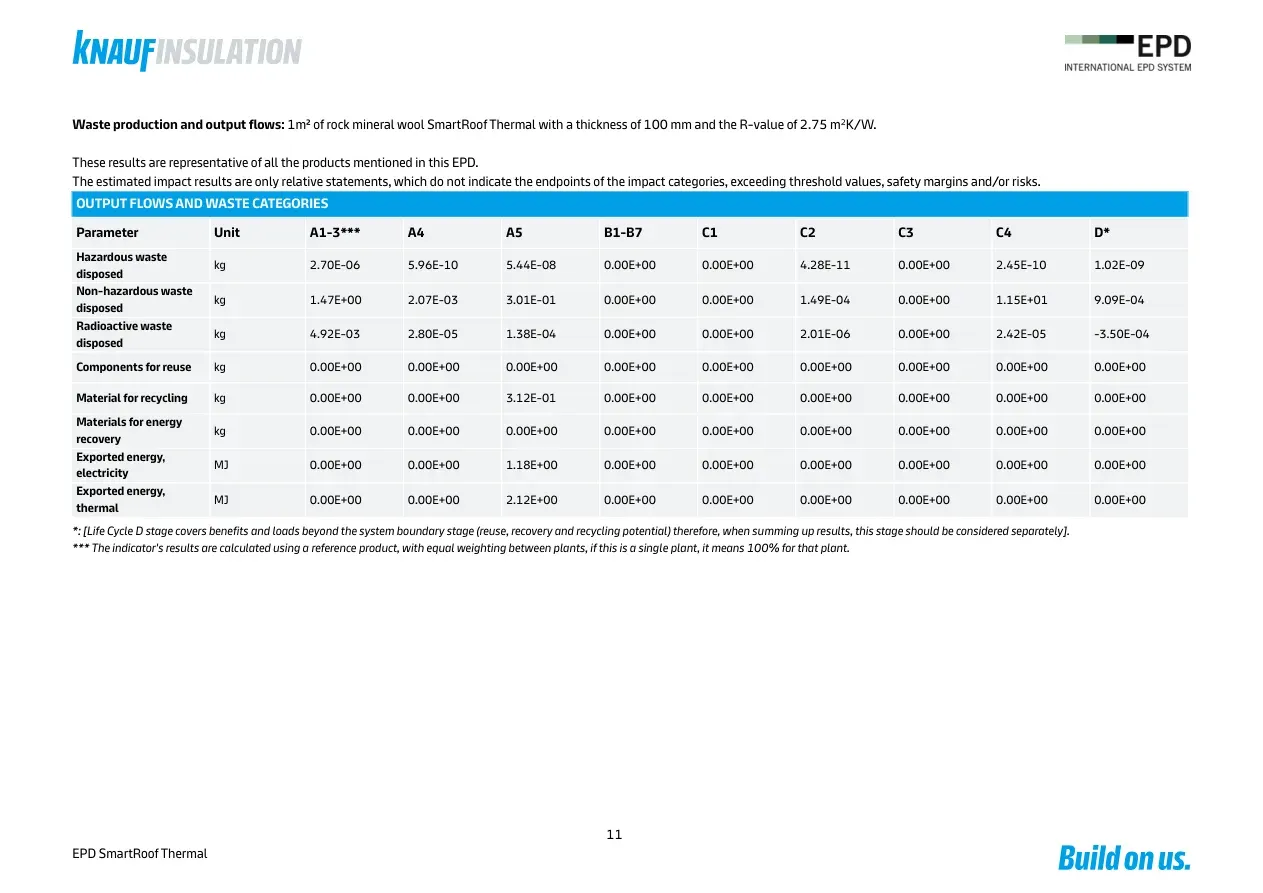
11 EPD SmartRoof Thermal, Holzbau Fassaden-Dämmplatte HFD (STD) Waste production and output flows: 1m² of rock mineral wool SmartRoof Thermal, Holzbau Fassaden-Dämmplatte HFD (STD) with a thickness of 100 mm and the R-value of 2.75 m2K/W. These results are representative of all the products mentioned in this EPD. The estimated impact results are only relative statements, which do not indicate the endpoints of the impact categories, exceeding threshold values, safety margins and/or risks. OUTPUT FLOWS AND WASTE CATEGORIES Parameter Unit A1-3*** A4 A5 B1-B7 C1 C2 C3 C4 D* Hazardous waste disposed kg 2.70E-06 5.96E-10 5.44E-08 0.00E+00 0.00E+00 4.28E-11 0.00E+00 2.45E-10 1.02E-09 Non-hazardous waste disposed kg 1.47E+00 2.07E-03 3.01E-01 0.00E+00 0.00E+00 1.49E-04 0.00E+00 1.15E+01 9.09E-04 Radioactive waste disposed kg 4.92E-03 2.80E-05 1.38E-04 0.00E+00 0.00E+00 2.01E-06 0.00E+00 2.42E-05 -3.50E-04 Components for reuse kg 0.00E+00 0.00E+00 0.00E+00 0.00E+00 0.00E+00 0.00E+00 0.00E+00 0.00E+00 0.00E+00 Material for recycling kg 0.00E+00 0.00E+00 3.12E-01 0.00E+00 0.00E+00 0.00E+00 0.00E+00 0.00E+00 0.00E+00 Materials for energy recovery kg 0.00E+00 0.00E+00 0.00E+00 0.00E+00 0.00E+00 0.00E+00 0.00E+00 0.00E+00 0.00E+00 Exported energy, electricity MJ 0.00E+00 0.00E+00 1.18E+00 0.00E+00 0.00E+00 0.00E+00 0.00E+00 0.00E+00 0.00E+00 Exported energy, thermal MJ 0.00E+00 0.00E+00 2.12E+00 0.00E+00 0.00E+00 0.00E+00 0.00E+00 0.00E+00 0.00E+00 *: [Life Cycle D stage covers benefits and loads beyond the system boundary stage (reuse, recovery and recycling potential) therefore, when summing up results, this stage should be considered separately]. *** The indicator's results are calculated using a reference product, with equal weighting between plants, if this is a single plant, it means 100% for that plant.
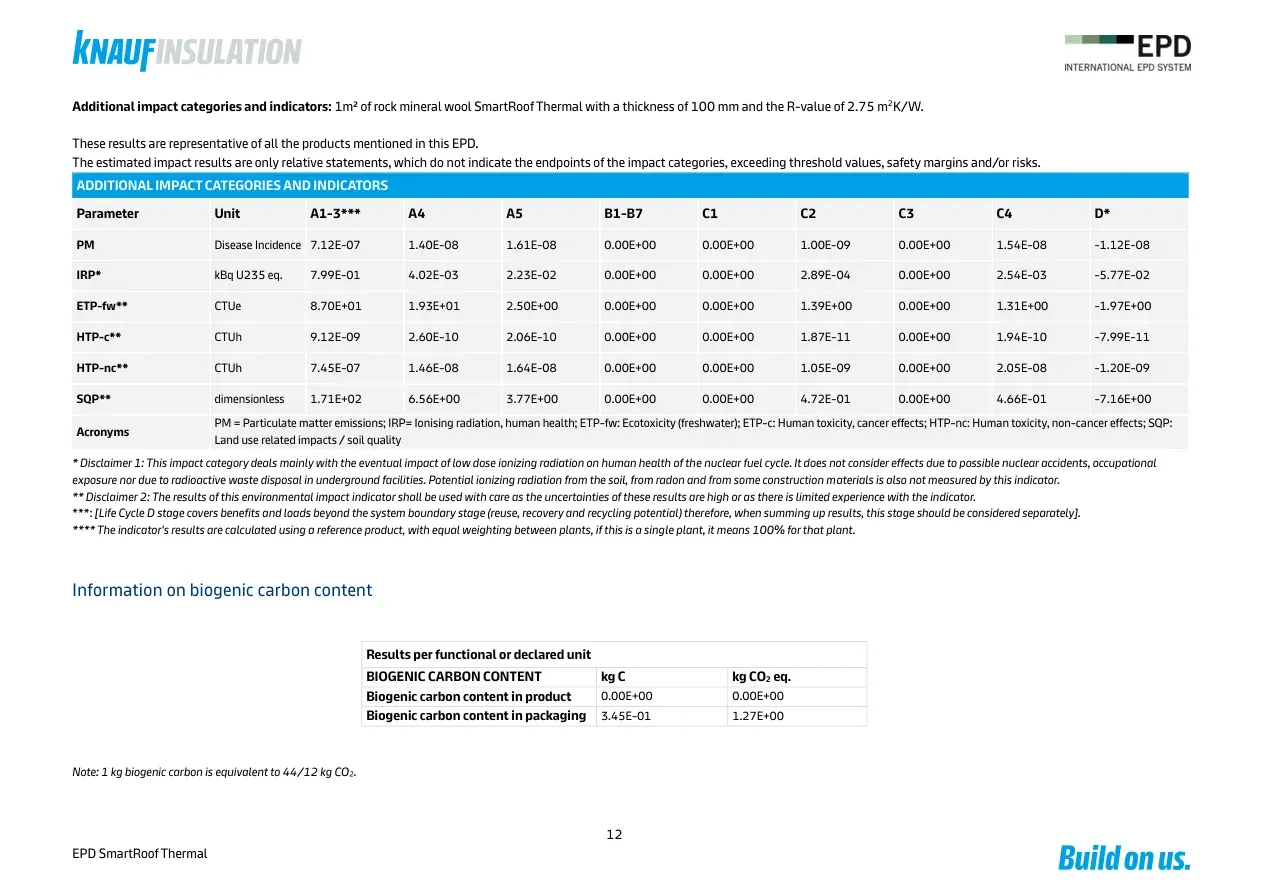
12 EPD SmartRoof Thermal, Holzbau Fassaden-Dämmplatte HFD (STD) Additional impact categories and indicators: 1m² of rock mineral wool SmartRoof Thermal, Holzbau Fassaden-Dämmplatte HFD (STD) with a thickness of 100 mm and the R-value of 2.75 m2K/W. These results are representative of all the products mentioned in this EPD. The estimated impact results are only relative statements, which do not indicate the endpoints of the impact categories, exceeding threshold values, safety margins and/or risks. ADDITIONAL IMPACT CATEGORIES AND INDICATORS Parameter Unit A1-3*** A4 A5 B1-B7 C1 C2 C3 C4 D* PM Disease Incidence 7.12E-07 1.40E-08 1.61E-08 0.00E+00 0.00E+00 1.00E-09 0.00E+00 1.54E-08 -1.12E-08 IRP* kBq U235 eq. 7.99E-01 4.02E-03 2.23E-02 0.00E+00 0.00E+00 2.89E-04 0.00E+00 2.54E-03 -5.77E-02 ETP-fw** CTUe 8.70E+01 1.93E+01 2.50E+00 0.00E+00 0.00E+00 1.39E+00 0.00E+00 1.31E+00 -1.97E+00 HTP-c** CTUh 9.12E-09 2.60E-10 2.06E-10 0.00E+00 0.00E+00 1.87E-11 0.00E+00 1.94E-10 -7.99E-11 HTP-nc** CTUh 7.45E-07 1.46E-08 1.64E-08 0.00E+00 0.00E+00 1.05E-09 0.00E+00 2.05E-08 -1.20E-09 SQP** dimensionless 1.71E+02 6.56E+00 3.77E+00 0.00E+00 0.00E+00 4.72E-01 0.00E+00 4.66E-01 -7.16E+00 Acronyms PM = Particulate matter emissions; IRP= Ionising radiation, human health; ETP-fw: Ecotoxicity (freshwater); ETP-c: Human toxicity, cancer effects; HTP-nc: Human toxicity, non-cancer effects; SQP: Land use related impacts / soil quality * Disclaimer 1: This impact category deals mainly with the eventual impact of low dose ionizing radiation on human health of the nuclear fuel cycle. It does not consider effects due to possible nuclear accidents, occupational exposure nor due to radioactive waste disposal in underground facilities. Potential ionizing radiation from the soil, from radon and from some construction materials is also not measured by this indicator. ** Disclaimer 2: The results of this environmental impact indicator shall be used with care as the uncertainties of these results are high or as there is limited experience with the indicator. ***: [Life Cycle D stage covers benefits and loads beyond the system boundary stage (reuse, recovery and recycling potential) therefore, when summing up results, this stage should be considered separately]. **** The indicator's results are calculated using a reference product, with equal weighting between plants, if this is a single plant, it means 100% for that plant. Information on biogenic carbon content Results per functional or declared unit BIOGENIC CARBON CONTENT kg C kg CO2 eq. Biogenic carbon content in product 0.00E+00 0.00E+00 Biogenic carbon content in packaging 3.45E-01 1.27E+00 Note: 1 kg biogenic carbon is equivalent to 44/12 kg CO2.
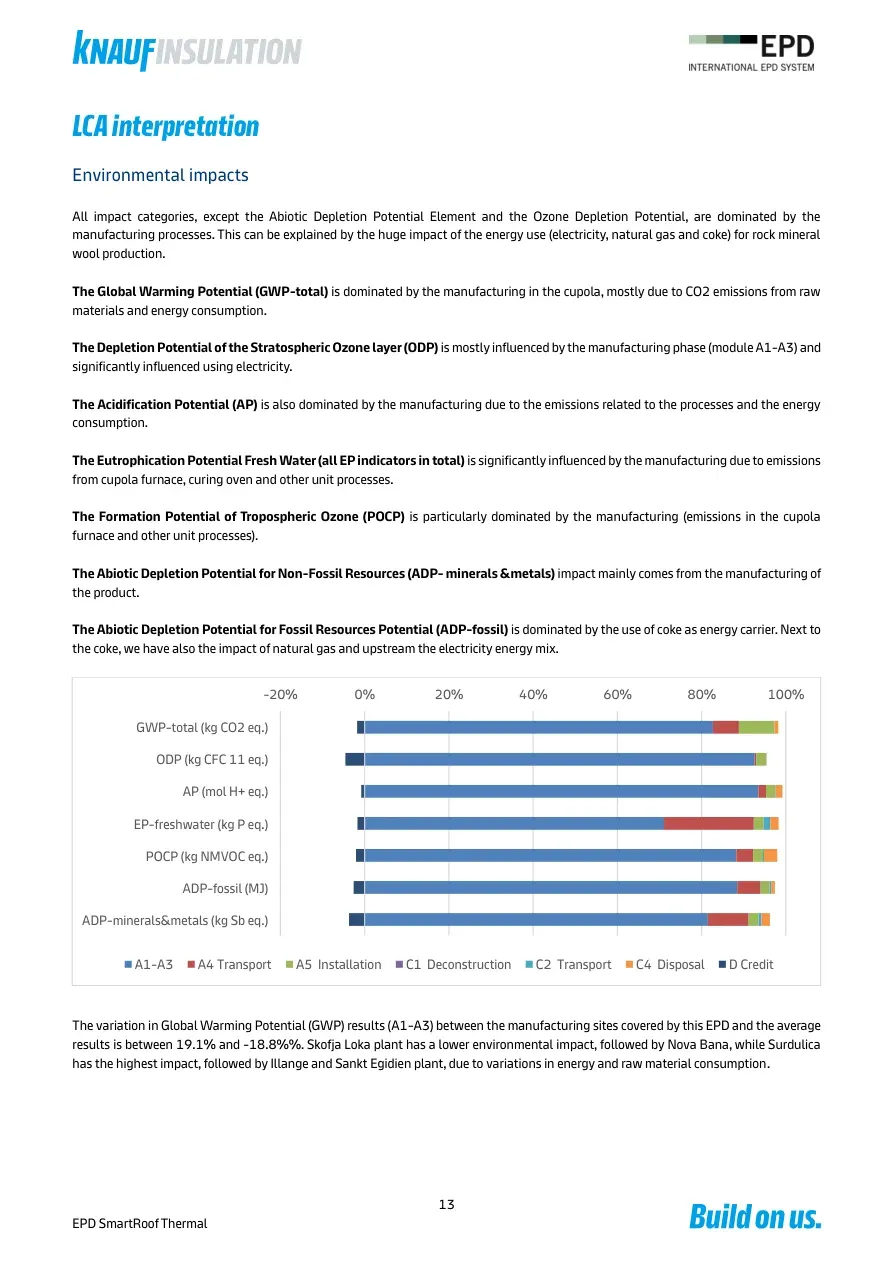
13 EPD SmartRoof Thermal, Holzbau Fassaden-Dämmplatte HFD (STD) LCA interpretation Environmental impacts All impact categories, except the Abiotic Depletion Potential Element and the Ozone Depletion Potential, are dominated by the manufacturing processes. This can be explained by the huge impact of the energy use (electricity, natural gas and coke) for rock mineral wool production. The Global Warming Potential (GWP-total) is dominated by the manufacturing in the cupola, mostly due to CO2 emissions from raw materials and energy consumption. The Depletion Potential of the Stratospheric Ozone layer (ODP) is mostly influenced by the manufacturing phase (module A1-A3) and significantly influenced using electricity. The Acidification Potential (AP) is also dominated by the manufacturing due to the emissions related to the processes and the energy consumption. The Eutrophication Potential Fresh Water (all EP indicators in total) is significantly influenced by the manufacturing due to emissions from cupola furnace, curing oven and other unit processes. The Formation Potential of Tropospheric Ozone (POCP) is particularly dominated by the manufacturing (emissions in the cupola furnace and other unit processes). The Abiotic Depletion Potential for Non-Fossil Resources (ADP- minerals &metals) impact mainly comes from the manufacturing of the product. The Abiotic Depletion Potential for Fossil Resources Potential (ADP-fossil) is dominated by the use of coke as energy carrier. Next to the coke, we have also the impact of natural gas and upstream the electricity energy mix. The variation in Global Warming Potential (GWP) results (A1-A3) between the manufacturing sites covered by this EPD and the average results is between 19.1% and -18.8%%. Skofja Loka plant has a lower environmental impact, followed by Nova Bana, while Surdulica has the highest impact, followed by Illange and Sankt Egidien plant, due to variations in energy and raw material consumption. -20%0%20%40%60%80%100%GWP-total (kg CO2 eq.)ODP (kg CFC 11 eq.)AP (mol H+ eq.)EP-freshwater (kg P eq.)POCP (kg NMVOC eq.)ADP-fossil (MJ)ADP-minerals&metals (kg Sb eq.)A1-A3A4 TransportA5 InstallationC1 DeconstructionC2 TransportC4 DisposalD Credit
14 EPD SmartRoof Thermal, Holzbau Fassaden-Dämmplatte HFD (STD) Resources use Total Use of Non-Renewable Primary Energy Resources (PENRT) is dominated by the manufacturing of rock mineral wool products (especially due to the energy carrier, coke). Total Use of Renewable Primary Energy Resources (PERT) is dominated by the manufacturing, mostly due to electricity consumption and packaging. Version history Version Date Difference(s) versus previous version(s) Original 2025-11-07 - 2 2026-05-27 GWP-total value in C2 corrected and other small editorial updates and product name added
15 EPD SmartRoof Thermal, Holzbau Fassaden-Dämmplatte HFD (STD) Abbreviations Abbreviation Definition General Abbreviations EN European Norm (Standard) EPD Environmental Product Declaration EF Environmental Footprint GPI General Programme Instructions ISO International Organization for Standardization LCA Life Cycle Assessment PCR Product Category Rules c-PCR Complementary Product Category Rules CEN European Committee for Standardization CLC Co-location centre CPC Central product classification GHS Globally harmonized system of classification and labelling of chemicals GRI Global Reporting Initiative Environmental Impact Indicators (EN 15804) GHG Greenhouse gas GWP Global Warming Potential (kg CO₂ eq.) GWP-fossil Global Warming Potential from fossil sources (kg CO₂ eq.) GWP-biogenic Global Warming Potential from biogenic sources (kg CO₂ eq.) GWP-luluc Global Warming Potential from land use and land use change (kg CO₂ eq.) GWP-total Total Global Warming Potential (kg CO₂ eq.) GWP-GHG Global Warming Potential for greenhouse gases (kg CO₂ eq.) ODP Ozone Depletion Potential (kg CFC-11 eq.) AP Acidification Potential (mol H⁺ eq.) EP Eutrophication Potential EP-freshwater Freshwater eutrophication potential (kg P eq.) EP-marine Marine eutrophication potential (kg N eq.) EP-terrestrial Terrestrial eutrophication potential (mol N eq.) POCP Photochemical Ozone Creation Potential (kg NMVOC eq.) ADP Abiotic Depletion Potential ADP-minerals&metals Abiotic depletion potential for non-fossil resources (kg Sb eq.) ADP-fossil Abiotic depletion potential for fossil resources (MJ) WDP Water Deprivation Potential (m³) Resource Use Indicators PERE Use of renewable primary energy excluding renewable primary energy resources used as raw materials (MJ) PERM Use of renewable primary energy resources used as raw materials (MJ) PERT Total use of renewable primary energy resources (MJ) PENRE Use of non-renewable primary energy excluding non-renewable primary energy resources used as raw materials (MJ) PENRM Use of non-renewable primary energy resources used as raw materials (MJ) PENRT Total use of non-renewable primary energy resources (MJ) SM Use of secondary material (kg) RSF Use of renewable secondary fuels (MJ) NRSF Use of non-renewable secondary fuels (MJ) FW Use of net fresh water (m³) Waste Indicators HW Hazardous Waste (disposed) (kg) NHW Non-Hazardous Waste (disposed) (kg) RW Radioactive Waste (disposed) (kg)
16 EPD SmartRoof Thermal, Holzbau Fassaden-Dämmplatte HFD (STD) Output Flow Indicators CFR Components for Reuse (kg) MR Material for Recycling (kg) MER Materials for Energy Recovery (kg) EEE Exported Energy, Electricity (MJ) EET Exported Energy, Thermal (MJ) Lifecycle Stages / Modules A1 Raw material supply A2 Transport A3 Manufacturing A4 Transport to site A5 Construction/Installation B1 Use B2 Maintenance B3 Repair B4 Replacement B5 Refurbishment B6 Operational energy use B7 Operational water use C1 Deconstruction/Demolition C2 Transport to waste processing C3 Waste processing C4 Disposal D Reuse-Recovery-Recycling potential Other Relevant Terms SVHC Substances of Very High Concern EC No. European Community Number CAS No. Chemical Abstracts Service Number MJ Megajoule kg Kilogram m³ Cubic Meter NMVOC Non-Methane Volatile Organic Compounds Sb eq. Antimony Equivalents P eq. Phosphorus Equivalents N eq. Nitrogen Equivalents CFC-11 eq. Chlorofluorocarbon-11 Equivalents CO₂ eq. Carbon Dioxide Equivalents kg C Kilograms of Carbon kg CO₂ eq. Kilograms of Carbon Dioxide Equivalent ND Not Declared DoP Declaration of Performance m²K/W Meter Squared Kelvin per Watt MLC Managed Life Cycle Content (formerly GaBi databases) PE Polyethylene PET Polyethylene Terephthalate PU Polyurethane R-value Thermal Resistance RMW Rock Mineral Wool RSL Reference Service Life W/(mK) Watts per Meter-Kelvin GMW Glass Mineral Wool
17 EPD SmartRoof Thermal, Holzbau Fassaden-Dämmplatte HFD (STD) References International EPD® System General Programme Instructions of the International EPD® System. Version 5.0.1 Product category rules (PCR): PCR 2019:14 v.2.0.1 Construction products (EN 15804+A2) C-PCR-005 Thermal insulation products (EN 16783: 2024) Version: 2025-04-08 ISO 14025 DIN EN ISO 14025:2011-10: Environmental labels and declarations — Type III environmental declarations — Principles and procedures EN 15804:2012+A2:2019/AC:2021 EN 15804:2012+A2:2019/AC:2021: Sustainability of construction works — Environmental Product Declarations — Core rules for the product category of construction products EN 16783:2024 Thermal insulation products - Environmental Product Declarations (EPD) - Product Category Rules (PCR) complementary to EN 15804 for factory made and in-situ formed products EN 15941:2024 Sustainability of construction works - Data quality for environmental assessment of products and construction work - Selection and use of data LCA for Experts 10.9 LCA for Experts 10.9: Software and database for life cycle engineering. LBP, University of Stuttgart and Sphera, 2025 EN 1602 EN1602: 2013 Thermal insulation products for building applications – Determination of the apparent density EN 12667 EN 12667: 2001 Thermal performance of building materials and products - Determination of thermal resistance by means of guarded hot plate and heat flow meter methods - Products of high and medium thermal resistance EN 13162 EN 13162:2012 Thermal insulation products for buildings - Factory made mineral wool (MW) products - Specification EN 12086 EN 12086: 2013 Thermal insulating products for building applications –determination of water vapour transmission properties EN 15978: 2011 EN 15978: 2011 Sustainability of construction works - Assessment of environmental performance of buildings - Calculation method ISO 8301:1991 Thermal insulation — Determination of steady-state thermal resistance and related properties — Heat flow meter apparatus ISO 14021 ISO 14021:2016 Environmental labels and declarations — Self-declared environmental claims (Type II environmental labelling) DoP R4309KPCPR, R4224KPCPR, R4238KPCPR, R4308KPCPR, R4296KPCPR Declaration of Performance www.dopki.com DIN 4102-17 Fire behaviour of building materials and building components - Part 17: Melting point of mineral wool insulating materials - Terms and definitions, requirements and test
18 EPD SmartRoof Thermal, Holzbau Fassaden-Dämmplatte HFD (STD) 2025_10_07 SR Base - ILL, NB, SE, SL, SU (I-report) I-report is an interactive report created with GaBi based on the scenario. More details about the product characteristics, plant allocation and scenario on i-report BR_RMW_2025 (Background Report) Calculation rules for the Life Cycle Assessment and Requirements and more details about the production on the Background Report
19 EPD SmartRoof Thermal, Holzbau Fassaden-Dämmplatte HFD (STD) Contact information: EPD owner: Knauf Insulation Rue de Maestricht 95 4600 Visé Belgium www.knauf.com Contact : sustainability@knaufinsulation.com LCA support: CO2 Logic Cantersteen 47 1000 Brussels Belgium Sphera Hauptstraße 111-113 70771 Leinfelden-Echterdingen Germany Programme operator: EPD International AB support@environdec.com Certification body Fabriksgatan 13 41250 Göteborg Sweden
