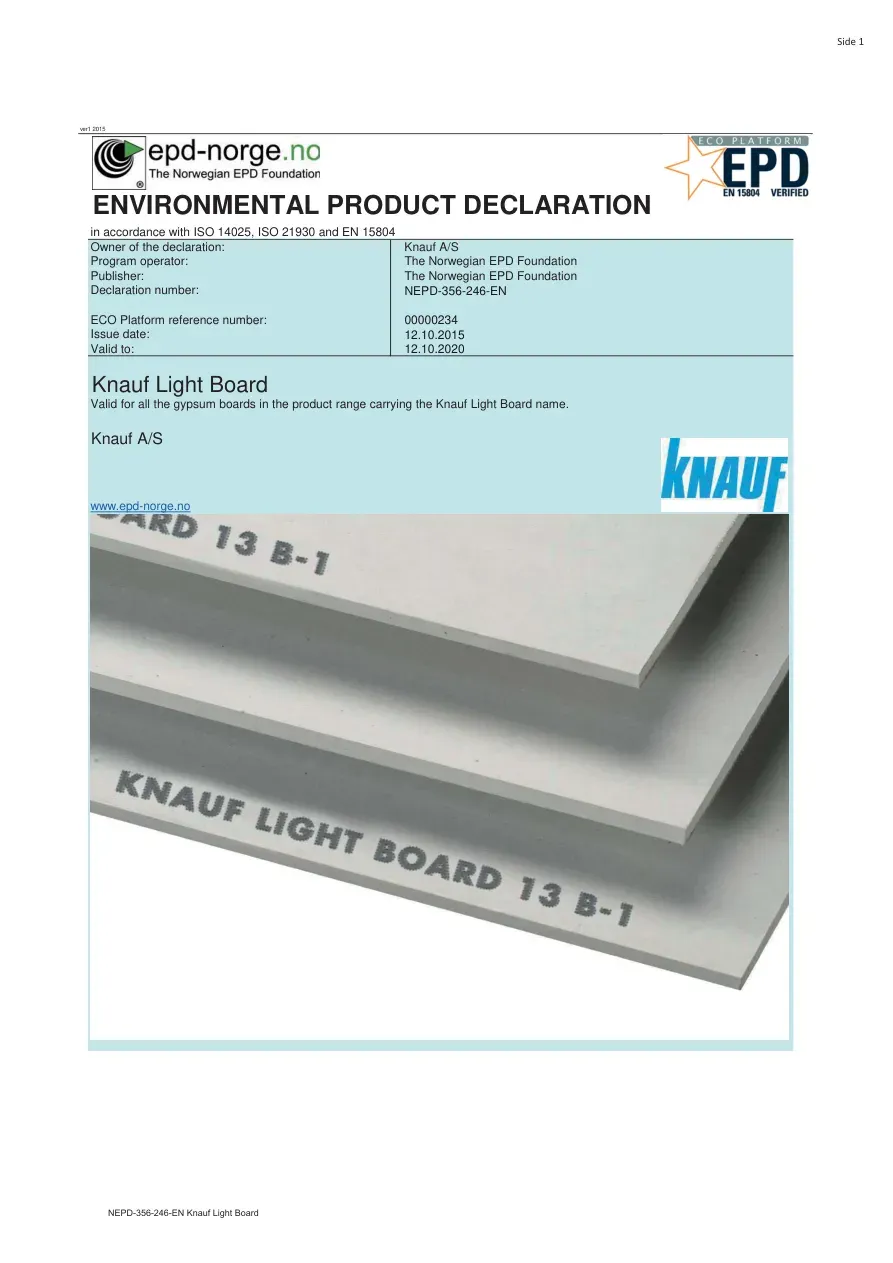
Side 1ver1 2015ENVIRONMENTAL PRODUCT DECLARATIONin accordance with ISO 14025, ISO 21930 and EN 15804Owner of the declaration:Knauf A/SProgram operator:The Norwegian EPD FoundationPublisher:The Norwegian EPD FoundationDeclaration number:NEPD-356-246-ENECO Platform reference number:00000234Issue date:12.10.2015Valid to:12.10.2020Knauf Light Boardwww.epd-norge.noKnauf A/SValid for all the gypsum boards in the product range carrying the Knauf Light Board name.Only a picture or corresponding graphics shall be inserted showing the product or the use of the product. NB! Images must be high resolution (clear and sharp) with dimensions 22cm x 21 cm. ���������������������������������
General informationProduct:Owner of the declaration:Knauf A/SContact person:Carl Erik BechPhone:+45 20889145e-mail:bech.carl.erik@knauf.dkProgram operator:Manufacturer:Knauf A/SPhone:+47 23 08 82 92Phone:+45 9657 3000e-mail:post@epd-norge.noe-mail:info@knaufdanogips.comDeclaration number:Place of production:ECO Platform reference number:Management system:00000234ISO 14001:2004ISO 9001:2008 OHSAS 18001:2008Organisation no:CEN Standard EN 15804 serves as core PCRIssue date:Valid to:Declared unit:Year of study:ScopeCradle to GraveFunctional unit:The EPD has been worked out by:Marianne Rose InmanReidun Dahl Schlanbusch<sign>Verification:Approved P.O. Box 5250 Majorstuen N-0303 Oslo NorwayPCR 010 rev 1 Building Boards (12 2013)Company logoThe owner of the declaration shall be liable for the underlying information and evidence. EPD Norway shall not be liable with respect to manufacturer information, life cycle assessment data and evidences.This declaration is based on Product Category Rules:externalKnauf Light BoardThe Norwegian EPD FoundationHobro, Denmark12.10.201512.10.2020Comparability:NEPD-356-246-EN54050313Kløvermarksvej 6, DK-9500 Hobro, DenmarkinternalLars G. F. Tellnes, Norwegian Institute of Wood TechnologyStatement of liability:1m2 of Light Board, from raw material extraction (A1) to the factory gate (A3).EPD of construction products may not be comparable if they do not comply with EN 15804 and are seen in a building context.The CEN Norm EN 15804 serves as the core PCR. Independent verification of the declaration and data, according to ISO14025:2010Third party verifier:20151m2 of installed Light Board, with a service lifetime of 60 years, from extraction of raw materials (A1) to the end-of-waste state (C3 and C4).(Independent verifier approved by EPD Norway)integ2/8 ���������������������������������
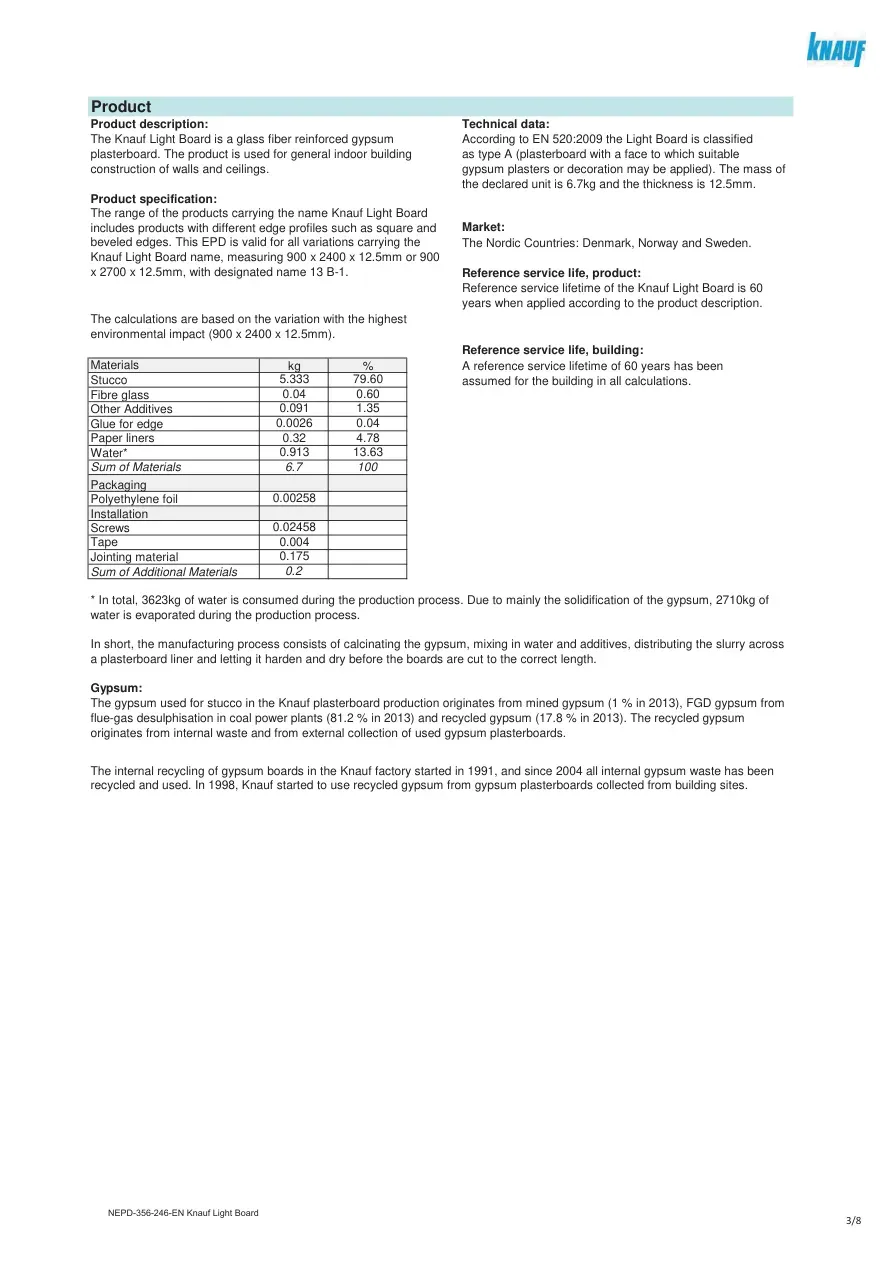
ProductTechnical data:as type A (plasterboard with a face to which suitableProduct specification:Market:Reference service life, product:Reference service life, building:MaterialsStuccoFibre glassOther AdditivesGlue for edgePaper linersWater*Sum of MaterialsPackagingPolyethylene foilInstallationScrewsTapeJointing materialSum of Additional MaterialsGypsum:A reference service lifetime of 60 years has been assumed for the building in all calculations.0.00258In short, the manufacturing process consists of calcinating the gypsum, mixing in water and additives, distributing the slurry across a plasterboard liner and letting it harden and dry before the boards are cut to the correct length.Product description:According to EN 520:2009 the Light Board is classifiedReference service lifetime of the Knauf Light Board is 60 years when applied according to the product description.The calculations are based on the variation with the highest environmental impact (900 x 2400 x 12.5mm).The Knauf Light Board is a glass fiber reinforced gypsum plasterboard. The product is used for general indoor building construction of walls and ceilings.The Nordic Countries: Denmark, Norway and Sweden.gypsum plasters or decoration may be applied). The mass of the declared unit is 6.7kg and the thickness is 12.5mm.The range of the products carrying the name Knauf Light Board includes products with different edge profiles such as square and beveled edges. This EPD is valid for all variations carrying the Knauf Light Board name, measuring 900 x 2400 x 12.5mm or 900 x 2700 x 12.5mm, with designated name 13 B-1.5.3330.91313.63* In total, 3623kg of water is consumed during the production process. Due to mainly the solidification of the gypsum, 2710kg ofwater is evaporated during the production process.The gypsum used for stucco in the Knauf plasterboard production originates from mined gypsum (1 % in 2013), FGD gypsum from flue-gas desulphisation in coal power plants (81.2 % in 2013) and recycled gypsum (17.8 % in 2013). The recycled gypsum originates from internal waste and from external collection of used gypsum plasterboards.0.024580.004The internal recycling of gypsum boards in the Knauf factory started in 1991, and since 2004 all internal gypsum waste has beenrecycled and used. In 1998, Knauf started to use recycled gypsum from gypsum plasterboards collected from building sites.kg%1.350.044.780.040.0910.00260.320.17579.600.606.71000.23/8 ���������������������������������
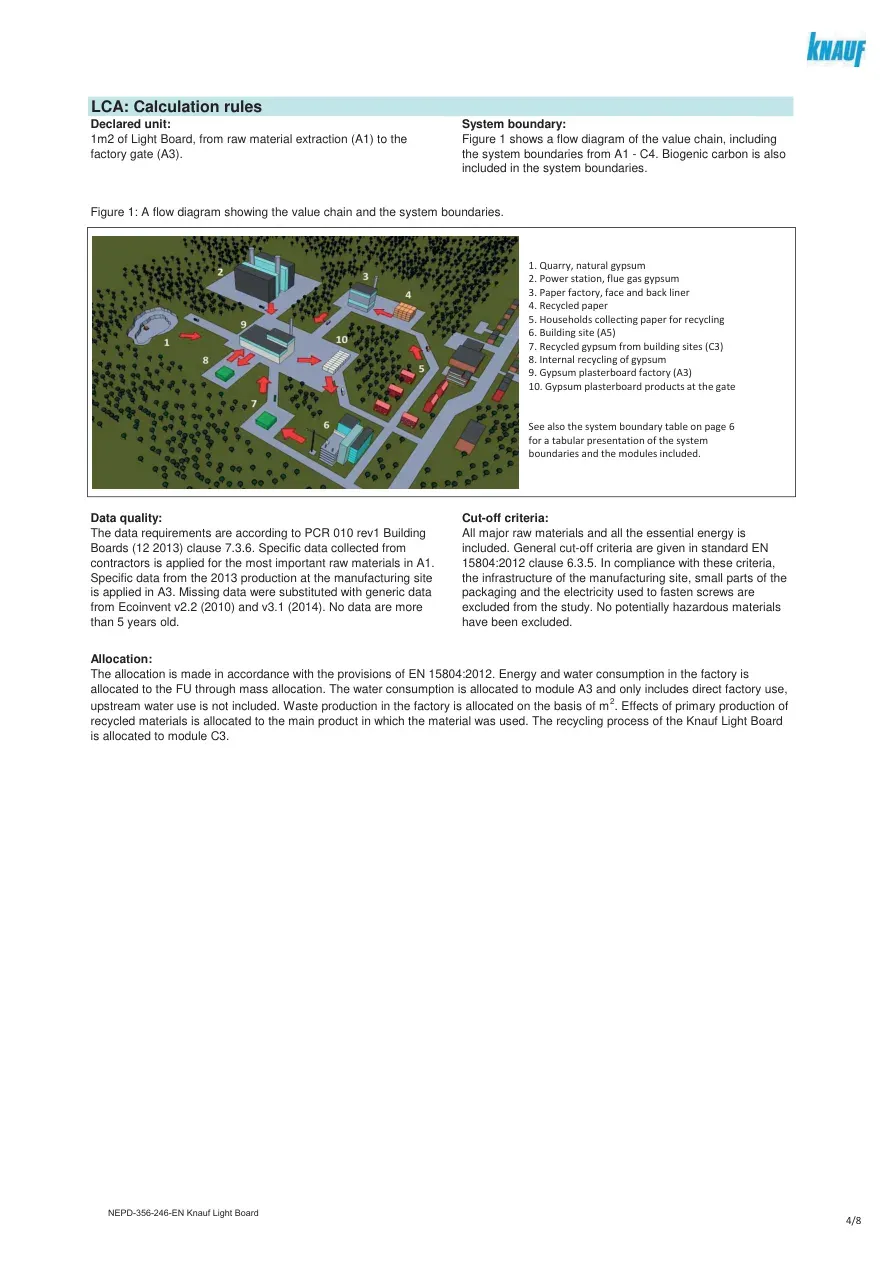
LCA: Calculation rulesDeclared unit:System boundary:Figure 1: A flow diagram showing the value chain and the system boundaries.Data quality:Cut-off criteria:Allocation:1m2 of Light Board, from raw material extraction (A1) to the factory gate (A3).The data requirements are according to PCR 010 rev1 Building Boards (12 2013) clause 7.3.6. Specific data collected from contractors is applied for the most important raw materials in A1. Specific data from the 2013 production at the manufacturing site is applied in A3. Missing data were substituted with generic data from Ecoinvent v2.2 (2010) and v3.1 (2014). No data are more than 5 years old.Figure 1 shows a flow diagram of the value chain, including the system boundaries from A1 - C4. Biogenic carbon is also included in the system boundaries.The allocation is made in accordance with the provisions of EN 15804:2012. Energy and water consumption in the factory is allocated to the FU through mass allocation. The water consumption is allocated to module A3 and only includes direct factory use, upstream water use is not included. Waste production in the factory is allocated on the basis of m2. Effects of primary production of recycled materials is allocated to the main product in which the material was used. The recycling process of the Knauf Light Boardis allocated to module C3.All major raw materials and all the essential energy is included. General cut-off criteria are given in standard EN 15804:2012 clause 6.3.5. In compliance with these criteria, the infrastructure of the manufacturing site, small parts of the packaging and the electricity used to fasten screws are excluded from the study. No potentially hazardous materials have been excluded.1. Quarry, natural gypsum2. Power station, flue gas gypsum3. Paper factory, face and back liner4. Recycled paper5. Households collecting paper for recycling6. Building site (A5)7. Recycled gypsum from building sites (C3)8. Internal recycling of gypsum9. Gypsum plasterboard factory (A3)10. Gypsum plasterboard products at the gateSee also the system boundary table on page 6for a tabular presentation of the system boundaries and the modules included.4/8 ���������������������������������
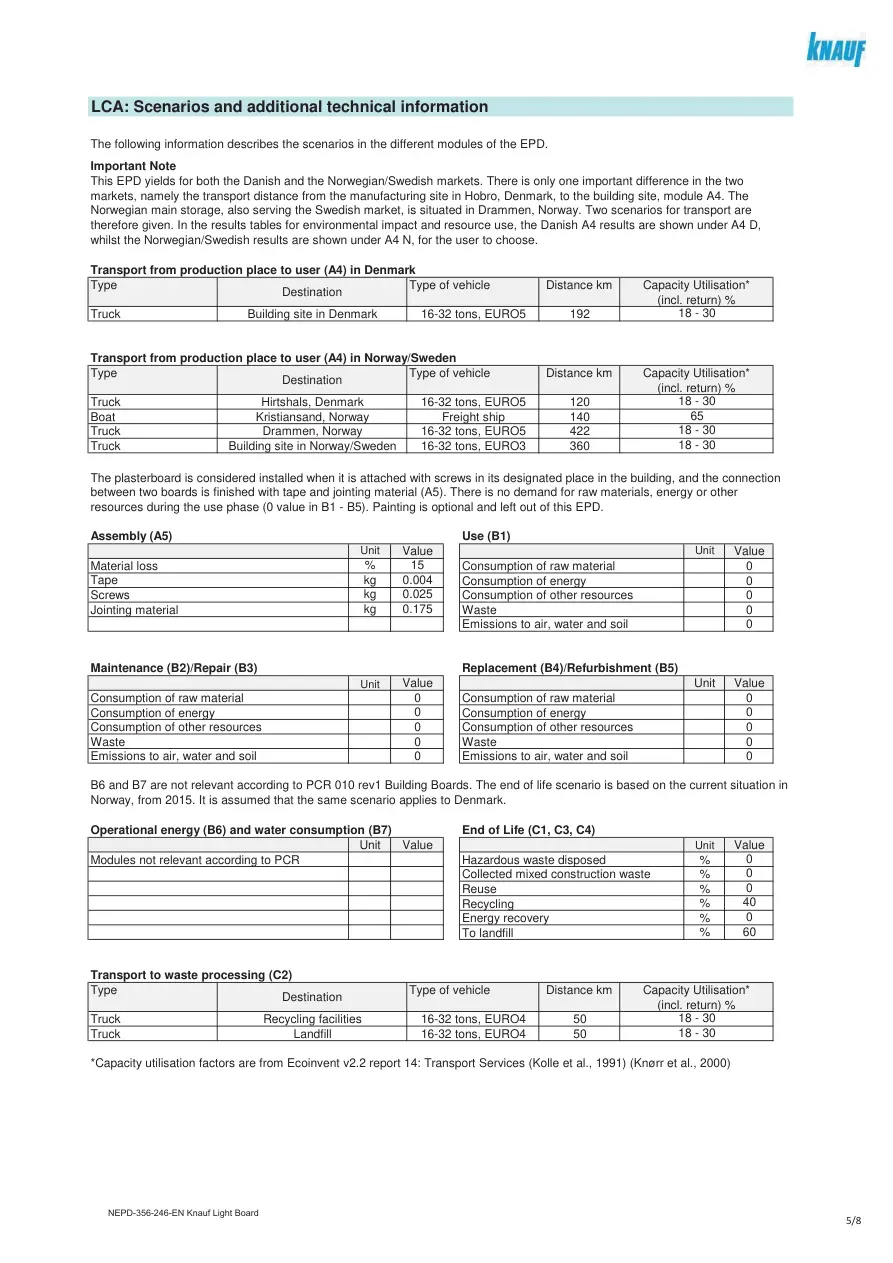
LCA: Scenarios and additional technical informationTransport from production place to user (A4) in DenmarkTruckTransport from production place to user (A4) in Norway/SwedenTruckBoatTruckTruckAssembly (A5)Use (B1)Material lossConsumption of raw materialTape Consumption of energyScrewsConsumption of other resourcesJointing materialWasteEmissions to air, water and soilMaintenance (B2)/Repair (B3)Replacement (B4)/Refurbishment (B5)Consumption of raw materialConsumption of raw materialConsumption of energyConsumption of energyConsumption of other resourcesConsumption of other resourcesWasteWasteEmissions to air, water and soilEmissions to air, water and soilEnd of Life (C1, C3, C4)Modules not relevant according to PCRHazardous waste disposedCollected mixed construction wasteReuseRecyclingEnergy recoveryTo landfillTransport to waste processing (C2)TruckTruck00%50Distance km5060%40%%Capacity Utilisation* (incl. return) %18 - 3018 - 30*Capacity utilisation factors are from Ecoinvent v2.2 report 14: Transport Services (Kolle et al., 1991) (Knørr et al., 2000)ValueUnitB6 and B7 are not relevant according to PCR 010 rev1 Building Boards. The end of life scenario is based on the current situation in Norway, from 2015. It is assumed that the same scenario applies to Denmark.140Building site in Norway/SwedenUnit%%%18 - 3018 - 30360kgUnitValue00000ValueUnit000Important NotekgUnit0.004Freight ship16-32 tons, EURO512016-32 tons, EURO318 - 3065Hirtshals, Denmark422kgValue16-32 tons, EURO500TypeDestinationDistance kmCapacity Utilisation* (incl. return) %00Unit16-32 tons, EURO4Type of vehicleValueOperational energy (B6) and water consumption (B7)TypeRecycling facilitiesDestination0Landfill0016-32 tons, EURO4This EPD yields for both the Danish and the Norwegian/Swedish markets. There is only one important difference in the two markets, namely the transport distance from the manufacturing site in Hobro, Denmark, to the building site, module A4. The Norwegian main storage, also serving the Swedish market, is situated in Drammen, Norway. Two scenarios for transport are therefore given. In the results tables for environmental impact and resource use, the Danish A4 results are shown under A4 D, whilst the Norwegian/Swedish results are shown under A4 N, for the user to choose.0.17515TypeBuilding site in Denmark16-32 tons, EURO5192Type of vehicleDistance kmDestinationType of vehicleThe following information describes the scenarios in the different modules of the EPD.18 - 30Capacity Utilisation* (incl. return) %00ValueThe plasterboard is considered installed when it is attached with screws in its designated place in the building, and the connection between two boards is finished with tape and jointing material (A5). There is no demand for raw materials, energy or other resources during the use phase (0 value in B1 - B5). Painting is optional and left out of this EPD.Drammen, NorwayKristiansand, Norway0.0255/8 ���������������������������������
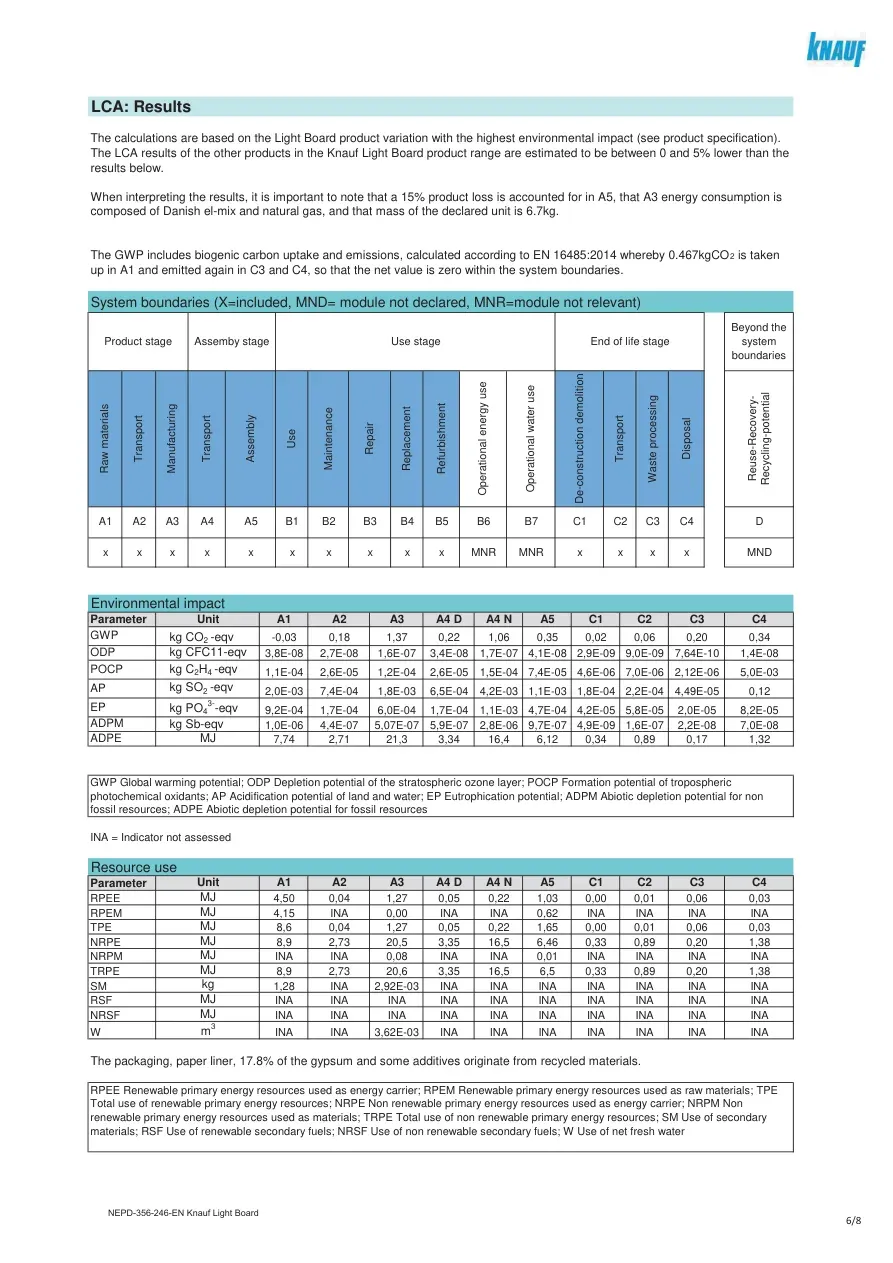
LCA: ResultsSystem boundaries (X=included, MND= module not declared, MNR=module not relevant)Environmental impactINA = Indicator not assessedResource useThe packaging, paper liner, 17.8% of the gypsum and some additives originate from recycled materials.INAINAINA3,62E-03INAINAINAINAINAINAINAINAINAINAINAINAINAINAINAINAINA8,92,7320,63,3516,56,50,330,890,201,38INAINA0,08INAINA0,01INAINAINA0,038,92,7320,53,3516,56,460,330,890,201,388,60,041,270,050,221,650,000,010,060,034,15INA0,00INAINA0,62INAINAINAINA4,500,041,270,050,221,030,000,010,068,2E-057,0E-081,32A1A2A3A4 DA4 NA5C1C2C34,2E-054,9E-090,345,8E-057,741,6E-070,896,124,7E-040,173,341,7E-040,207,64E-101,1E-032,9E-090,341,4E-085,0E-030,122,12E-060,069,0E-097,0E-062,2E-044,49E-054,6E-061,8E-040,023,4E-082,6E-056,5E-041,061,7E-071,5E-044,2E-030,354,1E-087,4E-054,4E-072,712,0E-052,2E-081,7E-04The calculations are based on the Light Board product variation with the highest environmental impact (see product specification). The LCA results of the other products in the Knauf Light Board product range are estimated to be between 0 and 5% lower than theresults below. When interpreting the results, it is important to note that a 15% product loss is accounted for in A5, that A3 energy consumption is composed of Danish el-mix and natural gas, and that mass of the declared unit is 6.7kg.The GWP includes biogenic carbon uptake and emissions, calculated according to EN 16485:2014 whereby 0.467kgCO2 is taken up in A1 and emitted again in C3 and C4, so that the net value is zero within the system boundaries.Raw materialsA1TransportA2Beyond the system boundariesTransportxRepairRefurbishmentMNRxDe-construction demolitionC3x0,22Product stageOperational energy useB7AssemblyB6A31,371,6E-07POCPkg C2H4 -eqvADPEParameter1,1E-032,8E-0616,40,182,7E-082,6E-057,4E-041,1E-042,0E-039,2E-041,0E-06A4 NODPA21,8E-036,0E-045,9E-07A5C1C4GWP Global warming potential; ODP Depletion potential of the stratospheric ozone layer; POCP Formation potential of troposphericphotochemical oxidants; AP Acidification potential of land and water; EP Eutrophication potential; ADPM Abiotic depletion potential for non fossil resources; ADPE Abiotic depletion potential for fossil resourcesMJkg SO2 -eqvAPMNRxxUnitEPADPMkg PO43--eqv9,7E-07xxxGWP5,07E-0721,3A4 D1,2E-04kg Sb-eqvTRPEA1Unitkg CFC11-eqvxMJRPEEUseA4B1MJNRPMRPEMTPEkg CO2 -eqv-0,033,8E-08NRPEMJParameterMJMJDDisposalReuse-Recovery-Recycling-potentialC4xWaste processingC4C2MNDTransportxC2C3kgMJMJm3SMRSFWNRSFRPEE Renewable primary energy resources used as energy carrier; RPEM Renewable primary energy resources used as raw materials; TPE Total use of renewable primary energy resources; NRPE Non renewable primary energy resources used as energy carrier; NRPM Non renewable primary energy resources used as materials; TRPE Total use of non renewable primary energy resources; SM Use of secondary materials; RSF Use of renewable secondary fuels; NRSF Use of non renewable secondary fuels; W Use of net fresh waterINAINAINAINAINAINAINAINAINAINAINAINAINAINAINAINAEnd of life stageB5C11,28MJxReplacementxxAssemby stageB3A3Operational water useMaintenanceA5B2B4ManufacturingUse stageINA2,92E-03INA6/8 ���������������������������������
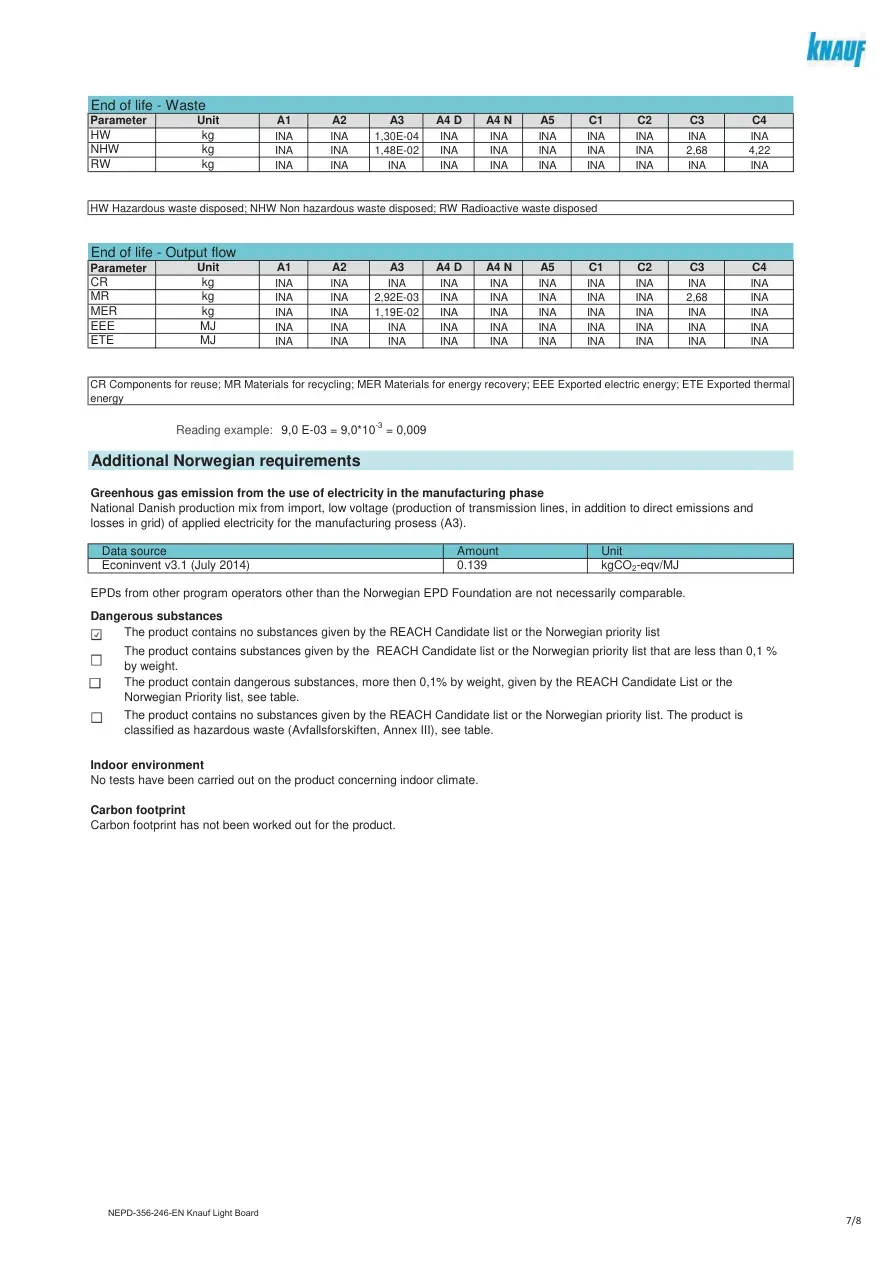
End of life - WasteEnd of life - Output flow 9,0 E-03 = 9,0*10-3 = 0,009Additional Norwegian requirementsGreenhous gas emission from the use of electricity in the manufacturing phaseEPDs from other program operators other than the Norwegian EPD Foundation are not necessarily comparable.Dangerous substancesIndoor environmentNo tests have been carried out on the product concerning indoor climate.Carbon footprintCarbon footprint has not been worked out for the product.INAINAINAINAINAINAINAINAINAINAINAINAINA1,19E-02INAINAINAINAINAINAINAINAINAINAINAINAINAINAINAINAINA2,92E-03INAINAINAINAINA2,68INAINAINAA1A2A3A4 DA4 NA5C1C2C3INAINAINAINAC4INAINAINAINA1,48E-02INAINAINAINAINA2,684,22INAINA1,30E-04INAINAINAINAINAINAA1A2A3A4 DA4 NA5C1C2C3C4ParameterHWNHWkgThe product contain dangerous substances, more then 0,1% by weight, given by the REACH Candidate List or the Norwegian Priority list, see table.0.139National Danish production mix from import, low voltage (production of transmission lines, in addition to direct emissions and losses in grid) of applied electricity for the manufacturing prosess (A3).INAINAINAINAINAINAINAkgkgReading example:ParameterRWkgUnitkgkgCRINAINAINAINAThe product contains no substances given by the REACH Candidate list or the Norwegian priority list. The product is classified as hazardous waste (Avfallsforskiften, Annex III), see table.MJThe product contains substances given by the REACH Candidate list or the Norwegian priority list that are less than 0,1 % by weight.kgCO2-eqv/MJData sourceAmountUnitEconinvent v3.1 (July 2014)HW Hazardous waste disposed; NHW Non hazardous waste disposed; RW Radioactive waste disposedMRMERUnitThe product contains no substances given by the REACH Candidate list or the Norwegian priority listEEEETECR Components for reuse; MR Materials for recycling; MER Materials for energy recovery; EEE Exported electric energy; ETE Exported thermal energyINAINAINAMJ7/8 ���������������������������������
BibliographyISO 14001:2004Environmental management systems - Requirements with guidance for useISO 9001: 2008Quality management system - RequirementsOHSAS 18001: 2007Occupational health and safety management systems. RequirementsEN 520: 2009Gypsum Plasterboards. Definitions, requirements and test methodsEN 16485: 2014Pre ConsultantsEcoinvent v2.2 and v3.1 Database, 2014Ecoinvent report no.14: Transport Services, 2007The Norwegian EPD FoundationPCR 010 rev1 Building Boards, December 2013Program operatorPhone:The Norwegian EPD FoundationPost Box 5250 Majorstuen, 0303 Osloe-mail:post@epd-norge.noNorwayweb www.epd-norge.noPublisherPhone:+47 23 08 82 92The Norwegian EPD FoundationPost Box 5250 Majorstuen, 0303 Osloe-mail:post@epd-norge.noNorwayweb www.epd-norge.noOwner of the declarationPhone:+45 96 573000Knauf A/SFax+45 96 573001Kløvermarksvej 6e-mail:info@knaufdanogips.com9500 Hobro, Denmarkweb www.knauf.dkAuthor of the Life Cycle AssessmentPhone:48 146 279Reidun Dahl Sclanbusch & Marianne Rose Inmanmarianne.inman@sintef.no SINTEF Building and Infrastructuree-mail:reidun.schlanbusch@sintef.noForskningsvn 3b, 0314 Oslo, Norwayweb www.sintef.noSpielmann, M., Bauer, C., Dones, R., Tuchschmid, M.Round and sawn timber. Environmental Product Declarations. Product Category Rules for wood and wood-based products.Schlanbusch, Reidun Dahl & Inman, Marianne RoseLCI/LCA Report: Six Gypsum Plaster Building Boards, SINTEF Building and Infrastructure, Knauf A/S, Report number SBF2015F0324, 2015+47 23 08 82 92ISO 21930:2007ISO 14025:2010Sustainability in building construction - Environmental declaration of building productsEnvironmental management - Life cycle assessment - Requirements and guidelinesISO 14044:2006Environmental labels and declarations - Type III environmental declarations - Principles and proceduresSustainability of construction works - Environmental product declaration - Core rules for the product category of construction productsEN 15804:2012+A1:20138/8 ���������������������������������
