Umwelt Produktdeklaration Name des Herstellers – Name des ProduktsENVIRONMENTAL PRODUCT DECLARATIONas per ISO 14025 and EN 15804Owner of the DeclarationKnauf InsulationProgramme holderInstitut Bauen und Umwelt e.V. (IBU)PublisherInstitut Bauen und Umwelt e.V. (IBU)Declaration numberEPD-KIN-20140162-CBB1-ENECO EPD Ref. No.ECO-00000003Issue date22.09.2014Valid to21.09.2019Glass Mineral Wool 040 unfaced rollsClassic 040, TI 140, TI 140 Decibel, Naturoll 040, EXPERT LRR 040, EXPERT LFR 040, Ekoroll LFR 040with ECOSE® TechnologyKnauf Insulation www.bau-umwelt.com / https://epd-online.com
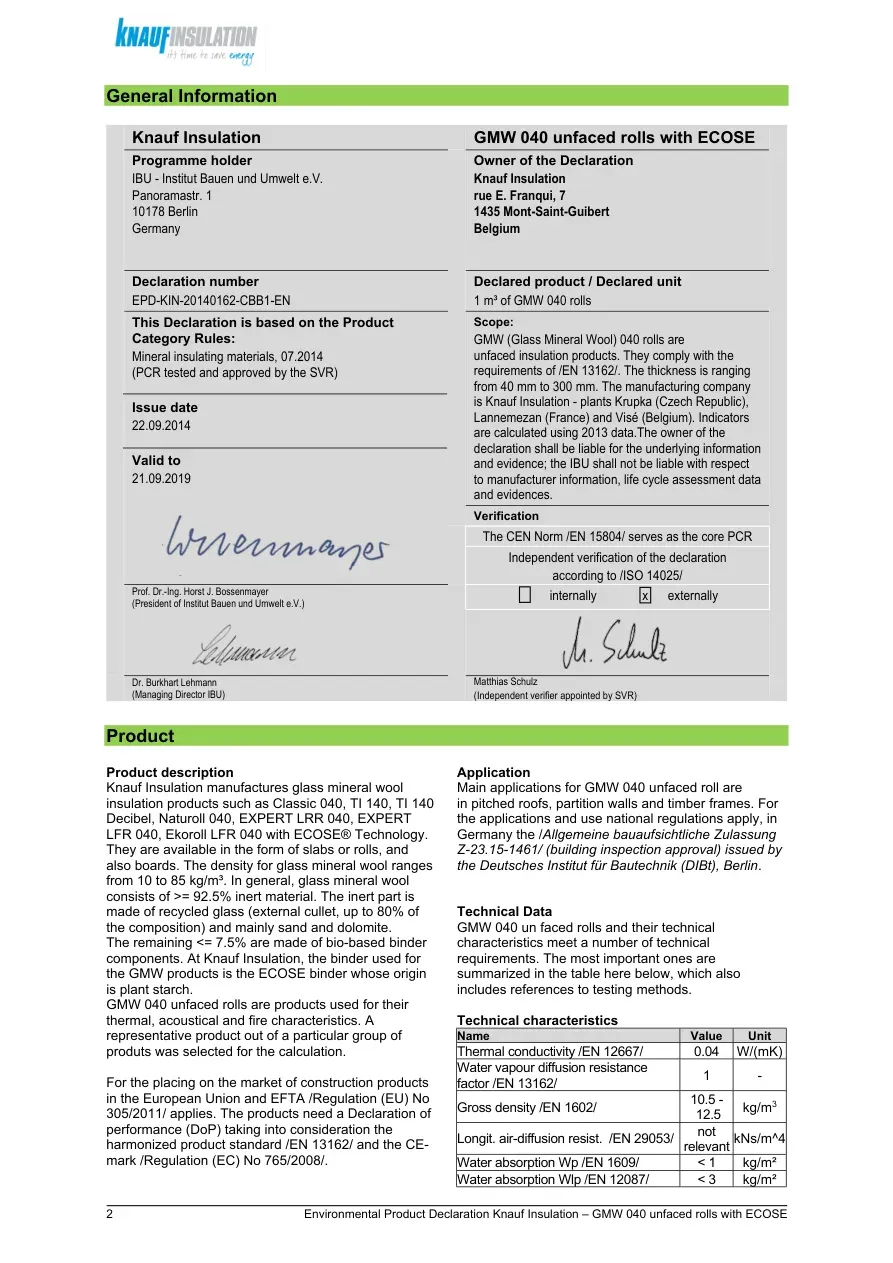
2Environmental Product Declaration Knauf Insulation – GMW 040 unfaced rolls with ECOSEGeneral InformationKnauf InsulationGMW 040 unfaced rolls with ECOSEProgramme holderIBU - Institut Bauen und Umwelt e.V.Panoramastr. 110178 BerlinGermanyOwner of the DeclarationKnauf Insulationrue E. Franqui, 71435 Mont-Saint-Guibert Belgium Declaration numberEPD-KIN-20140162-CBB1-ENDeclared product / Declared unit1 m³ of GMW 040 rollsThis Declaration is based on the Product Category Rules:Mineral insulating materials, 07.2014 (PCR tested and approved by the SVR)Issue date22.09.2014Valid to21.09.2019Scope:GMW (Glass Mineral Wool) 040 rolls are unfaced insulation products. They comply with the requirements of /EN 13162/. The thickness is ranging from 40 mm to 300 mm. The manufacturing company is Knauf Insulation - plants Krupka (Czech Republic), Lannemezan (France) and Visé (Belgium). Indicators are calculated using 2013 data.The owner of the declaration shall be liable for the underlying information and evidence; the IBU shall not be liable with respect to manufacturer information, life cycle assessment data and evidences.VerificationThe CEN Norm /EN 15804/ serves as the core PCRIndependent verification of the declarationaccording to /ISO 14025/Prof. Dr.-Ing. Horst J. Bossenmayer(President of Institut Bauen und Umwelt e.V.) internally x externallyDr. Burkhart Lehmann(Managing Director IBU)Matthias Schulz(Independent verifier appointed by SVR)ProductProduct descriptionKnauf Insulation manufactures glass mineral wool insulation products such as Classic 040, TI 140, TI 140 Decibel, Naturoll 040, EXPERT LRR 040, EXPERT LFR 040, Ekoroll LFR 040 with ECOSE® Technology. They are available in the form of slabs or rolls, and also boards. The density for glass mineral wool ranges from 10 to 85 kg/m³. In general, glass mineral wool consists of >= 92.5% inert material. The inert part is made of recycled glass (external cullet, up to 80% of the composition) and mainly sand and dolomite.The remaining <= 7.5% are made of bio-based binder components. At Knauf Insulation, the binder used for the GMW products is the ECOSE binder whose origin is plant starch.GMW 040 unfaced rolls are products used for their thermal, acoustical and fire characteristics. A representative product out of a particular group of produts was selected for the calculation. For the placing on the market of construction products in the European Union and EFTA /Regulation (EU) No 305/2011/ applies. The products need a Declaration of performance (DoP) taking into consideration the harmonized product standard /EN 13162/ and the CE-mark /Regulation (EC) No 765/2008/. ApplicationMain applications for GMW 040 unfaced roll are in pitched roofs, partition walls and timber frames. For the applications and use national regulations apply, in Germany the /Allgemeine bauaufsichtliche Zulassung Z-23.15-1461/ (building inspection approval) issued by the Deutsches Institut für Bautechnik (DIBt), Berlin. Technical DataGMW 040 un faced rolls and their technical characteristics meet a number of technical requirements. The most important ones are summarized in the table here below, which also includes references to testing methods. Technical characteristicsNameValueUnitThermal conductivity /EN 12667/0.04W/(mK)Water vapour diffusion resistance factor /EN 13162/1-Gross density /EN 1602/ 10.5 - 12.5kg/m3Longit. air-diffusion resist. /EN 29053/not relevant kNs/m^4Water absorption Wp /EN 1609/< 1kg/m²Water absorption Wlp /EN 12087/< 3kg/m²
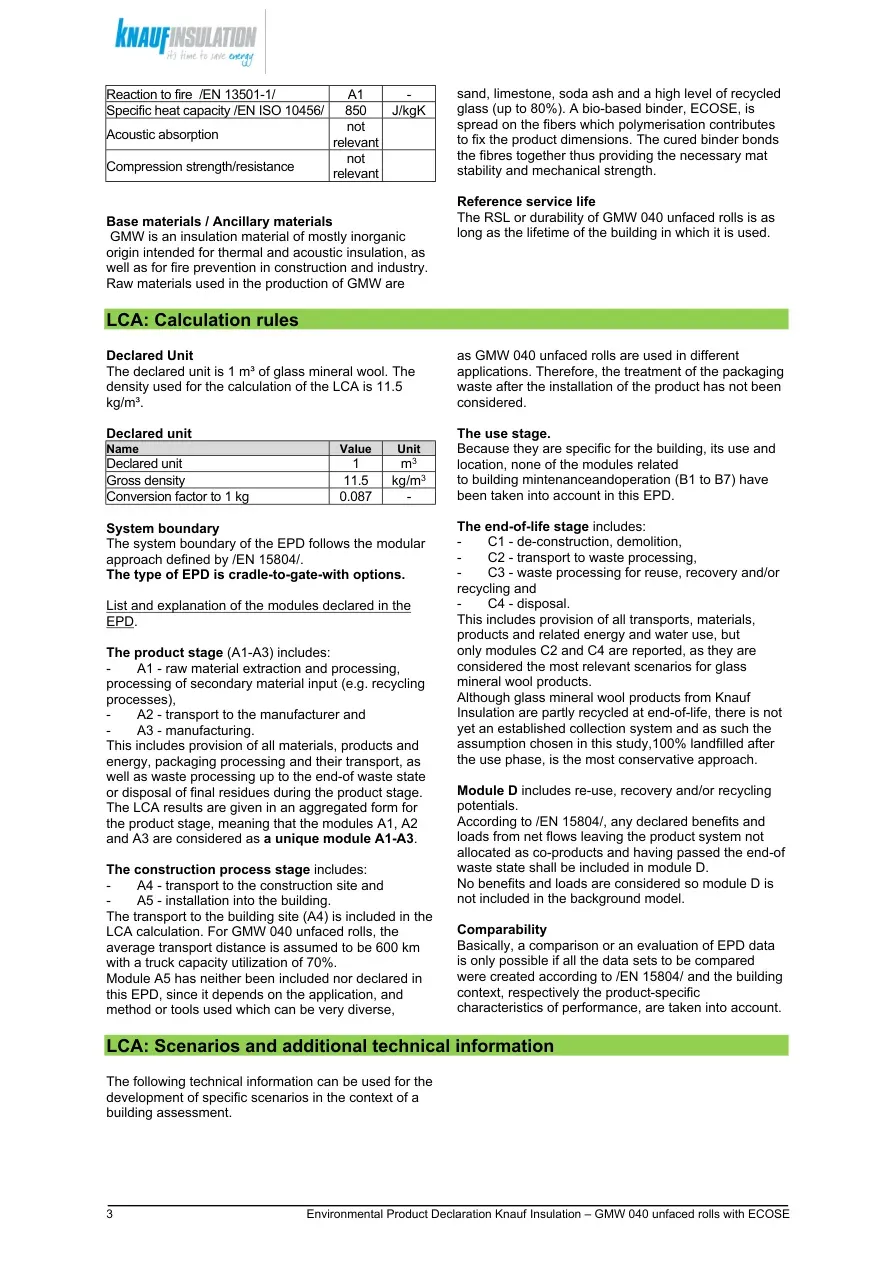
3Environmental Product Declaration Knauf Insulation – GMW 040 unfaced rolls with ECOSEReaction to fire /EN 13501-1/A1-Specific heat capacity /EN ISO 10456/850J/kgKAcoustic absorptionnot relevantCompression strength/resistancenot relevantBase materials / Ancillary materials GMW is an insulation material of mostly inorganic origin intended for thermal and acoustic insulation, as well as for fire prevention in construction and industry. Raw materials used in the production of GMW are sand, limestone, soda ash and a high level of recycled glass (up to 80%). A bio-based binder, ECOSE, is spread on the fibers which polymerisation contributes to fix the product dimensions. The cured binder bonds the fibres together thus providing the necessary mat stability and mechanical strength. Reference service lifeThe RSL or durability of GMW 040 unfaced rolls is as long as the lifetime of the building in which it is used. LCA: Calculation rulesDeclared UnitThe declared unit is 1 m³ of glass mineral wool. The density used for the calculation of the LCA is 11.5 kg/m³.Declared unitNameValueUnitDeclared unit1m3Gross density11.5kg/m3Conversion factor to 1 kg0.087-System boundaryThe system boundary of the EPD follows the modular approach defined by /EN 15804/. The type of EPD is cradle-to-gate-with options. List and explanation of the modules declared in the EPD. The product stage (A1-A3) includes:- A1 - raw material extraction and processing, processing of secondary material input (e.g. recycling processes),- A2 - transport to the manufacturer and- A3 - manufacturing.This includes provision of all materials, products and energy, packaging processing and their transport, as well as waste processing up to the end-of waste state or disposal of final residues during the product stage.The LCA results are given in an aggregated form for the product stage, meaning that the modules A1, A2 and A3 are considered as a unique module A1-A3. The construction process stage includes:- A4 - transport to the construction site and- A5 - installation into the building.The transport to the building site (A4) is included in the LCA calculation. For GMW 040 unfaced rolls, the average transport distance is assumed to be 600 km with a truck capacity utilization of 70%. Module A5 has neither been included nor declared in this EPD, since it depends on the application, and method or tools used which can be very diverse, as GMW 040 unfaced rolls are used in different applications. Therefore, the treatment of the packaging waste after the installation of the product has not been considered. The use stage.Because they are specific for the building, its use and location, none of the modules related to building mintenanceandoperation (B1 to B7) have been taken into account in this EPD. The end-of-life stage includes:- C1 - de-construction, demolition, - C2 - transport to waste processing,- C3 - waste processing for reuse, recovery and/or recycling and- C4 - disposal.This includes provision of all transports, materials, products and related energy and water use, but only modules C2 and C4 are reported, as they are considered the most relevant scenarios for glass mineral wool products. Although glass mineral wool products from Knauf Insulation are partly recycled at end-of-life, there is not yet an established collection system and as such the assumption chosen in this study,100% landfilled after the use phase, is the most conservative approach. Module D includes re-use, recovery and/or recycling potentials.According to /EN 15804/, any declared benefits and loads from net flows leaving the product system not allocated as co-products and having passed the end-of waste state shall be included in module D. No benefits and loads are considered so module D is not included in the background model. ComparabilityBasically, a comparison or an evaluation of EPD data is only possible if all the data sets to be compared were created according to /EN 15804/ and the building context, respectively the product-specific characteristics of performance, are taken into account. LCA: Scenarios and additional technical informationThe following technical information can be used for the development of specific scenarios in the context of a building assessment.
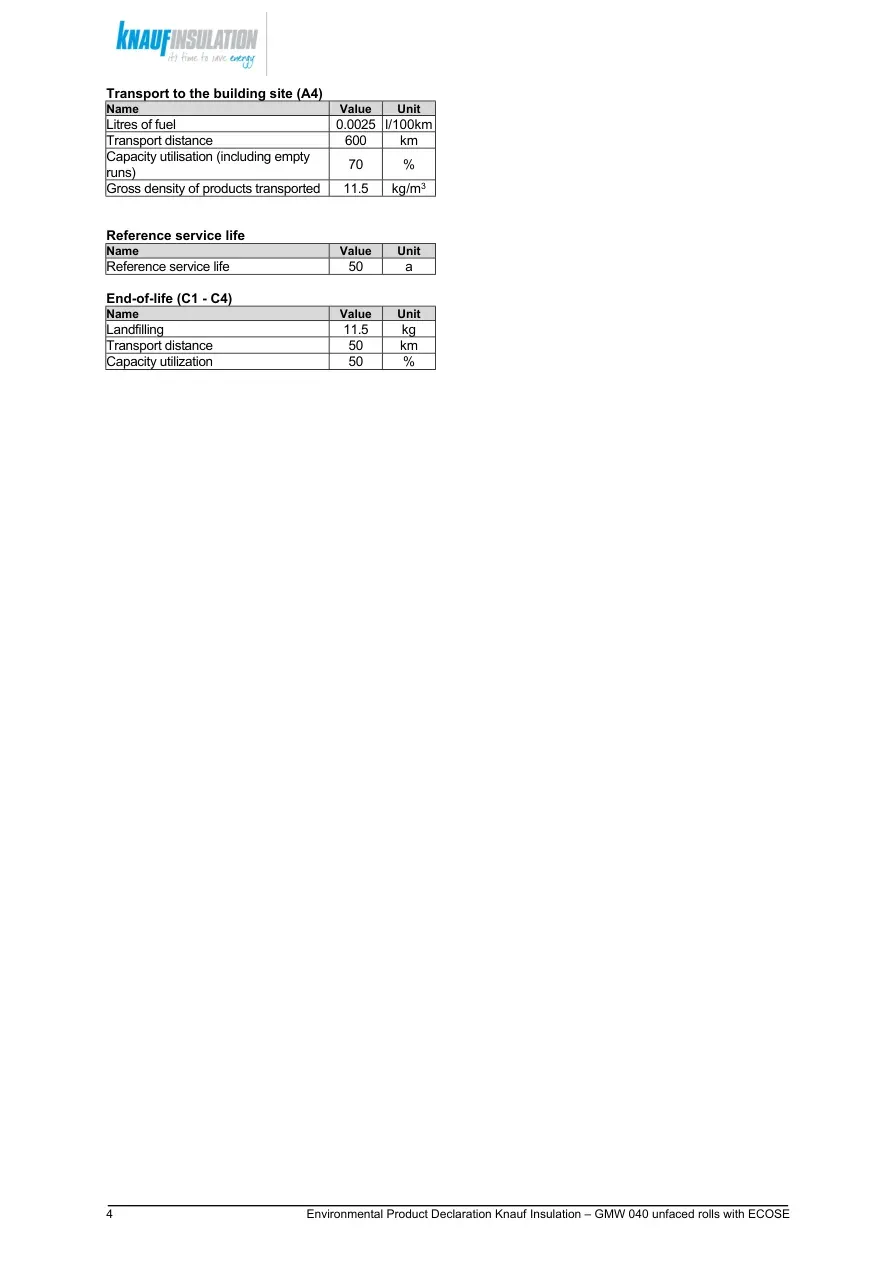
4Environmental Product Declaration Knauf Insulation – GMW 040 unfaced rolls with ECOSETransport to the building site (A4)NameValueUnitLitres of fuel0.0025 l/100kmTransport distance600kmCapacity utilisation (including empty runs)70%Gross density of products transported11.5kg/m3 Reference service lifeNameValueUnitReference service life50a End-of-life (C1 - C4)NameValueUnitLandfilling11.5kgTransport distance50kmCapacity utilization50%
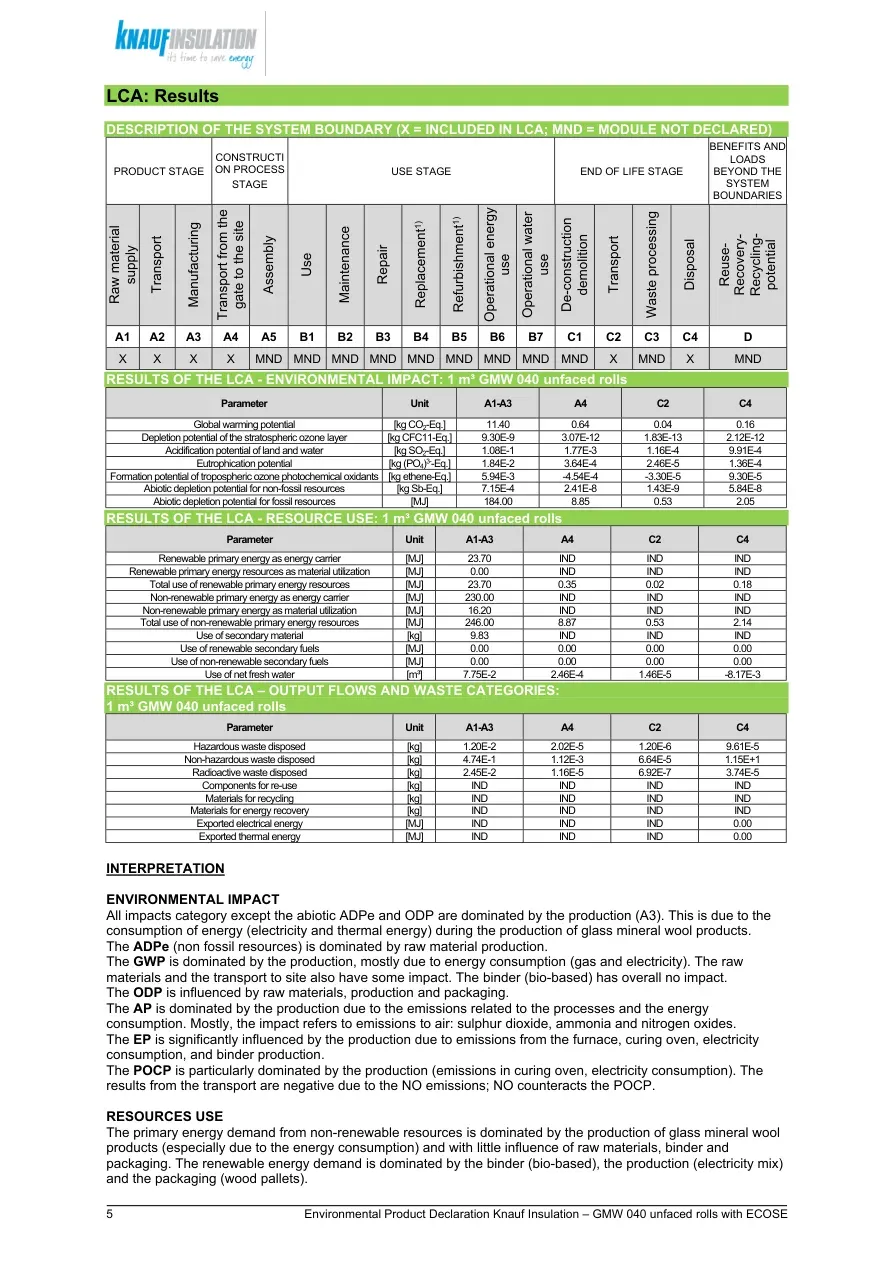
5Environmental Product Declaration Knauf Insulation – GMW 040 unfaced rolls with ECOSELCA: ResultsDESCRIPTION OF THE SYSTEM BOUNDARY (X = INCLUDED IN LCA; MND = MODULE NOT DECLARED)PRODUCT STAGECONSTRUCTION PROCESS STAGEUSE STAGEEND OF LIFE STAGEBENEFITS AND LOADS BEYOND THE SYSTEM BOUNDARIESRaw material supplyTransportManufacturingTransport from the gate to the siteAssemblyUseMaintenanceRepairReplacement1)Refurbishment1)Operational energy use Operational water useDe-constructiondemolitionTransportWaste processingDisposalReuse-Recovery-Recycling-potentialA1A2A3A4A5B1B2B3B4B5B6B7C1C2C3C4DXXXXMNDMNDMNDMNDMNDMNDMNDMNDMNDXMNDXMNDRESULTS OF THE LCA - ENVIRONMENTAL IMPACT: 1 m³ GMW 040 unfaced rollsParameterUnitA1-A3A4C2C4Global warming potential[kg CO2-Eq.]11.400.640.040.16Depletion potential of the stratospheric ozone layer[kg CFC11-Eq.]9.30E-93.07E-121.83E-132.12E-12Acidification potential of land and water[kg SO2-Eq.]1.08E-11.77E-31.16E-49.91E-4Eutrophication potential[kg (PO4)3--Eq.]1.84E-23.64E-42.46E-51.36E-4Formation potential of tropospheric ozone photochemical oxidants[kg ethene-Eq.]5.94E-3-4.54E-4-3.30E-59.30E-5Abiotic depletion potential for non-fossil resources[kg Sb-Eq.]7.15E-42.41E-81.43E-95.84E-8Abiotic depletion potential for fossil resources[MJ]184.008.850.532.05RESULTS OF THE LCA - RESOURCE USE: 1 m³ GMW 040 unfaced rollsParameterUnitA1-A3A4C2C4Renewable primary energy as energy carrier[MJ]23.70INDINDINDRenewable primary energy resources as material utilization[MJ]0.00INDINDINDTotal use of renewable primary energy resources[MJ]23.700.350.020.18Non-renewable primary energy as energy carrier[MJ]230.00INDINDINDNon-renewable primary energy as material utilization[MJ]16.20INDINDINDTotal use of non-renewable primary energy resources[MJ]246.008.870.532.14Use of secondary material[kg]9.83INDINDINDUse of renewable secondary fuels[MJ]0.000.000.000.00Use of non-renewable secondary fuels[MJ]0.000.000.000.00Use of net fresh water[m³]7.75E-22.46E-41.46E-5-8.17E-3RESULTS OF THE LCA – OUTPUT FLOWS AND WASTE CATEGORIES: 1 m³ GMW 040 unfaced rollsParameterUnitA1-A3A4C2C4Hazardous waste disposed[kg]1.20E-22.02E-51.20E-69.61E-5Non-hazardous waste disposed[kg]4.74E-11.12E-36.64E-51.15E+1Radioactive waste disposed[kg]2.45E-21.16E-56.92E-73.74E-5Components for re-use[kg]INDINDINDINDMaterials for recycling[kg]INDINDINDINDMaterials for energy recovery[kg]INDINDINDINDExported electrical energy[MJ]INDINDIND0.00Exported thermal energy[MJ]INDINDIND0.00 INTERPRETATION ENVIRONMENTAL IMPACT All impacts category except the abiotic ADPe and ODP are dominated by the production (A3). This is due to the consumption of energy (electricity and thermal energy) during the production of glass mineral wool products.The ADPe (non fossil resources) is dominated by raw material production.The GWP is dominated by the production, mostly due to energy consumption (gas and electricity). The raw materials and the transport to site also have some impact. The binder (bio-based) has overall no impact. The ODP is influenced by raw materials, production and packaging.The AP is dominated by the production due to the emissions related to the processes and the energy consumption. Mostly, the impact refers to emissions to air: sulphur dioxide, ammonia and nitrogen oxides. The EP is significantly influenced by the production due to emissions from the furnace, curing oven, electricity consumption, and binder production.The POCP is particularly dominated by the production (emissions in curing oven, electricity consumption). The results from the transport are negative due to the NO emissions; NO counteracts the POCP. RESOURCES USEThe primary energy demand from non-renewable resources is dominated by the production of glass mineral wool products (especially due to the energy consumption) and with little influence of raw materials, binder and packaging. The renewable energy demand is dominated by the binder (bio-based), the production (electricity mix) and the packaging (wood pallets).
6Environmental Product Declaration Knauf Insulation – GMW 040 unfaced rolls with ECOSEReferencesInstitut Bauen und UmweltInstitut Bauen und Umwelt e.V., Berlin(pub.):Generation of Environmental Product Declarations (EPDs);General principlesfor the EPD range of Institut Bauen und Umwelt e.V. (IBU), 2013/04www.bau-umwelt.deISO 14025DIN EN ISO 14025:2011-10: Environmental labels and declarations — Type III environmental declarations — Principles and proceduresEN 15804EN 15804:2012-04+A1 2013: Sustainability of construction works — Environmental Product Declarations — Core rules for the product category of construction productsPCR Part AInstitut Bauen und Umwelt e.V., Berlin (pub.): Product Category Rules for Construction Products from the range of Environmental Product Declarations of Institut Bauen und Umwelt (IBU), Part A: Calculation Rules for the Life Cycle Assessment and Requirements on the Background Report. April 2013www.bau-umwelt.de IBU 2014 Part BPCR -Part B: Requirements on the EPD for Mineral insulating materials (in german „Anforderungen an die EPD für Mineralische Dämmstoffe“), Version 1.3 Institut Bauen und Umwelt e.V., www.bau-umwelt.com, 074/2014 GaBi 6 2012GaBi 6: Software and database for life cycle engineering. LBP, University of Stuttgart and PE INTERNATIONAL AG, Leinfelden-Echterdingen, 2012. GaBi 6 2012BGaBi 6: Documentation of GaBi6-Datasets for life cycle engineering. LBP University of Stuttgart and PE INTERNATIONAL AG, 2012. http://documentation.gabi-software.com/ SoFi 5.8. 2014SoFi 5.8 : Database for Enterprise Sustainibility Perfomance. PE INTERNATIONAL AG, Leinfelden-Echterdingen, 2014. DIN 4108-10DIN 4108-00 (2004-09): Thermal insulation and energy economy in buildings - Part 10: Application-related requirements for thermal insulation materials - Factory made products EN 13162 EN 13162:2012 Thermal insulation products for buildings - Factory made mineral wool (MW) products - Specification EN 12667EN 12667: 2001 Thermal performance of building materials and products - Determination of thermal resistance by means of guarded hot plate and heat flow meter methods - Products of high and medium thermal resistance EN 1602EN 1602: 2013 Thermal insulating products for building applications - Determination of the apparent density EN 29053EN 29053: 1993 Acoustics; materials for acoustical applications; determination of airflow resistance EN 1609EN 1609: 2013 Thermal insulating products for building applications - Determination of short term water absorption by partial immersion EN 12087EN 12087: 2013 Thermal insulating products for building applications - Determination of long term water absorption by immersion EN 13501-1EN 13501-1: 2009 Fire classification of construction products and building elements - Part 1: Classification using test data from reaction to fire tests ISO 10456ISO 10456: 2007 Building materials and products - Hygrothermal properties - Tabulated design values and procedures for determining declared and design thermal values Regulation (EU) No 305/2011/Regulation (EU) No 305/2011/ laying down harmonised conditions for the marketing of construction products and repealing Council Directive 89/106/EEC . Regulation (EC) No 765/2008Regulation (EC) No 765/2008 setting out the requirements for accreditation and market surveillance relating to the marketing of products and repealing Regulation (EEC) No 339/93 Zulassung Z-23. 15-1461Zulassung Z-23. 15-1461 Building inspection approval issued by the Deutsches Institut für Bautechnik (DIBt), Berlin. Wärmedämmstoffe aus Mineralwolle (MW) nach DIN EN 13162:2009-02.
PublisherInstitut Bauen und Umwelt e.V.Panoramastr. 110178 BerlinGermanyTel+49 (0)30 3087748- 0Fax+49 (0)30 3087748- 29Mailinfo@bau-umwelt.comWebwww.bau-umwelt.comProgramme holderInstitut Bauen und Umwelt e.V.Panoramastr 110178 BerlinGermanyTel+49 (0)30 - 3087748- 0Fax+49 (0)30 – 3087748 - 29Mailinfo@bau-umwelt.comWebwww.bau-umwelt.comAuthor of the Life Cycle AssessmentPE InternationalHaupstrasse 11170771 Leinfelden-EchterdingenGermanyUniversité de LiègeAllée du 6 Aout B64000 Sart-Tilman (Liège)BelgiumTel+497113418170Fax+4971134181725Mailinfo@pe-international.comWebwww.pe-international.comTel+3243663547Fax+3243664435Mailsaicha.gerbinet@ulg.ac.beWebwww.chimapp.ulg.ac.be Owner of the DeclarationKnauf InsulationRue E. Francqui 71435 Mont-Saint-GuibertBelgium Tel+3210488458Fax+3210488474Mailsustainability@knaufinsulation.comWebwww.knaufinsulation.com
