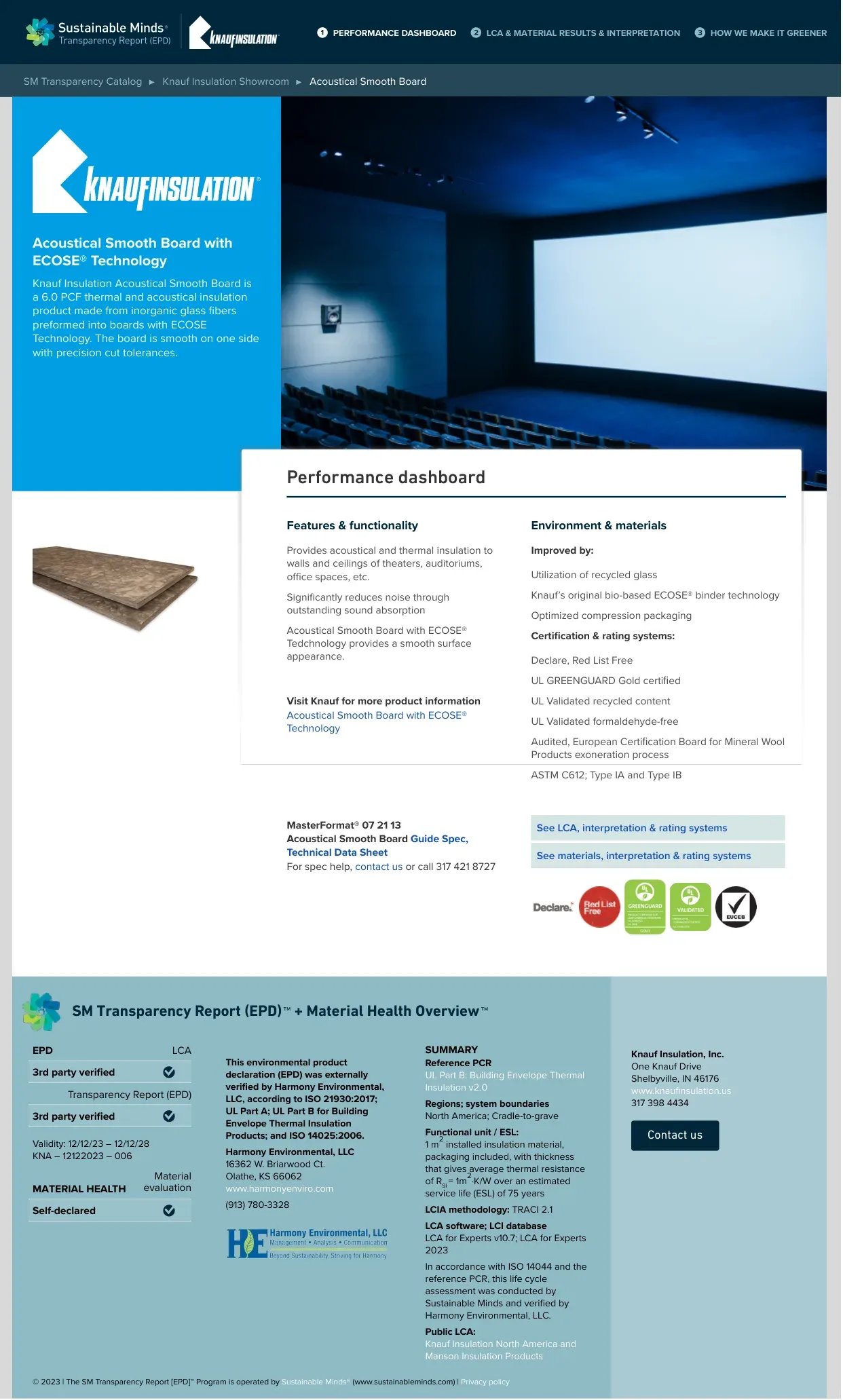
SM Transparency Catalog Knauf Insulation Showroom Acoustical Smooth Board PERFORMANCE DASHBOARDLCA & MATERIAL RESULTS & INTERPRETATIONHOW WE MAKE IT GREENERAcoustical Smooth Board withECOSE® TechnologyKnauf Insulation Acoustical Smooth Board isa 6.0 PCF thermal and acoustical insulationproduct made from inorganic glass fiberspreformed into boards with ECOSETechnology. The board is smooth on one sidewith precision cut tolerances.MasterFormat® 07 21 13Acoustical Smooth Board Guide Spec,Technical Data SheetFor spec help, contact us or call 317 421 8727See LCA, interpretation & rating systemsSee materials, interpretation & rating systemsFeatures & functionalityProvides acoustical and thermal insulation towalls and ceilings of theaters, auditoriums,office spaces, etc.Significantly reduces noise throughoutstanding sound absorptionAcoustical Smooth Board with ECOSE®Tedchnology provides a smooth surfaceappearance.Visit Knauf for more product informationAcoustical Smooth Board with ECOSE®TechnologyEnvironment & materialsImproved by:Utilization of recycled glassKnauf’s original bio-based ECOSE® binder technologyOptimized compression packagingCertification & rating systems:Declare, Red List FreeUL GREENGUARD Gold certifiedUL Validated recycled contentUL Validated formaldehyde-freeAudited, European Certification Board for Mineral WoolProducts exoneration processASTM C612; Type IA and Type IBPerformance dashboardValidity: 12/12/23 – 12/12/28KNA – 12122023 – 006This environmental productdeclaration (EPD) was externallyverified by Harmony Environmental,LLC, according to ISO 21930:2017;UL Part A; UL Part B for BuildingEnvelope Thermal InsulationProducts; and ISO 14025:2006.Harmony Environmental, LLC16362 W. Briarwood Ct.Olathe, KS 66062www.harmonyenviro.com(913) 780-3328SUMMARYReference PCRUL Part B: Building Envelope ThermalInsulation v2.0Regions; system boundariesNorth America; Cradle-to-graveFunctional unit / ESL:1 m installed insulation material,packaging included, with thicknessthat gives average thermal resistanceof R = 1m ·K/W over an estimatedservice life (ESL) of 75 yearsLCIA methodology: TRACI 2.1LCA software; LCI databaseLCA for Experts v10.7; LCA for Experts2023In accordance with ISO 14044 and thereference PCR, this life cycleassessment was conducted bySustainable Minds and verified byHarmony Environmental, LLC.Public LCA:Knauf Insulation North America andManson Insulation Products SM Transparency Report (EPD) ™ + Material Health Overview ™EPDLCA3rd party verifiedTransparency Report (EPD)3rd party verifiedMATERIAL HEALTHMaterialevaluationSelf-declared2SI 2© 2023 | The SM Transparency Report [EPD]™ Program is operated by Sustainable Minds® (www.sustainableminds.com) | Privacy policyKnauf Insulation, Inc.One Knauf DriveShelbyville, IN 46176www.knaufinsulation.us317 398 4434Contact us
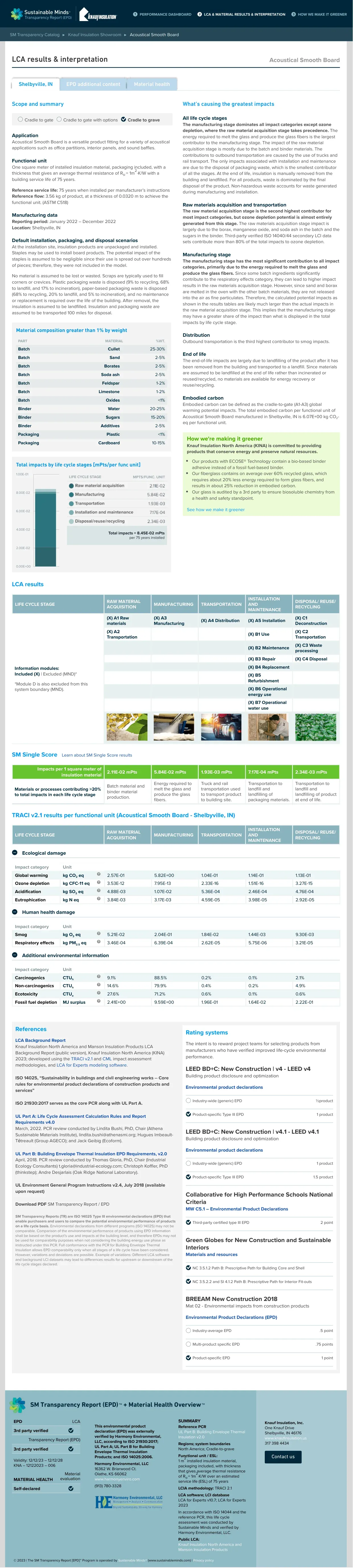
SM Transparency Catalog Knauf Insulation Showroom Acoustical Smooth Board PERFORMANCE DASHBOARDLCA & MATERIAL RESULTS & INTERPRETATIONHOW WE MAKE IT GREENERAcoustical Smooth BoardScope and summaryCradle to gate Cradle to gate with options Cradle to graveApplicationAcoustical Smooth Board is a versatile product fitting for a variety of acousticalapplications such as office partitions, interior panels, and sound baffles.Functional unitOne square meter of installed insulation material, packaging included, with athickness that gives an average thermal resistance of R = 1m ·K/W with abuilding service life of 75 years.Reference service life: 75 years when installed per manufacturer’s instructionsReference flow: 3.56 kg of product, at a thickness of 0.0320 m to achieve thefunctional unit. (ASTM C518)Manufacturing dataReporting period: January 2022 – December 2022Location: Shelbyville, INDefault installation, packaging, and disposal scenariosAt the installation site, insulation products are unpackaged and installed.Staples may be used to install board products. The potential impact of thestaples is assumed to be negligible since their use is spread out over hundredsof pieces; therefore, they were not included in the model.No material is assumed to be lost or wasted. Scraps are typically used to fillcorners or crevices. Plastic packaging waste is disposed (9% to recycling, 68%to landfill, and 17% to incineration), paper-based packaging waste is disposed(68% to recycling, 20% to landfill, and 5% to incineration), and no maintenanceor replacement is required over the life of the building. After removal, theinsulation is assumed to be landfilled. Insulation and packaging waste areassumed to be transported 100 miles for disposal.What’s causing the greatest impactsAll life cycle stagesThe manufacturing stage dominates all impact categories except ozonedepletion, where the raw material acquisition stage takes precedence. Theenergy required to melt the glass and produce the glass fibers is the largestcontributor to the manufacturing stage. The impact of the raw materialacquisition stage is mostly due to the batch and binder materials. Thecontributions to outbound transportation are caused by the use of trucks andrail transport. The only impacts associated with installation and maintenanceare due to the disposal of packaging waste, which is the smallest contributorof all the stages. At the end of life, insulation is manually removed from thebuilding and landfilled. For all products, waste is dominated by the finaldisposal of the product. Non-hazardous waste accounts for waste generatedduring manufacturing and installation.Raw materials acquisition and transportationThe raw material acquisition stage is the second highest contributor formost impact categories, but ozone depletion potential is almost entirelygenerated from this stage. The raw materials acquisition stage impact islargely due to the borax, manganese oxide, and soda ash in the batch and thesugars in the binder. Third-party verified ISO 14040/44 secondary LCI datasets contribute more than 80% of the total impacts to ozone depletion.Manufacturing stageThe manufacturing stage has the most significant contribution to all impactcategories, primarily due to the energy required to melt the glass andproduce the glass fibers. Since some batch ingredients significantlycontribute to the respiratory effects category, they can lead to higher impactresults in the raw materials acquisition stage. However, since sand and boraxare melted in the oven with the other batch materials, they are not releasedinto the air as fine particulates. Therefore, the calculated potential impacts asshown in the results tables are likely much larger than the actual impacts inthe raw material acquisition stage. This implies that the manufacturing stagemay have a greater share of the impact than what is displayed in the totalimpacts by life cycle stage.DistributionOutbound transportation is the third highest contributor to smog impacts.End of lifeThe end-of-life impacts are largely due to landfilling of the product after it hasbeen removed from the building and transported to a landfill. Since materialsare assumed to be landfilled at the end of life rather than incinerated orreused/recycled, no materials are available for energy recovery orreuse/recycling.Embodied carbonEmbodied carbon can be defined as the cradle-to-gate (A1-A3) globalwarming potential impacts. The total embodied carbon per functional unit ofAcoustical Smooth Board manufactured in Shelbyville, IN is 6.07E+00 kg CO -eq per functional unit.How we're making it greenerKnauf Insulation North America (KINA) is committed to providingproducts that conserve energy and preserve natural resources.Our products with ECOSE® Technology contain a bio-based binderadhesive instead of a fossil fuel-based binder.Our fiberglass contains on average over 60% recycled glass, whichrequires about 20% less energy required to form glass fibers, andresults in about 25% reduction in embodied carbon.Our glass is audited by a 3rd party to ensure biosoluble chemistry froma health and safety standpoint.See how we make it greenerReferencesLCA Background ReportKnauf Insulation North America and Manson Insulation Products LCABackground Report (public version), Knauf Insulation North America (KINA)2023; developed using the TRACI v2.1 and CML impact assessmentmethodologies, and LCA for Experts modeling software.ISO 14025, “Sustainability in buildings and civil engineering works -- Corerules for environmental product declarations of construction products andservices”ISO 21930:2017 serves as the core PCR along with UL Part A.UL Part A: Life Cycle Assessment Calculation Rules and ReportRequirements v4.0March, 2022. PCR review conducted by Lindita Bushi, PhD, Chair (AthenaSustainable Materials Institute), lindita.bushi@athenasmi.org; Hugues Imbeault-Tétreault (Group AGECO); and Jack Geibig (Ecoform).UL Part B: Building Envelope Thermal Insulation EPD Requirements, v2.0April, 2018. PCR review conducted by Thomas Gloria, PhD, Chair (IndustrialEcology Consultants) t.gloria@industrial-ecology.com; Christoph Koffler, PhD(thinkstep); Andre Desjarlais (Oak Ridge National Laboratory).UL Environment General Program Instructions v2.4, July 2018 (availableupon request)Download PDF SM Transparency Report / EPDSM Transparency Reports (TR) are ISO 14025 Type III environmental declarations (EPD) thatenable purchasers and users to compare the potential environmental performance of productson a life cycle basis. Environmental declarations from different programs (ISO 14025) may not becomparable. Comparison of the environmental performance of products using EPD informationshall be based on the product’s use and impacts at the building level, and therefore EPDs may notbe used for comparability purposes when not considering the building energy use phase asinstructed under this PCR. Full conformance with the PCR for Building Envelope ThermalInsulation allows EPD comparability only when all stages of a life cycle have been considered.However, variations and deviations are possible. Example of variations: Different LCA softwareand background LCI datasets may lead to differences results for upstream or downstream of thelife cycle stages declared.Rating systemsThe intent is to reward project teams for selecting products frommanufacturers who have verified improved life-cycle environmentalperformance.LEED BD+C: New Construction | v4 - LEED v4Building product disclosure and optimizationEnvironmental product declarations½productIndustry-wide (generic) EPD1 productProduct-specific Type III EPDLEED BD+C: New Construction | v4.1 - LEED v4.1Building product disclosure and optimizationEnvironmental product declarations1 productIndustry-wide (generic) EPD1.5 productProduct-specific Type III EPDCollaborative for High Performance Schools NationalCriteriaMW C5.1 – Environmental Product Declarations2 pointThird-party certified type III EPDGreen Globes for New Construction and SustainableInteriorsMaterials and resourcesNC 3.5.1.2 Path B: Prescriptive Path for Building Core and ShellNC 3.5.2.2 and SI 4.1.2 Path B: Prescriptive Path for Interior Fit-outsBREEAM New Construction 2018Mat 02 - Environmental impacts from construction productsEnvironmental Product Declarations (EPD).5 pointIndustry-average EPD.75 pointsMulti-product specific EPD1 pointProduct-specific EPDLCA results & interpretationLCA resultsLIFE CYCLE STAGERAW MATERIALACQUISITIONMANUFACTURINGTRANSPORTATIONINSTALLATIONANDMAINTENANCEDISPOSAL/ REUSE/RECYCLINGInformation modules:Included (X) | Excluded (MND)**Module D is also excluded from thissystem boundary (MND).(X) A1 Rawmaterials(X) A3Manufacturing(X) A4 Distribution(X) A5 Installation(X) C1Deconstruction(X) A2Transportation (X) B1 Use(X) C2Transportation (X) B2 Maintenance(X) C3 Wasteprocessing (X) B3 Repair(X) C4 Disposal (X) B4 Replacement (X) B5Refurbishment (X) B6 Operationalenergy use (X) B7 Operationalwater use SM Single Score Learn about SM Single Score resultsImpacts per 1 square meter ofinsulation material2.11E-02 mPts5.84E-02 mPts1.93E-03 mPts7.17E-04 mPts2.34E-03 mPtsMaterials or processes contributing >20%to total impacts in each life cycle stageBatch material andbinder materialproduction.Energy required tomelt the glass andproduce the glassfibers.Truck and railtransportation usedto transport productto building site.Transportation tolandfill andlandfilling ofpackaging materials.Transportation tolandfill andlandfilling of productat end of life.TRACI v2.1 results per functional unit (Acoustical Smooth Board - Shelbyville, IN)LIFE CYCLE STAGERAW MATERIALACQUISITIONMANUFACTURINGTRANSPORTATIONINSTALLATIONANDMAINTENANCEDISPOSAL/ REUSE/RECYCLINGEcological damageImpact categoryUnitGlobal warmingkg CO eq2.57E-015.82E+001.04E-011.14E-011.13E-01Ozone depletionkg CFC-11 eq3.53E-127.95E-132.33E-161.51E-163.27E-15Acidificationkg SO eq4.88E-031.07E-025.36E-042.46E-044.76E-04Eutrophicationkg N eq3.84E-033.17E-034.59E-053.98E-052.92E-05Human health damageImpact categoryUnitSmogkg O eq5.21E-022.04E-011.84E-021.44E-039.30E-03Respiratory effectskg PM eq3.46E-046.39E-042.62E-055.75E-063.21E-05Additional environmental informationImpact categoryUnitCarcinogenicsCTU9.1%88.5%0.2%0.1%2.1%Non-carcinogenicsCTU14.6%79.9%0.4%0.2%4.9%EcotoxicityCTU27.6%71.2%0.6%0.1%0.6%Fossil fuel depletionMJ surplus2.41E+009.59E+001.96E-011.64E-022.22E-01 EPD additional contentMaterial healthSI 222232.5hheValidity: 12/12/23 – 12/12/28KNA – 12122023 – 006This environmental productdeclaration (EPD) was externallyverified by Harmony Environmental,LLC, according to ISO 21930:2017;UL Part A; UL Part B for BuildingEnvelope Thermal InsulationProducts; and ISO 14025:2006.Harmony Environmental, LLC16362 W. Briarwood Ct.Olathe, KS 66062www.harmonyenviro.com(913) 780-3328SUMMARYReference PCRUL Part B: Building Envelope ThermalInsulation v2.0Regions; system boundariesNorth America; Cradle-to-graveFunctional unit / ESL:1 m installed insulation material,packaging included, with thicknessthat gives average thermal resistanceof R = 1m ·K/W over an estimatedservice life (ESL) of 75 yearsLCIA methodology: TRACI 2.1LCA software; LCI databaseLCA for Experts v10.7; LCA for Experts2023In accordance with ISO 14044 and thereference PCR, this life cycleassessment was conducted bySustainable Minds and verified byHarmony Environmental, LLC.Public LCA:Knauf Insulation North America andManson Insulation Products SM Transparency Report (EPD) ™ + Material Health Overview ™EPDLCA3rd party verifiedTransparency Report (EPD)3rd party verifiedMATERIAL HEALTHMaterialevaluationSelf-declared2SI 2© 2023 | The SM Transparency Report [EPD]™ Program is operated by Sustainable Minds® (www.sustainableminds.com) | Privacy policyKnauf Insulation, Inc.One Knauf DriveShelbyville, IN 46176www.knaufinsulation.us317 398 4434Contact usShelbyville, IN
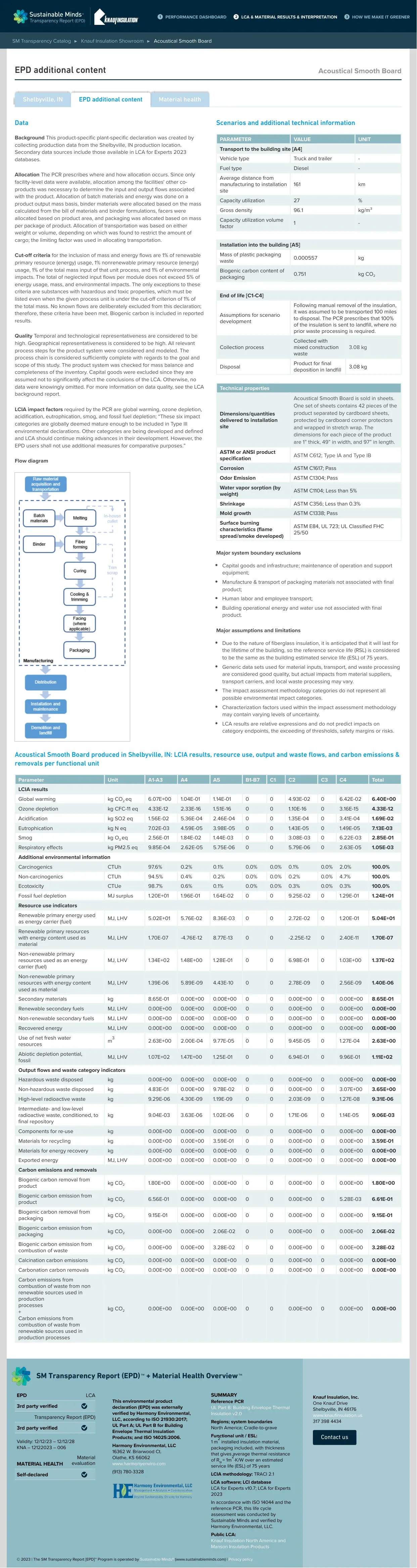
SM Transparency Catalog Knauf Insulation Showroom Acoustical Smooth Board PERFORMANCE DASHBOARDLCA & MATERIAL RESULTS & INTERPRETATIONHOW WE MAKE IT GREENERAcoustical Smooth BoardDataBackground This product-specific plant-specific declaration was created bycollecting production data from the Shelbyville, IN production location.Secondary data sources include those available in LCA for Experts 2023databases.Allocation The PCR prescribes where and how allocation occurs. Since onlyfacility-level data were available, allocation among the facilities' other co-products was necessary to determine the input and output flows associatedwith the product. Allocation of batch materials and energy was done on aproduct output mass basis, binder materials were allocated based on the masscalculated from the bill of materials and binder formulations, facers wereallocated based on product area, and packaging was allocated based on massper package of product. Allocation of transportation was based on eitherweight or volume, depending on which was found to restrict the amount ofcargo; the limiting factor was used in allocating transportation.Cut-off criteria for the inclusion of mass and energy flows are 1% of renewableprimary resource (energy) usage, 1% nonrenewable primary resource (energy)usage, 1% of the total mass input of that unit process, and 1% of environmentalimpacts. The total of neglected input flows per module does not exceed 5% ofenergy usage, mass, and environmental impacts. The only exceptions to thesecriteria are substances with hazardous and toxic properties, which must belisted even when the given process unit is under the cut-off criterion of 1% ofthe total mass. No known flows are deliberately excluded from this declaration;therefore, these criteria have been met. Biogenic carbon is included in reportedresults.Quality Temporal and technological representativeness are considered to behigh. Geographical representativeness is considered to be high. All relevantprocess steps for the product system were considered and modeled. Theprocess chain is considered sufficiently complete with regards to the goal andscope of this study. The product system was checked for mass balance andcompleteness of the inventory. Capital goods were excluded since they areassumed not to significantly affect the conclusions of the LCA. Otherwise, nodata were knowingly omitted. For more information on data quality, see the LCAbackground report.LCIA impact factors required by the PCR are global warming, ozone depletion,acidification, eutrophication, smog, and fossil fuel depletion; “These six impactcategories are globally deemed mature enough to be included in Type IIIenvironmental declarations. Other categories are being developed and definedand LCA should continue making advances in their development. However, theEPD users shall not use additional measures for comparative purposes.”Flow diagramScenarios and additional technical informationPARAMETERVALUEUNITTransport to the building site [A4]Vehicle typeTruck and trailer-Fuel typeDiesel-Average distance frommanufacturing to installationsite161kmCapacity utilization27%Gross density96.1kg/m³Capacity utilization volumefactor1-Installation into the building [A5]Mass of plastic packagingwaste0.000557kgBiogenic carbon content ofpackaging0.751kg COEnd of life [C1-C4]Assumptions for scenariodevelopmentFollowing manual removal of the insulation,it was assumed to be transported 100 milesto disposal. The PCR prescribes that 100%of the insulation is sent to landfill, where noprior waste processing is required.Collection processCollected withmixed constructionwaste3.08 kgDisposalProduct for finaldeposition in landfill3.08 kgTechnical propertiesDimensions/quantitiesdelivered to installationsiteAcoustical Smooth Board is sold in sheets.One set of sheets contains 42 pieces of theproduct separated by cardboard sheets,protected by cardboard corner protectorsand wrapped in stretch wrap. Thedimensions for each piece of the productare 1” thick, 49” in width, and 97” in length.ASTM or ANSI productspecificationASTM C612; Type IA and Type IBCorrosionASTM C1617; PassOdor EmissionASTM C1304; PassWater vapor sorption (byweight)ASTM C1104; Less than 5%ShrinkageASTM C356; Less than 0.3%Mold growthASTM C1338; PassSurface burningcharacteristics (flamespread/smoke developed)ASTM E84, UL 723; UL Classified FHC25/50Major system boundary exclusionsCapital goods and infrastructure; maintenance of operation and supportequipment;Manufacture & transport of packaging materials not associated with finalproduct;Human labor and employee transport;Building operational energy and water use not associated with finalproduct.Major assumptions and limitationsDue to the nature of fiberglass insulation, it is anticipated that it will last forthe lifetime of the building, so the reference service life (RSL) is consideredto be the same as the building estimated service life (ESL) of 75 years.Generic data sets used for material inputs, transport, and waste processingare considered good quality, but actual impacts from material suppliers,transport carriers, and local waste processing may vary.The impact assessment methodology categories do not represent allpossible environmental impact categories.Characterization factors used within the impact assessment methodologymay contain varying levels of uncertainty.LCA results are relative expressions and do not predict impacts oncategory endpoints, the exceeding of thresholds, safety margins or risks.EPD additional contentAcoustical Smooth Board produced in Shelbyville, IN: LCIA results, resource use, output and waste flows, and carbon emissions &removals per functional unitParameterUnitA1-A3A4A5B1-B7C1C2C3C4TotalLCIA resultsGlobal warmingkg CO eq6.07E+001.04E-011.14E-01004.93E-0206.42E-026.40E+00Ozone depletionkg CFC-11 eq4.33E-122.33E-161.51E-16001.10E-1603.16E-154.33E-12Acidificationkg SO2 eq1.56E-025.36E-042.46E-04001.35E-0403.41E-041.69E-02Eutrophicationkg N eq7.02E-034.59E-053.98E-05001.43E-0501.49E-057.13E-03Smogkg O eq2.56E-011.84E-021.44E-03003.08E-0306.22E-032.85E-01Respiratory effectskg PM2.5 eq9.85E-042.62E-055.75E-06005.79E-0602.63E-051.05E-03Additional environmental informationCarcinogenicsCTUh97.6%0.2%0.1%0.0%0.0%0.1%0.0%2.0%100.0%Non-carcinogenicsCTUh94.5%0.4%0.2%0.0%0.0%0.2%0.0%4.7%100.0%EcotoxicityCTUe98.7%0.6%0.1%0.0%0.0%0.3%0.0%0.3%100.0%Fossil fuel depletionMJ surplus1.20E+011.96E-011.64E-02009.25E-0201.29E-011.24E+01Resource use indicatorsRenewable primary energy usedas energy carrier (fuel)MJ, LHV5.02E+015.76E-028.36E-03002.72E-0201.20E-015.04E+01Renewable primary resourceswith energy content used asmaterialMJ, LHV1.70E-07-4.76E-128.77E-1300-2.25E-1202.40E-111.70E-07Non-renewable primaryresources used as an energycarrier (fuel)MJ, LHV1.34E+021.48E+001.28E-01006.98E-0101.03E+001.37E+02Non-renewable primaryresources with energy contentused as materialMJ, LHV1.39E-065.89E-094.43E-10002.78E-0902.56E-091.40E-06Secondary materialskg8.65E-010.00E+000.00E+00000.00E+0000.00E+008.65E-01Renewable secondary fuelsMJ, LHV0.00E+000.00E+000.00E+00000.00E+0000.00E+000.00E+00Non-renewable secondary fuelsMJ, LHV0.00E+000.00E+000.00E+00000.00E+0000.00E+000.00E+00Recovered energyMJ, LHV0.00E+000.00E+000.00E+00000.00E+0000.00E+000.00E+00Use of net fresh waterresourcesm2.63E+002.00E-049.77E-05009.45E-0501.27E-042.63E+00Abiotic depletion potential,fossilMJ, LHV1.07E+021.47E+001.25E-01006.94E-0109.96E-011.11E+02Output flows and waste category indicatorsHazardous waste disposedkg0.00E+000.00E+000.00E+00000.00E+0000.00E+000.00E+00Non-hazardous waste disposedkg4.83E-010.00E+009.78E-02000.00E+0003.07E+003.65E+00High-level radioactive wastekg9.29E-064.30E-091.19E-09002.03E-0901.27E-089.31E-06Intermediate- and low-levelradioactive waste, conditioned, tofinal repositorykg9.04E-033.63E-061.02E-06001.71E-0601.14E-059.06E-03Components for re-usekg0.00E+000.00E+000.00E+00000.00E+0000.00E+000.00E+00Materials for recyclingkg0.00E+000.00E+003.59E-01000.00E+0000.00E+003.59E-01Materials for energy recoverykg0.00E+000.00E+000.00E+00000.00E+0000.00E+000.00E+00Exported energyMJ, LHV0.00E+000.00E+000.00E+00000.00E+0000.00E+000.00E+00Carbon emissions and removalsBiogenic carbon removal fromproductkg CO1.80E+000.00E+000.00E+00000.00E+0000.00E+001.80E+00Biogenic carbon emission fromproductkg CO6.56E-010.00E+000.00E+00000.00E+0005.28E-036.61E-01Biogenic carbon removal frompackagingkg CO9.15E-010.00E+000.00E+00000.00E+0000.00E+009.15E-01Biogenic carbon emission frompackagingkg CO0.00E+000.00E+002.06E-02000.00E+0000.00E+002.06E-02Biogenic carbon emission fromcombustion of wastekg CO0.00E+000.00E+003.28E-02000.00E+0000.00E+003.28E-02Calcination carbon emissionskg CO0.00E+000.00E+000.00E+00000.00E+0000.00E+000.00E+00Carbonation carbon removalskg CO0.00E+000.00E+000.00E+00000.00E+0000.00E+000.00E+00Carbon emissions fromcombustion of waste from nonrenewable sources used inproductionprocesses+Carbon emissions fromcombustion of waste fromrenewable sources used inproduction processeskg CO0.00E+000.00E+000.00E+00000.00E+0000.00E+000.00E+00 Shelbyville, INMaterial health22 3 322222222Validity: 12/12/23 – 12/12/28KNA – 12122023 – 006This environmental productdeclaration (EPD) was externallyverified by Harmony Environmental,LLC, according to ISO 21930:2017;UL Part A; UL Part B for BuildingEnvelope Thermal InsulationProducts; and ISO 14025:2006.Harmony Environmental, LLC16362 W. Briarwood Ct.Olathe, KS 66062www.harmonyenviro.com(913) 780-3328SUMMARYReference PCRUL Part B: Building Envelope ThermalInsulation v2.0Regions; system boundariesNorth America; Cradle-to-graveFunctional unit / ESL:1 m installed insulation material,packaging included, with thicknessthat gives average thermal resistanceof R = 1m ·K/W over an estimatedservice life (ESL) of 75 yearsLCIA methodology: TRACI 2.1LCA software; LCI databaseLCA for Experts v10.7; LCA for Experts2023In accordance with ISO 14044 and thereference PCR, this life cycleassessment was conducted bySustainable Minds and verified byHarmony Environmental, LLC.Public LCA:Knauf Insulation North America andManson Insulation Products SM Transparency Report (EPD) ™ + Material Health Overview ™EPDLCA3rd party verifiedTransparency Report (EPD)3rd party verifiedMATERIAL HEALTHMaterialevaluationSelf-declared2SI 2© 2023 | The SM Transparency Report [EPD]™ Program is operated by Sustainable Minds® (www.sustainableminds.com) | Privacy policyKnauf Insulation, Inc.One Knauf DriveShelbyville, IN 46176www.knaufinsulation.us317 398 4434Contact usEPD additional content
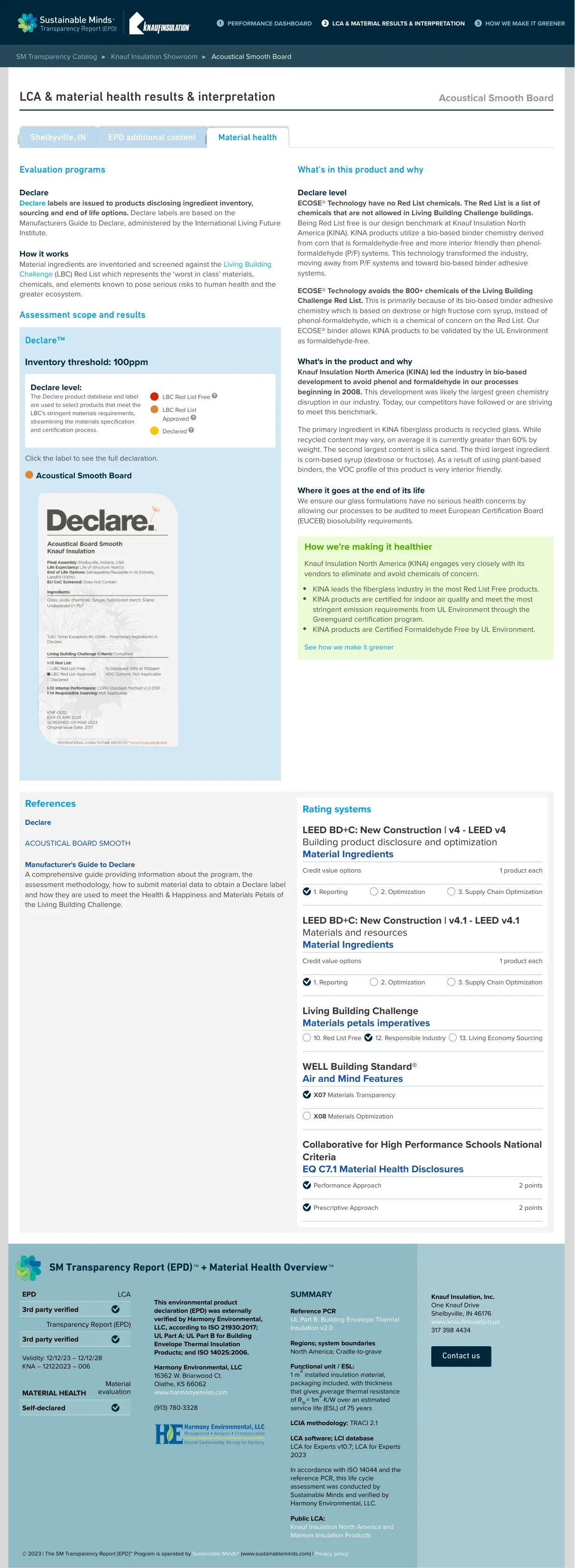
SM Transparency Catalog Knauf Insulation Showroom Acoustical Smooth Board PERFORMANCE DASHBOARDLCA & MATERIAL RESULTS & INTERPRETATIONHOW WE MAKE IT GREENERAcoustical Smooth BoardDeclare™Inventory threshold: 100ppmClick the label to see the full declaration.Acoustical Smooth BoardEvaluation programsDeclareDeclare labels are issued to products disclosing ingredient inventory,sourcing and end of life options. Declare labels are based on theManufacturers Guide to Declare, administered by the International Living FutureInstitute.How it worksMaterial ingredients are inventoried and screened against the Living BuildingChallenge (LBC) Red List which represents the ‘worst in class’ materials,chemicals, and elements known to pose serious risks to human health and thegreater ecosystem.Assessment scope and resultsWhat's in this product and whyDeclare levelECOSE® Technology have no Red List chemicals. The Red List is a list ofchemicals that are not allowed in Living Building Challenge buildings.Being Red List free is our design benchmark at Knauf Insulation NorthAmerica (KINA). KINA products utilize a bio-based binder chemistry derivedfrom corn that is formaldehyde-free and more interior friendly than phenol-formaldehyde (P/F) systems. This technology transformed the industry,moving away from P/F systems and toward bio-based binder adhesivesystems.ECOSE® Technology avoids the 800+ chemicals of the Living BuildingChallenge Red List. This is primarily because of its bio-based binder adhesivechemistry which is based on dextrose or high fructose corn syrup, instead ofphenol-formaldehyde, which is a chemical of concern on the Red List. OurECOSE® binder allows KINA products to be validated by the UL Environmentas formaldehyde-free.What's in the product and whyKnauf Insulation North America (KINA) led the industry in bio-baseddevelopment to avoid phenol and formaldehyde in our processesbeginning in 2008. This development was likely the largest green chemistrydisruption in our industry. Today, our competitors have followed or are strivingto meet this benchmark.The primary ingredient in KINA fiberglass products is recycled glass. Whilerecycled content may vary, on average it is currently greater than 60% byweight. The second largest content is silica sand. The third largest ingredientis corn-based syrup (dextrose or fructose). As a result of using plant-basedbinders, the VOC profile of this product is very interior friendly.Where it goes at the end of its lifeWe ensure our glass formulations have no serious health concerns byallowing our processes to be audited to meet European Certification Board(EUCEB) biosolubility requirements.How we're making it healthierKnauf Insulation North America (KINA) engages very closely with itsvendors to eliminate and avoid chemicals of concern.KINA leads the fiberglass industry in the most Red List Free products.KINA products are certified for indoor air quality and meet the moststringent emission requirements from UL Environment through theGreenguard certification program.KINA products are Certified Formaldehyde Free by UL Environment.See how we make it greenerReferencesDeclareACOUSTICAL BOARD SMOOTHManufacturer's Guide to DeclareA comprehensive guide providing information about the program, theassessment methodology, how to submit material data to obtain a Declare labeland how they are used to meet the Health & Happiness and Materials Petals ofthe Living Building Challenge.Rating systemsLEED BD+C: New Construction | v4 - LEED v4Building product disclosure and optimizationMaterial Ingredients1 product eachCredit value options1. Reporting2. Optimization3. Supply Chain OptimizationLEED BD+C: New Construction | v4.1 - LEED v4.1Materials and resourcesMaterial Ingredients1 product eachCredit value options1. Reporting2. Optimization3. Supply Chain OptimizationLiving Building ChallengeMaterials petals imperatives10. Red List Free12. Responsible Industry13. Living Economy SourcingWELL Building Standard®Air and Mind FeaturesX07 Materials TransparencyX08 Materials OptimizationCollaborative for High Performance Schools NationalCriteriaEQ C7.1 Material Health Disclosures2 pointsPerformance Approach2 pointsPrescriptive ApproachLCA & material health results & interpretation Shelbyville, INEPD additional contentThe Declare product database and labelare used to select products that meet theLBC's stringent materials requirements,streamlining the materials specificationand certification process.LBC Red List Free LBC Red ListApproved Declared Declare level:Validity: 12/12/23 – 12/12/28KNA – 12122023 – 006This environmental productdeclaration (EPD) was externallyverified by Harmony Environmental,LLC, according to ISO 21930:2017;UL Part A; UL Part B for BuildingEnvelope Thermal InsulationProducts; and ISO 14025:2006.Harmony Environmental, LLC16362 W. Briarwood Ct.Olathe, KS 66062www.harmonyenviro.com(913) 780-3328SUMMARYReference PCRUL Part B: Building Envelope ThermalInsulation v2.0Regions; system boundariesNorth America; Cradle-to-graveFunctional unit / ESL:1 m installed insulation material,packaging included, with thicknessthat gives average thermal resistanceof R = 1m ·K/W over an estimatedservice life (ESL) of 75 yearsLCIA methodology: TRACI 2.1LCA software; LCI databaseLCA for Experts v10.7; LCA for Experts2023In accordance with ISO 14044 and thereference PCR, this life cycleassessment was conducted bySustainable Minds and verified byHarmony Environmental, LLC.Public LCA:Knauf Insulation North America andManson Insulation Products SM Transparency Report (EPD) ™ + Material Health Overview ™EPDLCA3rd party verifiedTransparency Report (EPD)3rd party verifiedMATERIAL HEALTHMaterialevaluationSelf-declared2SI 2© 2023 | The SM Transparency Report [EPD]™ Program is operated by Sustainable Minds® (www.sustainableminds.com) | Privacy policyKnauf Insulation, Inc.One Knauf DriveShelbyville, IN 46176www.knaufinsulation.us317 398 4434Contact usMaterial health
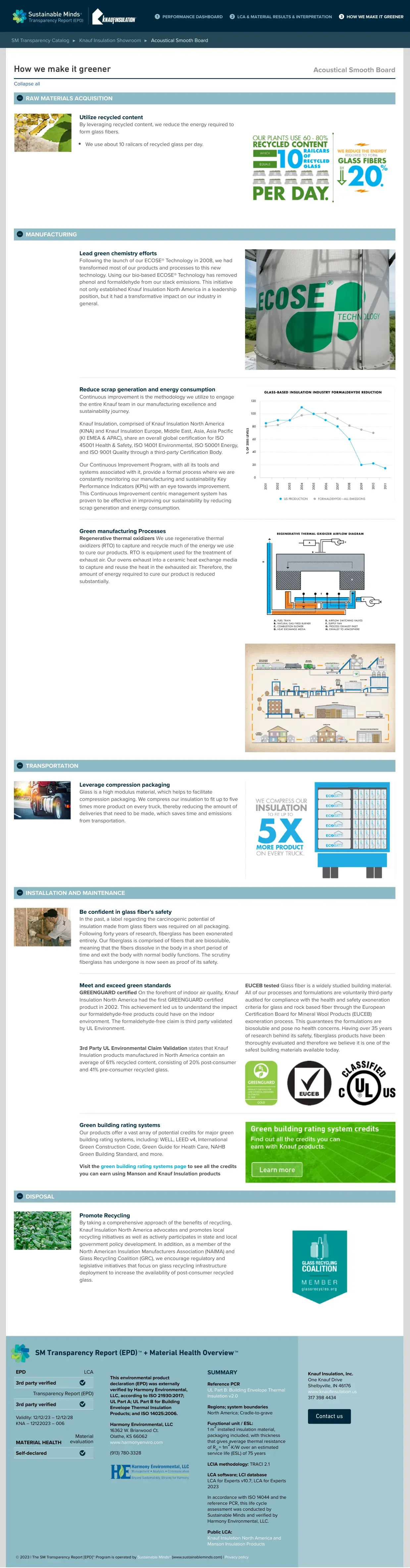
SM Transparency Catalog Knauf Insulation Showroom Acoustical Smooth Board PERFORMANCE DASHBOARDLCA & MATERIAL RESULTS & INTERPRETATIONHOW WE MAKE IT GREENERAcoustical Smooth BoardHow we make it greenerCollapse allRAW MATERIALS ACQUISITIONMANUFACTURINGTRANSPORTATIONINSTALLATION AND MAINTENANCEDISPOSALUtilize recycled contentBy leveraging recycled content, we reduce the energy required toform glass fibers.We use about 10 railcars of recycled glass per day.Lead green chemistry effortsFollowing the launch of our ECOSE® Technology in 2008, we hadtransformed most of our products and processes to this newtechnology. Using our bio-based ECOSE® Technology has removedphenol and formaldehyde from our stack emissions. This initiativenot only established Knauf Insulation North America in a leadershipposition, but it had a transformative impact on our industry ingeneral.Reduce scrap generation and energy consumptionContinuous improvement is the methodology we utilize to engagethe entire Knauf team in our manufacturing excellence andsustainability journey.Knauf Insulation, comprised of Knauf Insulation North America(KINA) and Knauf Insulation Europe, Middle East, Asia, Asia Pacific(KI EMEA & APAC), share an overall global certification for ISO45001 Health & Safety, ISO 14001 Environmental, ISO 50001 Energy,and ISO 9001 Quality through a third-party Certification Body.Our Continuous Improvement Program, with all its tools andsystems associated with it, provide a formal process where we areconstantly monitoring our manufacturing and sustainability KeyPerformance Indicators (KPIs) with an eye towards improvement.This Continuous Improvement centric management system hasproven to be effective in improving our sustainability by reducingscrap generation and energy consumption.Green manufacturing ProcessesRegenerative thermal oxidizers We use regenerative thermaloxidizers (RTO) to capture and recycle much of the energy we useto cure our products. RTO is equipment used for the treatment ofexhaust air. Our ovens exhaust into a ceramic heat exchange mediato capture and reuse the heat in the exhausted air. Therefore, theamount of energy required to cure our product is reducedsubstantially.Leverage compression packagingGlass is a high modulus material, which helps to facilitatecompression packaging. We compress our insulation to fit up to fivetimes more product on every truck, thereby reducing the amount ofdeliveries that need to be made, which saves time and emissionsfrom transportation.Be confident in glass fiber's safetyIn the past, a label regarding the carcinogenic potential ofinsulation made from glass fibers was required on all packaging.Following forty years of research, fiberglass has been exoneratedentirely. Our fiberglass is comprised of fibers that are biosoluble,meaning that the fibers dissolve in the body in a short period oftime and exit the body with normal bodily functions. The scrutinyfiberglass has undergone is now seen as proof of its safety.Meet and exceed green standardsGREENGUARD certified On the forefront of indoor air quality, KnaufInsulation North America had the first GREENGUARD certifiedproduct in 2002. This achievement led us to understand the impactour formaldehyde-free products could have on the indoorenvironment. The formaldehyde-free claim is third party validatedby UL Environment.3rd Party UL Environmental Claim Validation states that KnaufInsulation products manufactured in North America contain anaverage of 61% recycled content, consisting of 20% post-consumerand 41% pre-consumer recycled glass.EUCEB tested Glass fiber is a widely studied building material.All of our processes and formulations are voluntarily third-partyaudited for compliance with the health and safety exonerationcriteria for glass and rock based fiber through the EuropeanCertification Board for Mineral Wool Products (EUCEB)exoneration process. This guarantees the formulations arebiosoluble and pose no health concerns. Having over 35 yearsof research behind its safety, fiberglass products have beenthoroughly evaluated and therefore we believe it is one of thesafest building materials available today.Green building rating systemsOur products offer a vast array of potential credits for major greenbuilding rating systems, including: WELL, LEED v4, InternationalGreen Construction Code, Green Guide for Heath Care, NAHBGreen Building Standard, and more.Visit the green building rating systems page to see all the creditsyou can earn using Manson and Knauf Insulation productsPromote RecyclingBy taking a comprehensive approach of the benefits of recycling,Knauf Insulation North America advocates and promotes localrecycling initiatives as well as actively participates in state and localgovernment policy development. In addition, as a member of theNorth American Insulation Manufacturers Association (NAIMA) andGlass Recycling Coalition (GRC), we encourage regulatory andlegislative initiatives that focus on glass recycling infrastructuredeployment to increase the availability of post-consumer recycledglass.Validity: 12/12/23 – 12/12/28KNA – 12122023 – 006This environmental productdeclaration (EPD) was externallyverified by Harmony Environmental,LLC, according to ISO 21930:2017;UL Part A; UL Part B for BuildingEnvelope Thermal InsulationProducts; and ISO 14025:2006.Harmony Environmental, LLC16362 W. Briarwood Ct.Olathe, KS 66062www.harmonyenviro.com(913) 780-3328SUMMARYReference PCRUL Part B: Building Envelope ThermalInsulation v2.0Regions; system boundariesNorth America; Cradle-to-graveFunctional unit / ESL:1 m installed insulation material,packaging included, with thicknessthat gives average thermal resistanceof R = 1m ·K/W over an estimatedservice life (ESL) of 75 yearsLCIA methodology: TRACI 2.1LCA software; LCI databaseLCA for Experts v10.7; LCA for Experts2023In accordance with ISO 14044 and thereference PCR, this life cycleassessment was conducted bySustainable Minds and verified byHarmony Environmental, LLC.Public LCA:Knauf Insulation North America andManson Insulation Products SM Transparency Report (EPD) ™ + Material Health Overview ™EPDLCA3rd party verifiedTransparency Report (EPD)3rd party verifiedMATERIAL HEALTHMaterialevaluationSelf-declared2SI 2© 2023 | The SM Transparency Report [EPD]™ Program is operated by Sustainable Minds® (www.sustainableminds.com) | Privacy policyKnauf Insulation, Inc.One Knauf DriveShelbyville, IN 46176www.knaufinsulation.us317 398 4434Contact us
