In accordance with ISO 14025 and EN 15804:2012+A1:2013 for: Blowing wool insulation λ 0.037 - 0.042 W/mK From Program: The International EPD® System www.environdec.com Programme operator: EPD International AB EPD registration number: S-P-01756 Publication date: 2019-10-27 Validity date: 2024-12-22 ENVIRONMENTAL PRODUCT DECLARATION
Blowing wool insulation EPD S-P-01756 2 Programme-related information and verification EPD programme: The International EPD® System EPD programme operator: EPD International AB Box 210 60 SE-100 31 Stockholm - Sweden www.environdec.com info@environdec.com EPD registration number: S-P-01756 Published: 2019-10-27 Valid until: 2024-12-22 EPD owner: Knauf Insulation (Northern Europe) Stafford Road St Helens Merseyside WA10 3N - UK Product Category Rules: CEN standard EN 15804+A1 serves as the Core Product Category Rules (PCR) PCR 2012:01. Construction products and construction services. Version 2.3 Sub-PCR-I Thermal insulation products (EN 16783). Version 2018-11-22 PCR review conducted by: The Technical Committee of the International EPD® System Independent third-party verification of the declaration and data, according to ISO 14025:2006: ☐ internal certification ☒ external verification Third-party Verifier: Ugo Pretato Studio Fieschi & Soci S.r.l. Italy Procedure for follow-up of data during EPD validity involves third-party Verifier: ☒ Yes ☐ No LCA conducted by: EuGeos Limited, UK +44 (0)1625 434423 www.eugeos.co.uk Product group classification: UN CPC 37 Reference year for manufacturing data: 2018 Geographical application scope: Europe The EPD owner has the sole ownership, liability and responsibility for the EPD. EPDs within the same product category but from different programmes may not be comparable. EPDs of construction products may not be comparable if they do not comply with EN 15804.
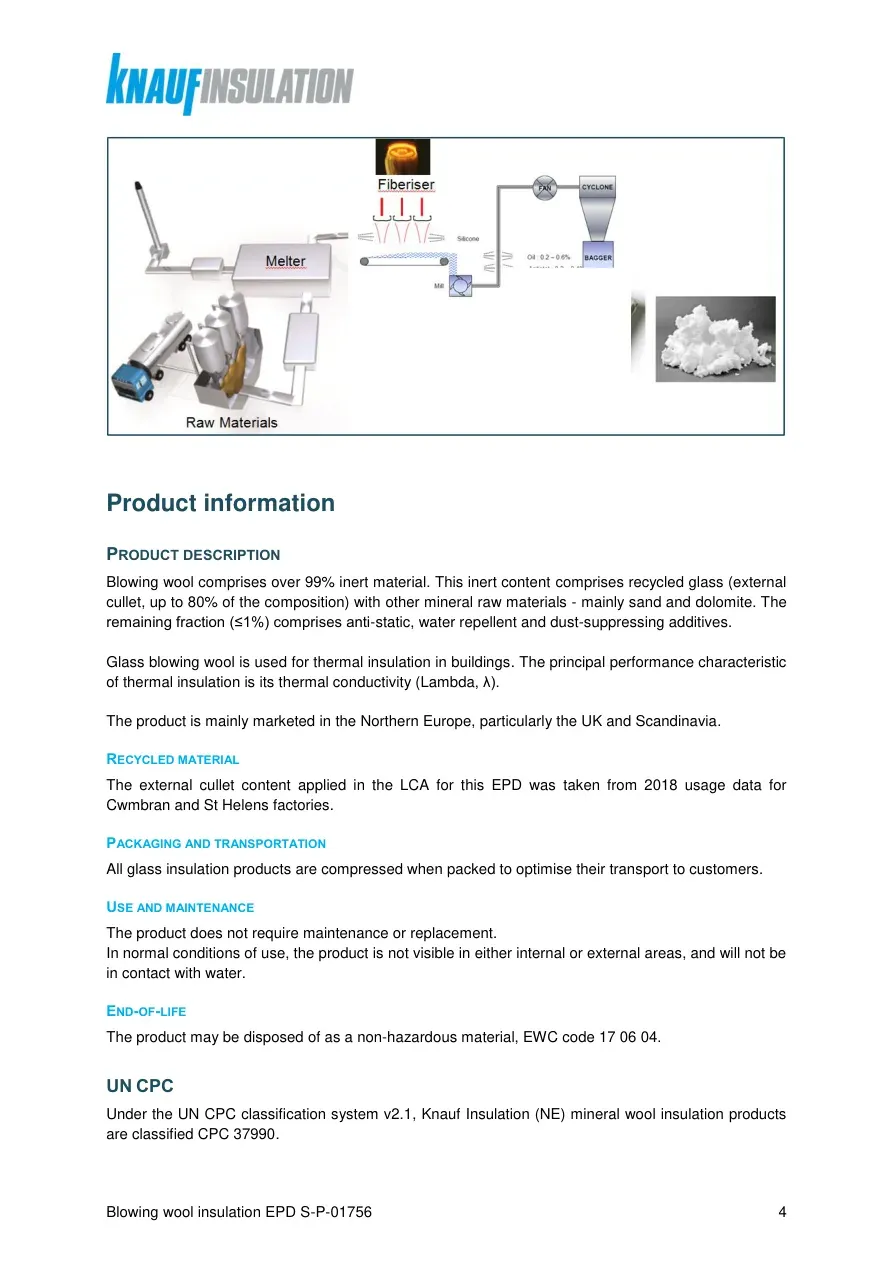
Blowing wool insulation EPD S-P-01756 3 About the company Knauf Insulation has more than 40 years of experience in the insulation industry and is one of the most respected names in insulation worldwide. At Knauf Insulation, we are committed to helping our customers meet the increasing demand for energy efficiency and sustainability in homes, non-residential buildings and industrial applications. As the only manufacturer of both Glass and Rock Mineral Wool, we are uniquely placed to provide the best insulation solution for each application. We offer a wide range of insulation solutions for all applications in commercial and residential buildings, for both new build and refurbishment projects, in addition to solutions for HVAC, industrial applications and fire protection, green roofs and bespoke applications. COMPANY CERTIFICATIONS All Knauf Insulation sites, including the manufacturing facilities for products covered by this EPD, are ISO 9001, ISO 14001, ISO 5001 and OHSAS 18001 certified under the scope "Design, Development and Production of Insulation Materials and Systems". PRODUCTION SITES Data used for the product LCA were collected from Knauf Insulation (Northern Europe)'s two glass insulation manufacturing facilities in the UK: Knauf Insulation, Stafford Road, St Helens, Merseyside Knauf Insulation, Cwmbran, Torfaen, Wales About glass mineral wool production Glass mineral wool insulation is available in two forms: Glass Mineral Wool (GMW) products contain binder and are manufactured in the form of slabs and rolls. Blowing wool products contain no binder for loose-fill applications. In the manufacturing process, recovered waste glass is melted together with other raw materials needed to achieve glass of the target composition. As molten glass leaves the furnace, it is cooled and formed into glass fibres. This is transformed directly into the blowing wool product. For mineral wool products, binder is then applied as a solution prior to the forming and oven-curing of the final product Both GMW and blowing wool are produced at Knauf Insulation (Northern Europe)'s glass insulation manufacturing facilities in the UK. This EPD concerns blowing wool products compliant with the requirements of EN 14064. These are manufactured in the form of flocks of unbound glass mineral wool; the production process for blowing wool is shown in the figure below.
Blowing wool insulation EPD S-P-01756 4 Product information PRODUCT DESCRIPTION Blowing wool comprises over 99% inert material. This inert content comprises recycled glass (external cullet, up to 80% of the composition) with other mineral raw materials - mainly sand and dolomite. The remaining fraction (≤1%) comprises anti-static, water repellent and dust-suppressing additives. Glass blowing wool is used for thermal insulation in buildings. The principal performance characteristic of thermal insulation is its thermal conductivity (Lambda, λ). The product is mainly marketed in the Northern Europe, particularly the UK and Scandinavia. RECYCLED MATERIAL The external cullet content applied in the LCA for this EPD was taken from 2018 usage data for Cwmbran and St Helens factories. PACKAGING AND TRANSPORTATION All glass insulation products are compressed when packed to optimise their transport to customers. USE AND MAINTENANCE The product does not require maintenance or replacement. In normal conditions of use, the product is not visible in either internal or external areas, and will not be in contact with water. END-OF-LIFE The product may be disposed of as a non-hazardous material, EWC code 17 06 04. UN CPC Under the UN CPC classification system v2.1, Knauf Insulation (NE) mineral wool insulation products are classified CPC 37990.
Blowing wool insulation EPD S-P-01756 5 PRODUCT RANGE Knauf Insulation Northern Europe's glass blowing wool products have been divided into a number of groups; each group encompasses products with thermal conductivity (lambda, λ) within a specified range. This EPD is for products with thermal conductivity in the range 0.037 - 0.042 W/mK. The products to which it applies are listed in the following table. THERMAL CONDUCTIVITY Λ 0.037 – 0.042 W/MK DENSITY RANGE 15 - 19 KG/M3 PRODUCTS SUPAFIL® 37 SUPAFIL® LOFT (0.040 - 0.042 W/MK) SUPAFIL® 40 SUPAFIL® FRAME (0.038 W/MK) SUPAFIL® PARTY WALL JET STREAM® (0.040 - 0.042 W/MK) TECHNICAL CHARACTERISTICS The products are intended for use as thermal insulation in buildings. They comply with BS EN 14064 and the CE mark. Key technical properties are shown in the table below; consult the relevant product Technical Data Sheet for a comprehensive specification. PARAMETER VALUE THERMAL CONDUCTIVITY (EN 12667) AT 10°C Λ 0.037 - 0.042 W/MK GROSS DRY DENSITY RANGE (EN 1602) 15 - 19 KG/M3 WATER VAPOUR DIFFUSION RESISTANCE FACTOR (BS EN 13162) 1 WATER ABSORPTION WP (BS EN 29767) <1 KG/M² REACTION TO FIRE (BS EN 13501-1:2002) EUROCLASS A1 REFERENCE SERVICE LIFE The expected lifetime of the product is as long as the lifetime of the building equipment in which it is installed (at least 50 years). RESIDUAL RISKS AND EMERGENCIES There are no residual risks associated with the normal day-to-day use of insulation products. Care must be taken to install the products in accordance with Knauf Insulation (NE)'s guidance.
Blowing wool insulation EPD S-P-01756 6 The product is classified as non-hazardous. The International Agency for Research on Cancer (IARC) classifies mineral wool fibres in group 3: "not classified as to their carcinogenicity to humans". These fibres are exempt from carcinogenic classification under European Regulation 1272/2008, having bio-persistence below the values defined in its note "Q". This exemption is certified by the European Certification Board (EUCEB, www.euceb.org). CONTENT DECLARATION No substance included in the Candidate List of Substances of Very High Concern for authorisation under the REACH Regulations is present in these insulation products, either above the threshold for registration with the European Chemicals Agency or above 0.1% (wt/wt). FURTHER PRODUCT INFORMATION Detailed product information and datasheets can be found • on our website: https://www.knaufinsulation.co.uk/ • or by contacting Customer Service by telephone: 01744 766 766 • or by email: technical.uk@knaufinsulation.com
Blowing wool insulation EPD S-P-01756 7 LCA information This section of the EPD records key features of the LCA on which it is based. DECLARED UNIT The declared unit is 1m2 at 100mm thickness. The applicable thermal conductivity is 0.037 - 0.042 W/mK. Indicator values are declared for product with density 17 kg/m3. If indicator values for other densities are required, they may be obtained by linear extrapolation of these values. SCOPE AND SYSTEM BOUNDARIES The system boundary of the EPD is defined using the modular approach set out in EN 15804 as shown in the table below. This a cradle-to-gate with options EPD. PRODUCT STAGE CONSTRUCTION PROCESS STAGE USE STAGE END OF LIFE STAGE BEYOND BOUNDARIES RAW MATERIAL SUPPLY TRANSPORT MANUFACTURING TRANSPORT TO THE SITE ASSEMBLY USE MAINTENANCE REPAIR REPLACEMENT REFURBISHMENT OPERATIONAL ENERGY USE OPERATIONAL WATER USE DE-CONSTRUCTION DEMOLITION TRANSPORT WASTE DISPOSAL DISPOSAL REUSE- RECOVERY- RECYCLING- POTENTIAL A 1 A 2 A 3 A 4 A 5 B1 B2 B3 B4 B5 B 6 B 7 C 1 C 2 C 3 C 4 D X X X X X MND MND MND MND MND M N D M N D M N D X MND X MND Modules declared in the EPD: X: included in LCA; MND: module not declared or NR for not relevant PRODUCT STAGE This stage includes the extraction and manufacture of raw materials, intermediate products and energy, as well as waste processing up to the end-of-waste state (i.e. no longer considered a waste material) or disposal of final residues arising during the product stage. All upstream resource extraction and manufacturing processes are included in the system. All energy used in factories and factory support offices is included but energy used in head offices and sales offices etc. is not. Maintenance of equipment is also excluded.
Blowing wool insulation EPD S-P-01756 8 Modules A1, A2 and A3 are declared as one aggregated module: A1 – A3. Details of the product and packaging applied in the LCA are provided in the table below PRODUCT PARAMETERS VALUE DECLARED DENSITY 17 KG/M³ GLASS MINERAL WOOL WEIGHT (WITHOUT FACING WEIGHT) 1.7 KG SURFACE 1 M² THICKNESS 100 MM VOLUME 0.1 M3 FACING NA PACKAGING PLASTIC SHEET 0.014 KG PACKAGING WOODEN PALLET 0.007KG CONSTRUCTION STAGE Module A4 covers transport of product from the place of manufacture to the construction site. It includes the transport distance and the relevant transport mode. Module A5 covers installation of the product in the building. Blowing wool is blown into place using compressed air; therefore for blowing wool products, A5 includes energy use as well as product wastage at 2% and management of product packaging after use. These modules are included in the LCA using scenarios, except for energy used to install blowing wool in module A5, which is modelled using data collected by Knauf Insulation for installation in different contexts within the building. The parameters applied are shown in the table below: PARAMETER VALUE AVERAGE TRANSPORT DISTANCE 600 KM TYPE OF FUEL AND VEHICLE CONSUMPTION OR TYPE OF VEHICLE USED FOR TRANSPORT TRUCK. EURO 6, 16 – 32 T / 16 T PAYLOAD, 21L / 100 KM TRUCK CAPACITY UTILISATION (INCLUDING 30% OF EMPTY RETURNS) 35 % LOSS OF MATERIALS ON SITE 2% PACKAGING WOODEN PALLET 31% RECYCLED, 69% TO LANDFILL PACKAGING PLASTIC SHEET 45% RECYCLED, 14% INCINERATED, 41% TO LANDFILL END-OF-LIFE STAGE Module C2 concerns transport of the end-of-life construction product, after removal from the building, to a waste processing facility Module C4 covers final disposal of the end-of-life construction product. These modules are included in the LCA using scenarios; the parameters used for these modules are shown in the table below:
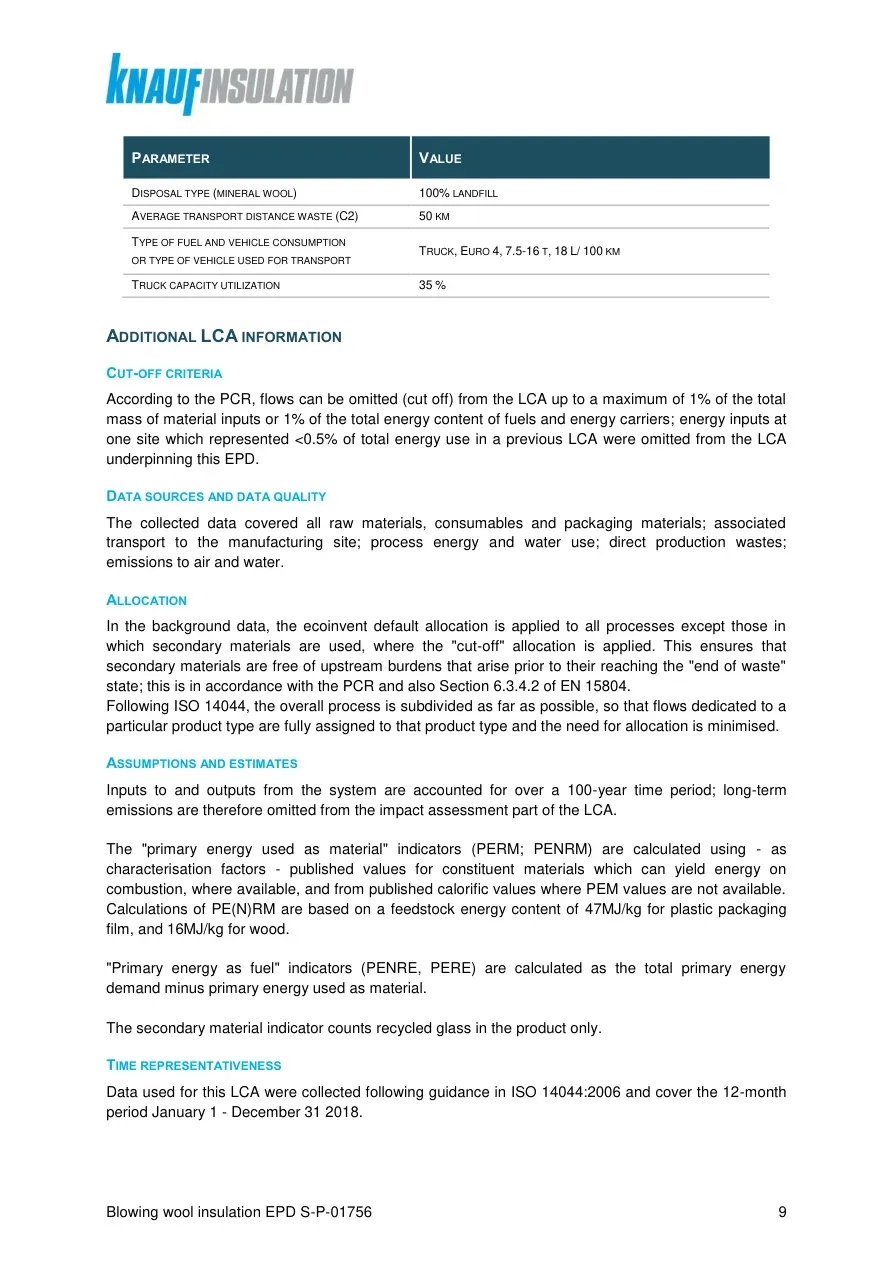
Blowing wool insulation EPD S-P-01756 9 PARAMETER VALUE DISPOSAL TYPE (MINERAL WOOL) 100% LANDFILL AVERAGE TRANSPORT DISTANCE WASTE (C2) 50 KM TYPE OF FUEL AND VEHICLE CONSUMPTION OR TYPE OF VEHICLE USED FOR TRANSPORT TRUCK, EURO 4, 7.5-16 T, 18 L/ 100 KM TRUCK CAPACITY UTILIZATION 35 % ADDITIONAL LCA INFORMATION CUT-OFF CRITERIA According to the PCR, flows can be omitted (cut off) from the LCA up to a maximum of 1% of the total mass of material inputs or 1% of the total energy content of fuels and energy carriers; energy inputs at one site which represented <0.5% of total energy use in a previous LCA were omitted from the LCA underpinning this EPD. DATA SOURCES AND DATA QUALITY The collected data covered all raw materials, consumables and packaging materials; associated transport to the manufacturing site; process energy and water use; direct production wastes; emissions to air and water. ALLOCATION In the background data, the ecoinvent default allocation is applied to all processes except those in which secondary materials are used, where the "cut-off" allocation is applied. This ensures that secondary materials are free of upstream burdens that arise prior to their reaching the "end of waste" state; this is in accordance with the PCR and also Section 6.3.4.2 of EN 15804. Following ISO 14044, the overall process is subdivided as far as possible, so that flows dedicated to a particular product type are fully assigned to that product type and the need for allocation is minimised. ASSUMPTIONS AND ESTIMATES Inputs to and outputs from the system are accounted for over a 100-year time period; long-term emissions are therefore omitted from the impact assessment part of the LCA. The "primary energy used as material" indicators (PERM; PENRM) are calculated using - as characterisation factors - published values for constituent materials which can yield energy on combustion, where available, and from published calorific values where PEM values are not available. Calculations of PE(N)RM are based on a feedstock energy content of 47MJ/kg for plastic packaging film, and 16MJ/kg for wood. "Primary energy as fuel" indicators (PENRE, PERE) are calculated as the total primary energy demand minus primary energy used as material. The secondary material indicator counts recycled glass in the product only. TIME REPRESENTATIVENESS Data used for this LCA were collected following guidance in ISO 14044:2006 and cover the 12-month period January 1 - December 31 2018.
Blowing wool insulation EPD S-P-01756 10 DATABASE(S) AND LCA SOFTWARE USED The LCA model, the data aggregation and environmental impacts were calculated in openLCA. Background data were taken from the ecoinvent v 3.4 database.
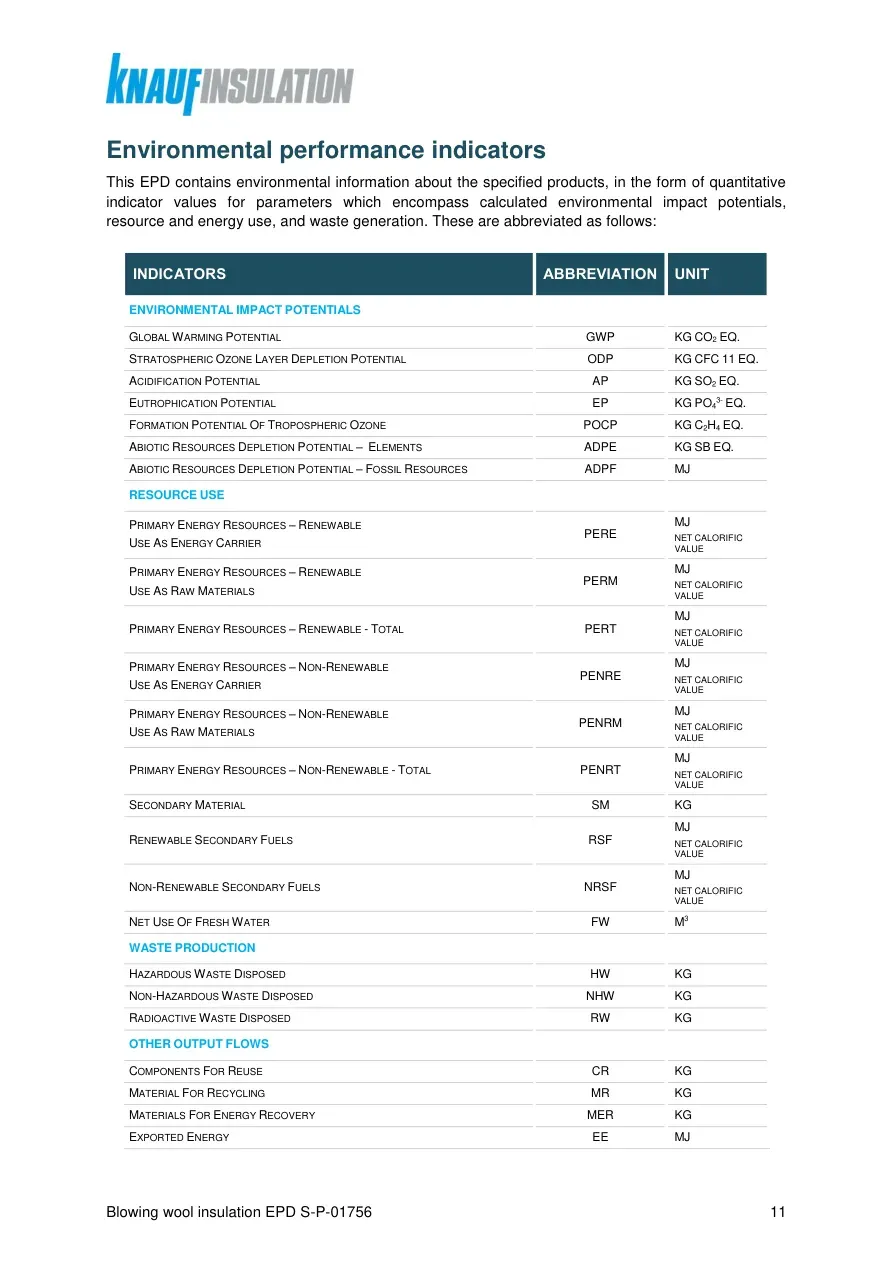
Blowing wool insulation EPD S-P-01756 11 Environmental performance indicators This EPD contains environmental information about the specified products, in the form of quantitative indicator values for parameters which encompass calculated environmental impact potentials, resource and energy use, and waste generation. These are abbreviated as follows: INDICATORS ABBREVIATION UNIT ENVIRONMENTAL IMPACT POTENTIALS GLOBAL WARMING POTENTIAL GWP KG CO2 EQ. STRATOSPHERIC OZONE LAYER DEPLETION POTENTIAL ODP KG CFC 11 EQ. ACIDIFICATION POTENTIAL AP KG SO2 EQ. EUTROPHICATION POTENTIAL EP KG PO43- EQ. FORMATION POTENTIAL OF TROPOSPHERIC OZONE POCP KG C2H4 EQ. ABIOTIC RESOURCES DEPLETION POTENTIAL – ELEMENTS ADPE KG SB EQ. ABIOTIC RESOURCES DEPLETION POTENTIAL – FOSSIL RESOURCES ADPF MJ RESOURCE USE PRIMARY ENERGY RESOURCES – RENEWABLE USE AS ENERGY CARRIER PERE MJ NET CALORIFIC VALUE PRIMARY ENERGY RESOURCES – RENEWABLE USE AS RAW MATERIALS PERM MJ NET CALORIFIC VALUE PRIMARY ENERGY RESOURCES – RENEWABLE - TOTAL PERT MJ NET CALORIFIC VALUE PRIMARY ENERGY RESOURCES – NON-RENEWABLE USE AS ENERGY CARRIER PENRE MJ NET CALORIFIC VALUE PRIMARY ENERGY RESOURCES – NON-RENEWABLE USE AS RAW MATERIALS PENRM MJ NET CALORIFIC VALUE PRIMARY ENERGY RESOURCES – NON-RENEWABLE - TOTAL PENRT MJ NET CALORIFIC VALUE SECONDARY MATERIAL SM KG RENEWABLE SECONDARY FUELS RSF MJ NET CALORIFIC VALUE NON-RENEWABLE SECONDARY FUELS NRSF MJ NET CALORIFIC VALUE NET USE OF FRESH WATER FW M3 WASTE PRODUCTION HAZARDOUS WASTE DISPOSED HW KG NON-HAZARDOUS WASTE DISPOSED NHW KG RADIOACTIVE WASTE DISPOSED RW KG OTHER OUTPUT FLOWS COMPONENTS FOR REUSE CR KG MATERIAL FOR RECYCLING MR KG MATERIALS FOR ENERGY RECOVERY MER KG EXPORTED ENERGY EE MJ
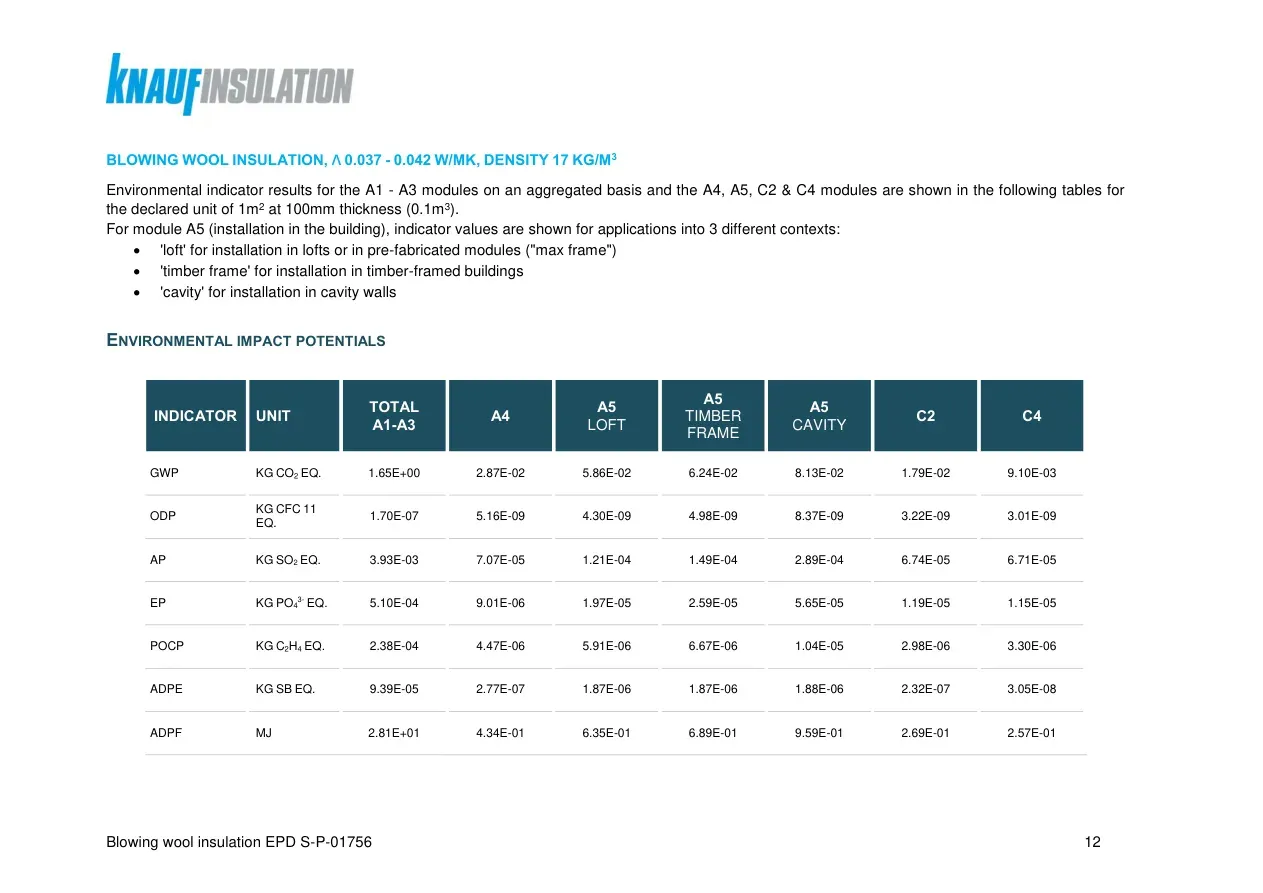
Blowing wool insulation EPD S-P-01756 12 BLOWING WOOL INSULATION, Λ 0.037 - 0.042 W/MK, DENSITY 17 KG/M3 Environmental indicator results for the A1 - A3 modules on an aggregated basis and the A4, A5, C2 & C4 modules are shown in the following tables for the declared unit of 1m2 at 100mm thickness (0.1m3). For module A5 (installation in the building), indicator values are shown for applications into 3 different contexts: 'loft' for installation in lofts or in pre-fabricated modules ("max frame") 'timber frame' for installation in timber-framed buildings 'cavity' for installation in cavity walls ENVIRONMENTAL IMPACT POTENTIALS INDICATOR UNIT TOTAL A1-A3 A4 A5 LOFT A5 TIMBER FRAME A5 CAVITY C2 C4 GWP KG CO2 EQ. 1.65E+00 2.87E-02 5.86E-02 6.24E-02 8.13E-02 1.79E-02 9.10E-03 ODP KG CFC 11 EQ. 1.70E-07 5.16E-09 4.30E-09 4.98E-09 8.37E-09 3.22E-09 3.01E-09 AP KG SO2 EQ. 3.93E-03 7.07E-05 1.21E-04 1.49E-04 2.89E-04 6.74E-05 6.71E-05 EP KG PO43- EQ. 5.10E-04 9.01E-06 1.97E-05 2.59E-05 5.65E-05 1.19E-05 1.15E-05 POCP KG C2H4 EQ. 2.38E-04 4.47E-06 5.91E-06 6.67E-06 1.04E-05 2.98E-06 3.30E-06 ADPE KG SB EQ. 9.39E-05 2.77E-07 1.87E-06 1.87E-06 1.88E-06 2.32E-07 3.05E-08 ADPF MJ 2.81E+01 4.34E-01 6.35E-01 6.89E-01 9.59E-01 2.69E-01 2.57E-01
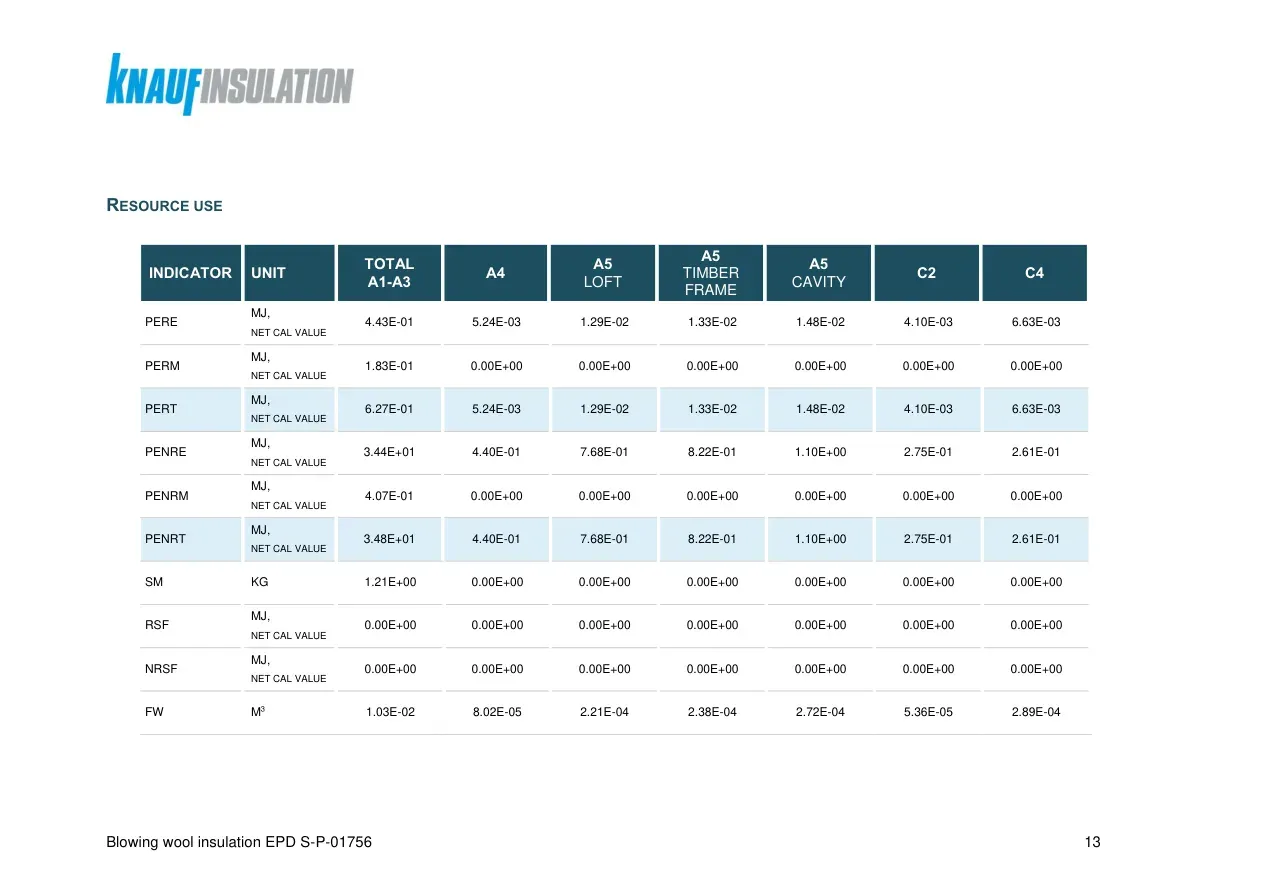
Blowing wool insulation EPD S-P-01756 13 RESOURCE USE INDICATOR UNIT TOTAL A1-A3 A4 A5 LOFT A5 TIMBER FRAME A5 CAVITY C2 C4 PERE MJ, NET CAL VALUE 4.43E-01 5.24E-03 1.29E-02 1.33E-02 1.48E-02 4.10E-03 6.63E-03 PERM MJ, NET CAL VALUE 1.83E-01 0.00E+00 0.00E+00 0.00E+00 0.00E+00 0.00E+00 0.00E+00 PERT MJ, NET CAL VALUE 6.27E-01 5.24E-03 1.29E-02 1.33E-02 1.48E-02 4.10E-03 6.63E-03 PENRE MJ, NET CAL VALUE 3.44E+01 4.40E-01 7.68E-01 8.22E-01 1.10E+00 2.75E-01 2.61E-01 PENRM MJ, NET CAL VALUE 4.07E-01 0.00E+00 0.00E+00 0.00E+00 0.00E+00 0.00E+00 0.00E+00 PENRT MJ, NET CAL VALUE 3.48E+01 4.40E-01 7.68E-01 8.22E-01 1.10E+00 2.75E-01 2.61E-01 SM KG 1.21E+00 0.00E+00 0.00E+00 0.00E+00 0.00E+00 0.00E+00 0.00E+00 RSF MJ, NET CAL VALUE 0.00E+00 0.00E+00 0.00E+00 0.00E+00 0.00E+00 0.00E+00 0.00E+00 NRSF MJ, NET CAL VALUE 0.00E+00 0.00E+00 0.00E+00 0.00E+00 0.00E+00 0.00E+00 0.00E+00 FW M3 1.03E-02 8.02E-05 2.21E-04 2.38E-04 2.72E-04 5.36E-05 2.89E-04
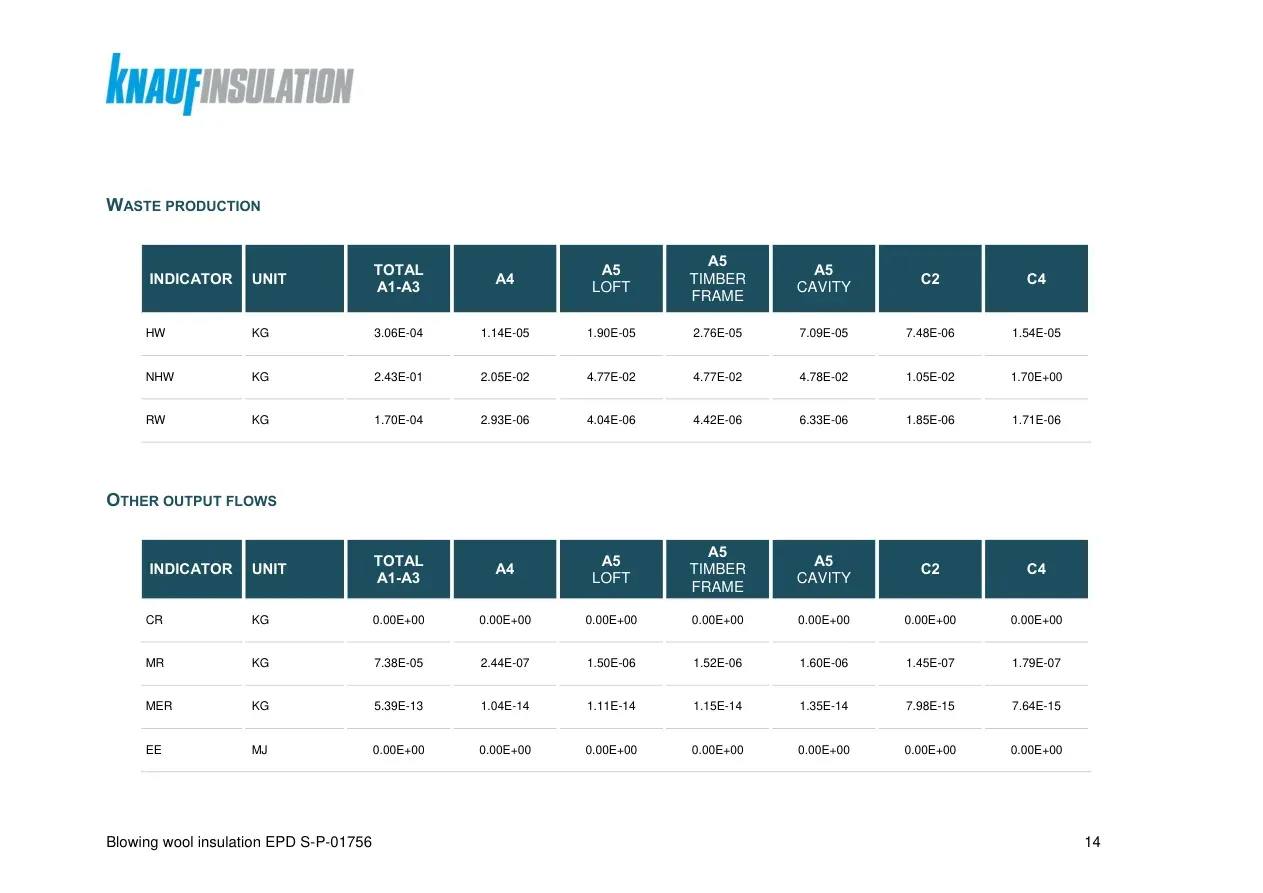
Blowing wool insulation EPD S-P-01756 14 WASTE PRODUCTION INDICATOR UNIT TOTAL A1-A3 A4 A5 LOFT A5 TIMBER FRAME A5 CAVITY C2 C4 HW KG 3.06E-04 1.14E-05 1.90E-05 2.76E-05 7.09E-05 7.48E-06 1.54E-05 NHW KG 2.43E-01 2.05E-02 4.77E-02 4.77E-02 4.78E-02 1.05E-02 1.70E+00 RW KG 1.70E-04 2.93E-06 4.04E-06 4.42E-06 6.33E-06 1.85E-06 1.71E-06 OTHER OUTPUT FLOWS INDICATOR UNIT TOTAL A1-A3 A4 A5 LOFT A5 TIMBER FRAME A5 CAVITY C2 C4 CR KG 0.00E+00 0.00E+00 0.00E+00 0.00E+00 0.00E+00 0.00E+00 0.00E+00 MR KG 7.38E-05 2.44E-07 1.50E-06 1.52E-06 1.60E-06 1.45E-07 1.79E-07 MER KG 5.39E-13 1.04E-14 1.11E-14 1.15E-14 1.35E-14 7.98E-15 7.64E-15 EE MJ 0.00E+00 0.00E+00 0.00E+00 0.00E+00 0.00E+00 0.00E+00 0.00E+00
Blowing wool insulation EPD S-P-01756 15
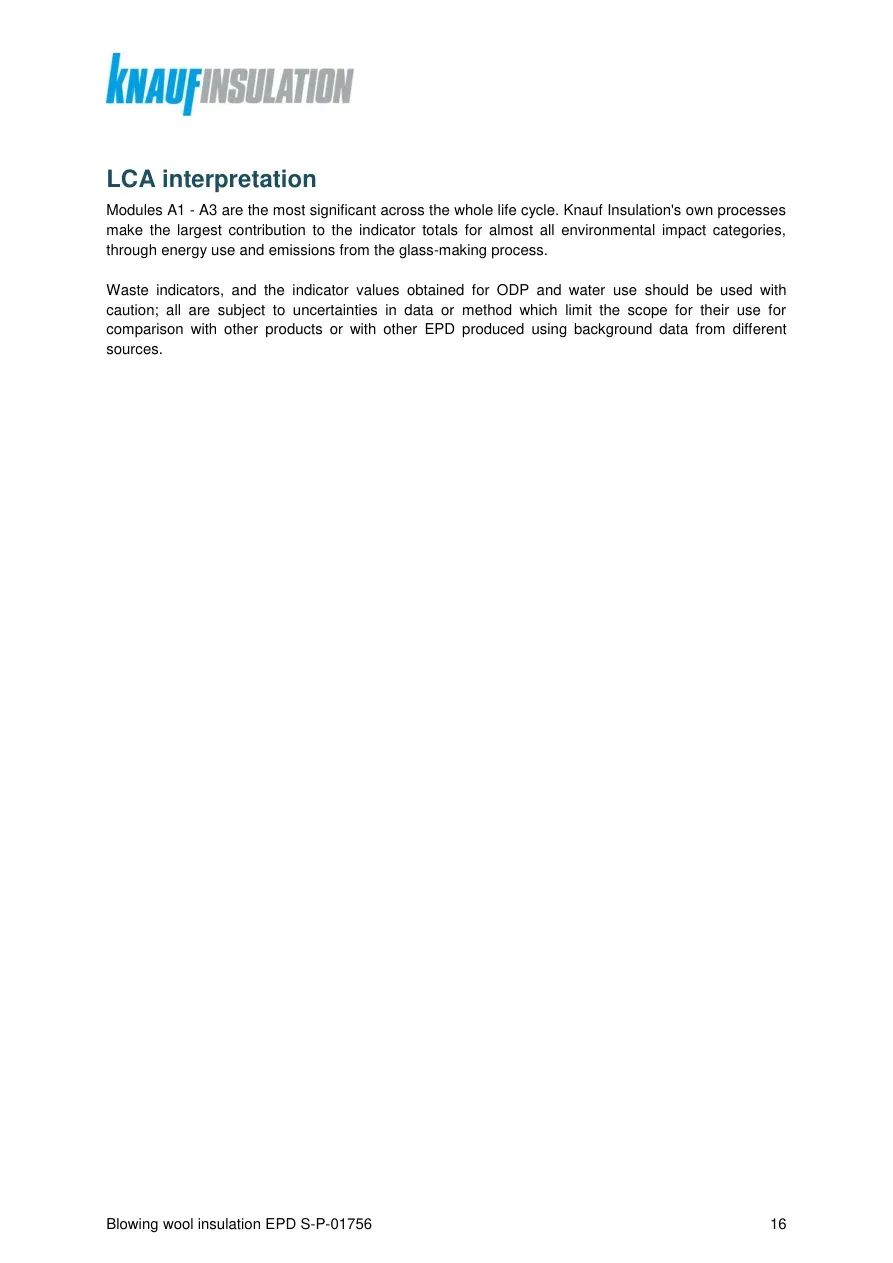
Blowing wool insulation EPD S-P-01756 16 LCA interpretation Modules A1 - A3 are the most significant across the whole life cycle. Knauf Insulation's own processes make the largest contribution to the indicator totals for almost all environmental impact categories, through energy use and emissions from the glass-making process. Waste indicators, and the indicator values obtained for ODP and water use should be used with caution; all are subject to uncertainties in data or method which limit the scope for their use for comparison with other products or with other EPD produced using background data from different sources.
References General Programme Instructions Version 2.5 - The International EPD® System - EPD International AB ISO 14025 EN ISO 14025:2011-10: Environmental labels and declarations — Type III environmental declarations — Principles and procedures EN 15804 EN 15804:2012-04+A1 2013: Sustainability of construction works — Environmental Product Declarations — Core rules for the product category of construction products EN 14064 - Part1 EN 14064:2010 Thermal insulation products for buildings - In-situ formed loosefill mineral wool products - Part 1: Specification for the loosefill products before installation EN 14064 - Part2 EN 14064:2010 Thermal insulation products for buildings - In-situ formed loosefill mineral wool products - Part 2: Specification for the installed products EN 1602 EN 1602: 2013 Thermal insulating products for building applications - Determination of the apparent density EN 12667 EN 12667: 2001 Thermal performance of building materials and products - Determination of thermal resistance by means of guarded hot plate and heat flow meter methods - Products of high and medium thermal resistance BS EN 13501-1 EN 13501-1: 2009 Fire classification of construction products and building elements - Part 1: Classification using test data from reaction to fire tests. BS EN 29767 BS EN ISO 29767:2019: Thermal insulating products for building applications. Determination of short-term water absorption by partial immersion LCA of Glass Mineral Wool Insulation with Ecose® (2019) - Report For Knauf Insulation Northern Europe - EuGeos Limited Product Category Rules PCR 2012:01. Construction products and construction services. Version 2.3 - The International EPD® System - EPD International AB Sub-PCR-I Thermal insulation products (EN 16783). Version 2018-11-22
Contact information EPD owner: Knauf Insulation (Northern Europe) PO Box 10 Stafford Road St. Helens Merseyside WA10 3NS UK Tel: 01744 766 766 Customer Service Email: technical.uk@knaufinsulation.com http://www.knaufinsulation.co.uk/ LCA support: EuGeos Limited - UK Tel: +44 (0)1625 434423 Email: lca@eugeos.co.uk www.eugeos.co.uk Programme operator: EPD International AB info@environdec.com
